
(Editor’s Note: This column was written for the November issue of Tiger Rag Magazine, which was printed before former LSU basketball coach Dale Brown passed away at age 90 on Oct. 23, 2026. The column has been updated.)
By JIM ENGSTER, President, Tiger Rag Magazine
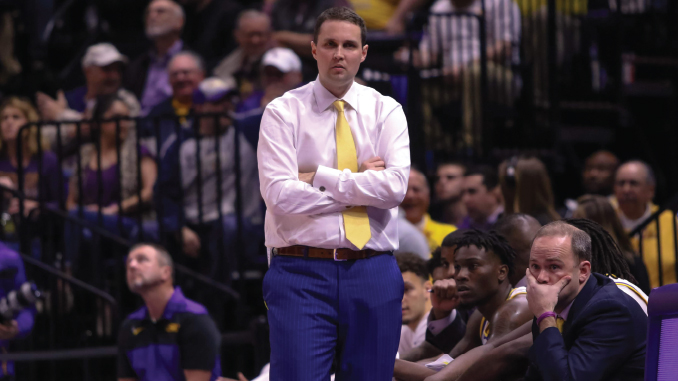
Will Wade returns to the Pete Maravich Assembly Center as LSU basketball maestro and the prodigal son of college hoops. His hiring comes four years removed from a firing squad amid a treacherous NCAA probe of major recruiting infractions that were proven. Revelations about Wade’s program shocked the most cynical observers of old under the table shenanigans.
Wade is back with a new lease on life as his Tigers open the 2026-27 season on Tuesday night against LSU-New Orleans in the PMAC (7 p.m., SEC Network+).
Yet he reigns as a poster boy for bending rules to win championships. In his second season at TigerTown in 2018-19, Wade’s crew won the SEC with a 16-2 record (15-2 under Wade as he was suspended by LSU before the last league game because of the NCAA investigation) – best conference ledger for the Bengals since coach Dale Brown’s 1980-81 Tigers won the SEC at 17-1.
Wade was engulfed by a dark NCAA cloud in the next three seasons of purgatory at LSU, producing an SEC mark of 32-21 in the final three years of his first foray in Baton Rouge.
Wade continued his winning ways at McNeese State for two seasons from 2023-25 and North Carolina State in 2025-26 before a union of LSU luminaries and Gov. Jeff Landry courted him to return to the land of his great triumph and grave failure.
It is hard to return home as Paul Dietzel learned when he was fired as athletic director in 1982, the year of Wade’s birth. But this coach is young at 44 with a budget that rivals the money expended to feed the basketball factory at Lexington, Kentucky.
No longer does a coach have to build a program as Brown did when he set up shop at the Assembly Center in 1972. It took six years before Brown lifted his team to the No. 2 slot in the league. One season later in 1978-79, LSU won its first SEC title in 25 years.
The Brown Bunch attracted players from here, there and everywhere with foreign imports coupled with top stars from cities like Los Angeles, San Antoinio, Louisville, New York, Miami, Dallas, Jackson and Gulfport.
Brown’s bedrock was always Louisiana, which provided his program with the likes of Howard Carter, Ethan Martin, Leonard Mitchell, Don Redden, Derrick Taylor, Anthony Wilson, Jordy Hultberg, Lionel Green, John Tudor, Randy Livingston and Collis Temple.
Wade’s current roster is the oldest and least Louisiana laden in LSU history. It is a new trajectory in college athletics, and Wade appears comfortable with the uncertain terrain. It will be a significant story no matter how things turn out for a coach who is viewed as a gifted but flawed work in progress. Sounds familiar.
A YEAR OF LOST LEGENDS
LSU lost coaches Skip Bertman and Jerry Stovall 17 days apart this August. They rank as two of the most influential members of the rich Tiger athletic legacy.
Bertman won five national titles on the diamond after inheriting a program that was secondary to spring football for a half-century. Stovall was a great player who starred under both Paul Dietzel and Charles McClendon, was named National Coach of the Year in 1982, and fired a year later at 42.
Bertman retired at 63 and stayed in Baton Rouge for a quarter-century after his coaching career ended before serving as athletic director from 2001-08. His legion of former players who loved their coach is his most profound testament to greatness.
Stovall was a Heisman Trophy runner-up tailback/kick returner in 1962, was an All-Pro defensive back as a member of the St. Louis Cardinals for nine seasons. He became LSU head coach in the most difficult of circumstances. His dream job opened after a plane crash killed Bo Rein on Jan. 10, 1980.
Stovall was at odds with Dietzel successor Bob Brodhead, who sacked him on Dec. 2, 1983, in a memorable showdown at a raucous LSU Board of Supervisors meeting. Brodhead implied that Stovall was in over his head. There remains a diversity of opinion on this assessment, but this writer can attest that Stovall saw the evolution of football.
The coach told me as a student journalist that the future of the game was big linemen and small running backs. Stovall loved offensive tackle Lance Smith and tailback Dalton Hilliard, because they fit his vision of the game. He was right. And he was wise enough to move the angular Eric Martin from running back to receiver, propelling Martin to a decade as a stalwart of the New Orleans Saints.
LSU basketball teammates Bob Pettit and Ned Clark died six months apart with Pettit following his sidekick to the other side on Sept. 23. Pettit and Clark guided the Tigers to the Final Four in 1953 and a conference record of 27-0 in the 1953 and ’54 seasons.
Pettit was one of the best players in the history of the game, winning NBA MVP awards in 1956 and 1959 and finishing in the top four for the honor eight times in eleven seasons. He led the St. Louis Hawks to the league title in 1958 and retired as the game’s top scorer and second leading rebounder in 1965.
Not bad for the skinny kid from Baton Rouge High who grew up at 1966 Olive Street and was the son of the town sheriff.
Ron Abernathy was the most notable of Dale Brown’s assistants in 25 years. He died at 75 on June 23 after battling cancer with the same spirit that made him one of the nation’s top recruiters in the 1970s and ‘80s. Abernathy came to LSU from Louisville where he coached Rudy Macklin at Shawnee High School. He was instrumental in coaxing a bevy of standouts, including Shaquille O’Neal, John Williams and Chris Jackson.
Abernathy returned to Baton Rouge in January for a reunion of the 1986 Final Four team and appeared to be in good health. He was a non-smoker who was diagnosed with lung cancer.
The rise of LSU basketball to its pinnacle from 1979-93 when the Tigers advanced to a post-season tournament every year and won four SEC championships is traced to the migration from Kentucky to Louisiana of Abertnathy and Macklin.
DALE BROWN WINS ONE OF HIS GREATEST HONORS JUST BEFORE PASSING
LSU’s most celebrated basketball coach in history, Dale Brown, died on Oct. 23 at age 90.
Just three days before his death, Brown would be receiving the prestigious John Wooden Legends of Coaching Award in Los Angeles next April. His daughter Robyn will be accepting the award for her father, whose wife of 67 years Vonnie has also survived him.
The Legends of Coaching distinction was first presented in 1999 and goes to one coach each year. Brown was chosen by a committee considering character, success rate on the court, graduation rate of athletes, coaching philosophy and identification of goals for the John R. Wooden Award.
The first four recipients were Dean Smith, Mike Kryzewski, Lute Olsen and Denny Crum. Women’s coaches to receive the award include Pat Summitt, Geno Auriemma and Dawn Staley. Wooden won 10 national championships at UCLA from 1964-75.
Brown’s father deserted his family two days before Dale’s birth on Halloween 1935 in the frigid hamlet of Minot, North Dakota. Wooden was the father figure in the remarkable life of the man who was touted as Billy Graham In Sneakers. Brown cites Wooden as his mentor despite competing vigorously against him on the recruiting trail as an assistant coach at Utah State.
Brown often visited Wooden at his modest residence in Encino, California, in the final years of life for the Wizard of Westwood. Wooden died in 2010 at 99 years old, more than 35 years after directing UCLA to 10 NCAA titles in 12 years.
Brown, 91, wept when he was informed of this selection by the Los Angeles Athletic Club.

Be the first to comment