
By GLENN GUILBEAU
Tiger Rag Editor
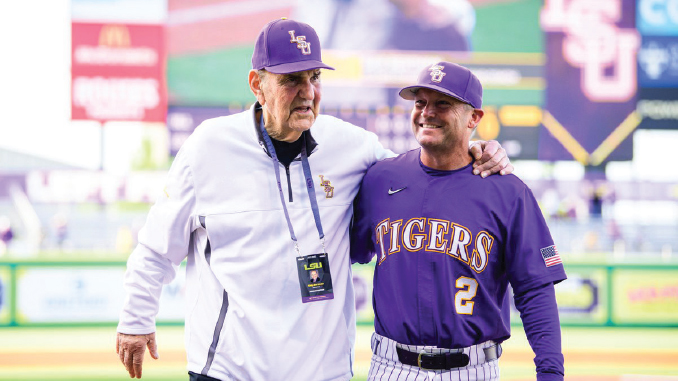
Skip Bertman, who made college baseball a happening in Baton Rouge as if it was football and built its brand nationally perhaps more than anyone else, died at approximately 1 a.m Friday in Baton Rouge after being hospitalized with heart issues.
Bertman was 88.
A native of Detroit who grew up in Miami, Bertman left the Miami Hurricanes associate head coach/pitching coach position a year after the Hurricanes won the 1982 national championship to take over an LSU baseball program in the summer of 1983 that had never sniffed Omaha, Nebraska, and the College World Series. In fact, LSU had not made the NCAA postseason since 1975 when it last won the Southeastern Conference and had eight losing seasons between 1965 and 1981.
Within just eight years of the Bertman Method, LSU’s fan base basically owned Omaha – before, during and long after games as the Tigers reached the CWS in Bertman’s third season in 1986, again in 1987, 1989, 1990 and won it all in 1991 as Bertman began to take over college baseball in attendance and championships.
From 1991 through 2000, Bertman won five national championships – 1991, ’93, ’96, ’97 and 2000 before retiring after the 2001 season and becoming LSU’s athletic director for eight years. In all, he took the Tigers and the LSU Nation to the Promised Land in Omaha 11 times.
He retired with an NCAA best 20-2 record (.909 percent) on championship day of NCAA Regionals, Super Regionals and national championship games. The NCAA didn’t move to best-of-three national title series in Omaha until 2003. Bertman was also 90-31 in NCAA postseason play for a .743 winning percentage – also an NCAA record when he retired. Overall, he was 870-330-3 for a .724 winning percentage.
He was one of only three college baseball coaches to win five national titles. The late USC head coach Rod Dedeaux won 11 from 1948-78 and the late Augie Garrido won five from 1979 through 2005 with the first three at Cal State Fullerton and the last two at Texas. Bertman also won the Bronze Medal with the U.S. Olympic team at the 1996 Atlanta Games. He was inducted into the first College Baseball Hall of Fame in 2006.
The Skip Bertman Coach of the Year Award has been bestowed on college baseball coaches at all levels since 2013.
“I look at this man, and I see the John Wooden of college baseball,” Jay Johnson said the day he was announced as LSU’s new baseball coach on June 28, 2021, inside Alex Box Stadium with Bertman in the audience – as he usually was for the three coaches who followed him.
Wooden won 10 national championship in college basketball at UCLA from 1964-75.
“This is the greatest college baseball coach of my entire lifetime,” Johnson continued. “Five national championships in a 10-year period is legendary.”
It was in 2001 when Johnson was a 24-year-old assistant coach at Division II Point Loma Nazarene in San Diego that he bought “Motivation and Teamwork: Winning The Big One,” a video by Bertman.
“I can’t tell you how influential that was in my development as a coach,” Johnson said, looking at Bertman during that press conference. “I used your speeches and your motivational sheets and all these things you utilized to motivate your players to do amazing things.”
Bertman’s most famous tale is the “Hold The Rope” story, which is the name of an “SEC Storied” documentary on Bertman that premiered in 2021 – just weeks before then-LSU athletic director Scott Woodward hired Johnson from Arizona to replace retiring coach Paul Mainieri. As athletic director after the 2006 baseball season, Bertman hired Mainieri, who won the Tigers’ sixth national title in 2009 with Bertman watching.
Johnson would go on to win the 2023 national championship with Bertman on the field after the game and the 2025 title with Bertman in the Tigers’ locker room before the game.
“The ‘Hold The Rope’ story was told to me in a small town in California 20 years ago,” Johnson said. “And I believe that was the start of my journey to here. So, coach, thank you, for showing me exactly how this is to be done.”
Along the way, Bertman also won six consecutive national championships in attendance from 1996 through 2001 at the original Alex Box Stadium, which Bertman kept building on annually like it was an Erector Set. But to LSU fans, it may as well have been the Colosseum in Rome.
LSU never lost an elimination game with Omaha on the line under Bertman through 10 NCAA Regionals in the Box in 1986, 1990, ’91, ’92, ’93, ’94, ’95, ’96, ’97 and ’98. In 2000 and ’01, Bertman kept that streak alive. He didn’t reach Omaha from the Box in 1992 and ’95, but he didn’t lose final round games with the CWS at stake.
“It’s the best college atmosphere I’ve ever seen,” then-Tennessee coach Rod Delmonico said during a three-game series that LSU swept in 1998. “They’ve got an Omaha crowd, except all of the fans are behind them.”
Bertman also advanced to Omaha in 1989 from College Station, Texas, where his Tigers beat No. 1 Texas A&M (58-5) at home in back-to-back games, 13-5 and 5-4. LSU previously reached Omaha out of an NCAA Regional at the University of New Orleans in 1987.
Bertman won seven Southeastern Conference championships in 1986, 1990, ’91, ’92, ’93, ’96 and ’97. Before him, LSU won just five SEC titles.
And he turned LSU into a virtual Major League Baseball farm club with 40 who played for him reaching the Big Show. During his last season in 2001 alone, there were 16 in MLB that season. That included Pittsburgh second baseman Warren Morris. His walk-off home run that beat Bertman’s former school and alma mater, Miami, 9-8, in the 1996 national championship game with two outs and one on in the bottom of the ninth became the signature moment of the Bertman Era and college baseball overall.
The late Billy Cannon, whose 89-yard punt return on Halloween Night 1959 for No. 1 LSU beat No. 3 Ole Miss, 7-3, and won him the school’s first Heisman Trophy, said it was the moment of LSU sports, period. He told Morris his home run was bigger than his punt return when they met at Tiger Stadium in 2019 while Cannon was being honored on the 60th anniversary of the return.
“Because yours won the national championship,” Cannon told Morris.
“We may win the national championship again,” Bertman said after what was his third title in six years. “But we’ll never do it like that.”
And nobody did it quite like Bertman, who was a disciplined, exacting taskmaster, but who often had as much fun as his players.
“I can remember him saying, ‘We want pressure. We invite it,’ Morris said in his foreword to Bertman’s biography – “Everything Matters In Baseball: The Skip Bertman Story.”
Morris wrote that Bertman often told his players, “Be the star of your own movie. He had a great quote he repeated, ‘Anything you vividly imagine, ardently desire, sincerely believe, and enthusiastically act upon, must, absolutely must come to pass.'”
That happened for Morris.
“I was one of the lucky ones to have been able to learn from one of the greatest leaders,” Morris wrote. “I tell people today, as a player at LSU under coach Bertman, you received more than just an education in baseball. You got an education in life.”
Bertman won as an athletic director at LSU, hiring four coaches who went on to win national championships. Late in the 2004 football season, he hired Les Miles to replace Nick Saban, who had left to coach the Miami Dolphins. Miles won the national championship in his third season in 2007. He hired Mainieri after the 2006 season, and Mainieri won the national title in his third season in 2009 and made the national championship series in 2017.
He promoted assistant track coach Dennis Shaver to head coach when Pat Henry left for Texas A&M after the 2003 seasons. Shaver won the NCAA women’s outdoor national title in 2008 and the men’s outdoor crown in 2021. Bertman hired Chuck Winstead as golf coach in 2006, and he won the 2015 national championship.
Under pressure to fire LSU basketball coach John Brady at times, Bertman didn’t pull the trigger, instead advised him to schedule tougher opponents and stuck with him. And Brady took LSU to the Final Four in 2006 for the first time in 20 years. Bertman did fire him two years later, though, in what was likely one of his few mistakes as Brady’s last team was injury filled. When his players returned the next season healthy in 2008-09 for new coach Trent Johnson, the Tigers won the SEC title. And Johnson gave Brady a championship ring as he knew he won with the players left for him.
“Skip’s era – it was the greatest era of LSU athletics so far,” current LSU athletic director Verge Ausberry said while he was deputy athletic director under Woodward. “Nothing better – two football championships (2003, 2007), Final Four in men’s basketball (2006), five Final Fours in women’s basketball (2004, ’05, ’06, ’07, ’08 before Kim Mulkey’s national title in 2023), women’s and men’s track national championships (2008, ’21). Baseball and softball went to the World Series.”
Bertman pupil Mike Bianco, a catcher for the Tigers in 1988 and ’89 and an assistant coach with LSU for national championships in 1993, ’96 and ’97, went on to win the 2022 national championship as Ole Miss’ coach. He spoke of Bertman’s influence throughout his run.
“His system evolved and came full circle with technology and the game changing,” Bianco said in the Bertman book. “Skip was never scared to change.”
Bertman won his first two national championships at LSU in 1991 and ’93 mainly with pitching. But as the game changed with bigger, more powerful bats, Bertman went from defensive coordinator to offensive coordinator and stayed ahead of the curve, if you will, by being the architect of Gorilla Ball for national championships in 1996 and ’97. LSU still holds the NCAA record for home runs in a season in ’97 with 188.
In fact, Bertman and LSU got so good at long ball that the NCAA changed the game by 1999 with less powerful bats.
“He had guts. He was willing to venture out,” Bianco said.
“And Skip was always more than a baseball coach,” friend and LSU Board of Supervisors member Stanley Jacobs at the time Bertman retired as athletic director in 2008.
“If you hire smart people like Skip,” they’re adaptable,” Woodward said shortly after becoming LSU athletic director in 2019. “And if you have someone who really has savvy and understands what they’re doing like Skip, and then they hire smart people around them – that’s the key to success.”
But first and foremost, Bertman was a baseball coach, always two or three innings ahead.
“Skip has elephant brain,” outfielder Rich Cordani, who was on the first national title team in 1991, said in the Bertman book. “You couldn’t get anything past him. Not that you wanted to. He would always be ahead mentally, situationally. He was our dad, and we were his sons. He was it.”
Bertman is survived by three daughters daughters – Jan, Jodi and Lori – and four grandchildren – Sophie, Isaac, Sam and Ezra. He was preceded in death by his daughter, Dr. Lisa Jo Pate, at age 44 of cancer in 2012 and by his wife of 63 years, Sandy, who passed away in March of 2025 at age 87.
Skip and Sandy Schwartz of Brooklyn met in 1961 when both were teachers at Madie Ives Elementary School in Miami. Sandy explained how they started dating in a Baton Rouge Advocate special section on Bertman in his last year as LSU coach in 2001.
“See that guy over there, that’s my kind of guy,” Sandy said she told her teaching girlfriends while at lunch one day at Corky’s in Miami when Bertman and some coaching friends happened to go to the same restaurant.
“I was in the office later that day, and he walked in,” she said. “I saw him every day when he’d come to school. We started talking, started dating, and that was it. It was just meant to be. He was always coaching baseball, but whenever there was a serious thing with the girls, I always had them call their dad. He always knew the right thing to say at difficult times.”
Be the first to comment