
Tiger Rag Column | Inside Courtroom 10C
Nine hours inside a packed Baton Rouge courtroom revealed everything wrong with the way college sports now makes its rules.
At 7:54 Friday morning, I was looking at a carefully worded statement from LSU President Wade Rousse.
“LSU respects the judicial process and the court’s decision.”LSU System President Wade Rousse
“Ain’t no fun when the rabbit got the gun!”Plaintiffs’ attorney Tony Clayton
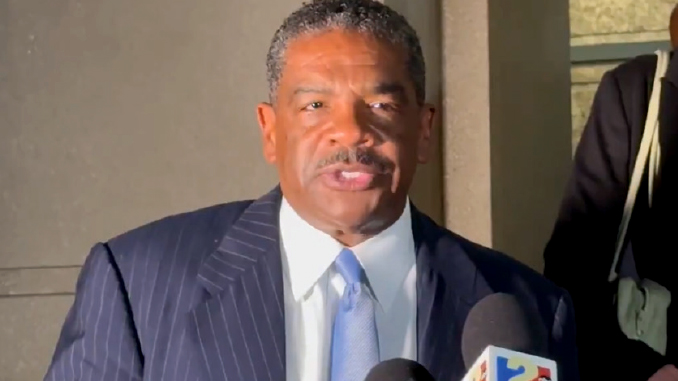
Clayton yelled that one across the courtroom after SEC attorney Jason Williams objected again during Clayton’s cross-examination of Southeastern Conference Commissioner Greg Sankey. Judge William Jorden overruled Williams, then ordered Clayton’s comment struck from the record.
Too late. It was all over social media by the time the hearing ended. People who knew little about injunctions, private associations or NCAA Rule 12.6 understood immediately what Clayton meant. For most of its history, the SEC had the gun. On Thursday, Sankey had to sit on a witness stand in a Baton Rouge courthouse for more than three hours and explain how the conference was using it.
The whole day was like that—formal law colliding with Louisiana, complicated arguments periodically reduced to something everybody could understand.
First, I Had to Get Inside
Courtroom 10C was already packed when the hearing started shortly after 11 a.m. Approximately 40 plaintiffs filled the benches, along with lawyers, family members, court personnel, spectators and reporters. The room is about half the size of the courtroom one floor above, where another trial was taking place in front of all of five people.
I was briefly allowed inside, then ordered out by the bailiff because there were no seats. A sheriff’s deputy at the door told me he would try to work me back in when somebody left. Until then, I stood in the hallway and reported what I could verify: Sankey had personally come to Baton Rouge. The plaintiffs were there. The hearing was underway. LSU had until the next day to submit its football roster to the conference.
Eventually, a seat opened. Once I got inside and began listening, something strange happened. I had heard this hearing before.
Not the exact testimony or the lawyers’ questions, of course. But I had spent the previous week writing about the SEC’s new policy and the questions it could not answer. What makes an athlete a professional now? Is it money, a contract, a roster spot or actual professional experience? Can the SEC punish LSU for using an athlete protected by a Louisiana court? When a court order and a conference rule collide, who gets the final word?
The hearing followed that analysis almost point by point. That was not because I had seen the future. The problems were sitting there in the rule. Thursday was simply the first time the NCAA and SEC had to answer for them under oath.
Walmart, Costco and the SEC’s Early Win
The SEC scored the first significant legal victory. Most of the lawsuit’s 44 plaintiffs did not have a direct connection to an SEC school. Williams argued that they could not attach their claims against the conference to those brought by athletes trying to attend LSU or another SEC institution.
Judge, I think if someone slipped and fell in Walmart, you couldn’t bring a suit against Costco.SEC attorney Jason Williams
Fair enough. The athletes’ lawyers agreed to narrow the SEC portion of the case to seven plaintiffs with direct conference connections, including Dae’Quan Wright and Zxavian Harris. It was a procedural win for the SEC, though it did not settle anything about the policy itself.
Then Sankey took the stand. He testified for approximately three hours and 10 minutes, defending the historic boundary between college and professional sports and warning that the NFL could become a recruiting ground for college football if the SEC allowed players to return after being cut.
That concern is not ridiculous. Nobody is arguing that established NFL veterans should start dropping back into the SEC whenever they feel like playing Alabama again. There has to be some line.
The problem Thursday was that no one could say exactly where it was.
The Boundary Sankey Couldn’t Locate
Clayton asked why the SEC policy named the NFL, NBA and WNBA but did not account for every overseas professional league or women’s professional soccer. Sankey said the conference had not had enough time to examine every professional organization.
The SEC had enough time to threaten a school with a fine equal to half of a sport’s operating budget. It had enough time to authorize a half-season suspension for a head coach, revoke a university’s conference voting rights and give the commissioner room to impose additional punishment. It just had not found enough time to determine whether its definition of “professional” made sense across every sport it governed.
Sankey also testified that he earned approximately $4.8 million during the previous tax year and traveled to Baton Rouge on a private plane. Neither fact made the SEC wrong. Sankey is highly compensated because he runs the most powerful conference in college athletics, and he deserves credit for appearing personally when no NCAA executive did.
Jorden gave him that credit, too. “For him to actually come down here, that was a big deal, and that took guts,” the judge said.
But the contrast inside the room was impossible to miss. Sankey was defending the old boundary between college and professional sports in a system where some college athletes make more money than many professionals.
Then the Plaintiffs Put Wright and Harris Before the Judge
Both men testified that they had earned more than seven figures through name, image and likeness compensation while playing college football. Wright signed with Philadelphia, was waived, claimed by Cleveland and later released. Harris signed with New Orleans after leaving Ole Miss. Both said their NFL teams paid them nothing.
That was the entire problem sitting there in two chairs. They had made seven figures as college athletes. They had made nothing from the professional organizations whose contracts could now make them too professional for college.
Other plaintiffs testified about receiving approximately $190 in travel or gasoline money and having it treated as professional compensation capable of ending their college eligibility permanently.
So Define “Pro”
- Getting paid? College athletes get paid.
- Having an agent? College athletes have representation.
- Signing a contract? Wright and Harris signed NFL agreements and received no NFL salary.
- Professional experience? The SEC policy does not consistently cover every league, sport or country.
The SEC wants to protect college football from becoming a destination for established professional players. That is reasonable. But the plaintiffs did not put established NFL players before Jorden. They put two men before him who entered the NFL process after being told their college eligibility had expired, were released without pay and later learned that the NCAA had changed the underlying eligibility structure.
When asked whether he wanted to return to college football, Harris answered with one word: “Yes.” For hours, the case had moved through the language of private associations, jurisdiction, standing, irreparable harm and preliminary injunctions. Harris reduced his part of it to the simplest human fact in the courtroom. He still wanted to play.
The Attorney General Walked Over
During a 30-minute recess, I was in the hallway talking with Clayton about his cross-examination. He believed Williams had tried to keep him from developing a rhythm with the repeated objections.
“I think he tried his best to keep me unbalanced,” Clayton told me. “I don’t think he did a good job with me. I got what I wanted out of it.”
Louisiana Attorney General Liz Murrill saw us talking and walked over. Her office had filed a friend-of-the-court brief the previous night. I asked her what she believed was really driving the SEC’s response.
This is about power and the fact that their power and their rules have been challenged, and they don’t like it.Louisiana Attorney General Liz Murrill
Murrill also rejected the idea that the lawsuit was nothing more than a Lane Kiffin roster scheme. “It’s not about Lane Kiffin,” she said. “It’s about these individuals who want to play.”
She had identified the issue beneath everything else. A court could protect an athlete from the NCAA, but that protection would mean very little if the SEC could threaten LSU with such enormous penalties that the university became afraid to use him.
LSU had already revealed its discomfort with that arrangement. The original policy passed unanimously, but when SEC presidents formally approved the punishment structure a day later, the vote was 15-0. LSU abstained. LSU did not vote against the penalties. It also did not put its name behind sanctions that could soon be aimed directly at LSU and Kiffin.
The SEC Opened a Second Front
While everyone was still inside the Baton Rouge courtroom, word arrived that the SEC had filed another lawsuit in federal court in Alabama against LSU, LSU President Wade Rousse, Athletics Director Verge Ausberry and Kiffin.
That was when any remaining pretense disappeared. This was about power. The SEC was being forced to defend its authority in a Louisiana courtroom it did not control. Before Jorden had even ruled, the conference opened another front in a federal court in Alabama.
Jorden ultimately declined to hold either the NCAA or SEC in contempt because neither organization had taken a sufficiently concrete action violating his earlier temporary restraining order. But he had no trouble understanding the message the SEC sent when it announced its potential penalties.
I’m showing you I’ve got a big gun. I’m showing you, if you feel froggy, go on and leap.Judge William Jorden, describing the SEC’s warning
There was the gun again. The SEC displayed it through its penalties. Jorden’s injunction temporarily prevented the conference from firing it at the universities, coaches and administrators covered by his order.
After Nine Hours, No Answer
Jorden granted the preliminary injunction. He protected the named athletes from the NCAA’s disputed eligibility restrictions for this academic year and prevented the SEC from punishing schools, coaches and administrators for signing, rostering or playing the SEC-connected plaintiffs covered by his order.
The judge did not rule that every former professional athlete can return to college. He did not eliminate the SEC’s ability to establish membership rules. He found that these plaintiffs had shown enough arbitrary and inconsistent treatment to justify protection while the case continues.
“It doesn’t make any rhyme or reason,” Jorden said. “It doesn’t make any sense.” After nine hours, that was about as good a summary as anybody had offered.
Rousse’s Statement Says More Than It Appears To Say
LSU did not spike the football afterward. Rousse said the university would support its programs while complying with the law and conference rules. He said LSU would review the order and continue working “constructively” with the SEC and NCAA.
That is diplomatic language from a university that had just been sued by its own conference.
“College football does not deserve this kind of ambiguity in eligibility standards.”LSU System President Wade Rousse, who called upon Congress to pass a version of the Protect College Sports Act
Rousse is right about the ambiguity. Congress may eventually have to create a national standard because the current system is not sustainable. But federal legislation cannot simply hand unrestricted power back to the organizations that produced this mess. Any new law must give athletes and universities rules they can understand before decisions are made, not explanations delivered after careers have already changed.
Thursday’s ruling solves LSU’s immediate problem. The university can submit its roster. Wright and Harris are protected by the order. Kiffin can prepare for Clemson without wondering whether using them will cost him half a season or cost LSU football half its operating budget.
The rest remains unsettled. The SEC can appeal. Its Alabama lawsuit is pending. The Louisiana case continues. No permanent national eligibility standard emerged from Courtroom 10C.
What makes someone a professional in a sport where the college players can earn millions and the supposed professionals can earn nothing?
Clayton supplied the line everybody will remember. Jorden struck it from the record, but by then the sentence belonged to Louisiana.
The rabbit got the gun. The people who wrote the rules still could not tell the judge where to point it.
Be the first to comment