
SEC commissioner testifies for more than three hours before Dae’Quan Wright and Zxavian Harris take the stand in a packed 19th Judicial District Court hearing
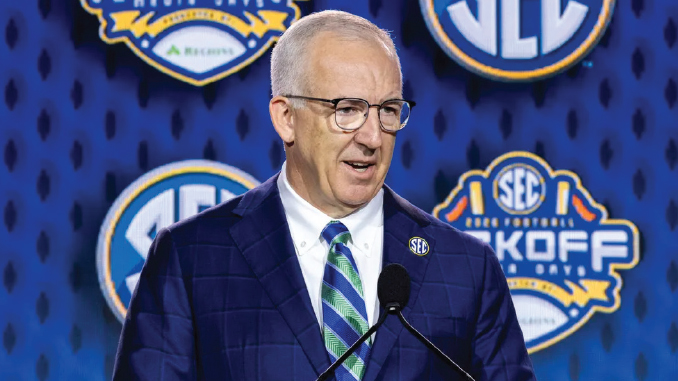
BATON ROUGE — Southeastern Conference Commissioner Greg Sankey spent more than three hours on the witness stand Thursday defending the SEC’s authority to keep former professional athletes from returning to college competition.
By the time he stepped down, Sankey had testified that he received approximately $4.8 million in compensation during the previous tax year, acknowledged traveling to Baton Rouge aboard a private plane and repeatedly defended the conference’s attempt to preserve a boundary between college and professional sports.
“The NFL is not a recruiting ground for college football,” Sankey testified.
Louisiana Attorney General Liz Murrill offered a considerably different explanation during a 30-minute recess.
“I think this is about power and the fact that their power and their rules have been challenged, and they don’t like it,” Murrill told Tiger Rag. “It’s that simple.”
The preliminary-injunction hearing began shortly after 11 a.m. before Judge William Jorden in Courtroom 10C of Louisiana’s 19th Judicial District Court. The courtroom was filled to capacity, with approximately 40 plaintiffs present and additional spectators and reporters waiting outside for seats.
Sankey attended personally and became the first witness called. His testimony lasted approximately three hours and 10 minutes.
Before addressing the larger eligibility dispute, Jorden narrowed the claims being pursued against the SEC. The conference argued that most of the lawsuit’s 44 plaintiffs had no direct connection to an SEC institution and could not properly combine their claims against the conference with those of athletes seeking to attend SEC schools.
Attorneys for the athletes agreed that only seven plaintiffs would continue pursuing claims against the SEC.
“Judge, I think if someone slipped and fell in Walmart, you couldn’t bring a suit against Costco,” SEC attorney Jason Williams said.
The ruling was procedural. Jorden did not uphold the SEC’s eligibility policy, dissolve the existing temporary restraining order or decide whether the conference may punish a member institution for using an athlete protected by a court order.
The larger preliminary-injunction question remained before the court.
Sankey defends the professional boundary
Sankey testified that the principle barring professional athletes from returning to college competition dates to at least 1911. He said the SEC’s members believe allowing athletes to return after entering professional sports could create competitive inequities and displace other college athletes from limited roster positions.
“The line between professional sports and college sports needs to be maintained,” Sankey said.
Attorneys for the athletes challenged both the substance of that position and the process through which the SEC acted.
They questioned Sankey about the relationship between SEC and NCAA eligibility rules, the timing of the conference’s action and the severe penalties established for schools, coaches and administrators who use athletes crossing specified professional thresholds.
Those penalties can include a fine equal to 50% of a sport’s operating budget, a suspension of up to half a season for a head coach and the loss of a university’s voting privileges within the conference.
Sankey maintained that the SEC acted independently rather than in coordination with the NCAA. He said conference presidents and chancellors believed they needed to establish a clear division between professional and college competition and meaningful consequences for institutions that crossed it.
He was also questioned about why the SEC’s policy specifically identifies athletes associated with certain American professional leagues—including the NFL, NBA and WNBA—without expressly addressing every overseas professional league or women’s professional soccer.
Sankey indicated that the conference had not had sufficient time to examine every professional organization.
Plaintiffs’ attorney Tony Clayton told Tiger Rag during the recess that Williams attempted to disrupt his examination of Sankey.
“I think he tried his best to keep me unbalanced, where I wouldn’t be able to cross-examine Sankey,” Clayton said. “I don’t think he did a good job with me. I got what I wanted out of it.”
Murrill: ‘It’s not about Lane Kiffin’
Murrill rejected the suggestion that the litigation is primarily a product of LSU coach Lane Kiffin’s effort to strengthen his first Tigers roster.
“It’s not about Lane Kiffin,” Murrill told Tiger Rag. “It’s about these individuals who want to play.”
She said the governing structure of college athletics has changed rapidly while the SEC continues to rely upon concepts formed under a substantially different economic model.
“There hasn’t been a whole lot of recognition from the commissioner about how much everything has changed,” Murrill said. “They are changing on the fly, and yet it affects these students dramatically.”
Those consequences, she said, are not confined to whether an athlete might eventually reach the NFL.
“It affects their economic opportunities—not just in the future, but today, right now,” Murrill said. “In fact, some of them have greater economic opportunities right now playing in college than they will when they get out of college.”
Clayton said Murrill’s presence beside the athletes’ legal team reflected her responsibilities as Louisiana’s top legal authority.
“She has a commitment to the Constitution and making sure the kids are being treated fairly,” Clayton told Tiger Rag. “This is a constitutional issue.”
Asked whether Murrill’s presence could influence Jorden, Clayton rejected the premise.
“She’s protecting the rights of young athletes all around the state, so she’s not there to help me,” Clayton said. “I don’t think I need any help.”
Murrill also questioned the credibility of Sankey’s testimony concerning his familiarity with the governing rules at the center of the dispute.
“I don’t even think that was a credible statement,” Murrill said. “With all the litigation that has been going around and around about the five-for-five rule, I don’t think it is credible that he hasn’t even read the rule or read the book or knows what the bylaws are. If that’s true, then he’s getting paid way too much.”
Wright and Harris testify
Former Ole Miss players Dae’Quan Wright and Zxavian Harris took the stand after Sankey completed his testimony.
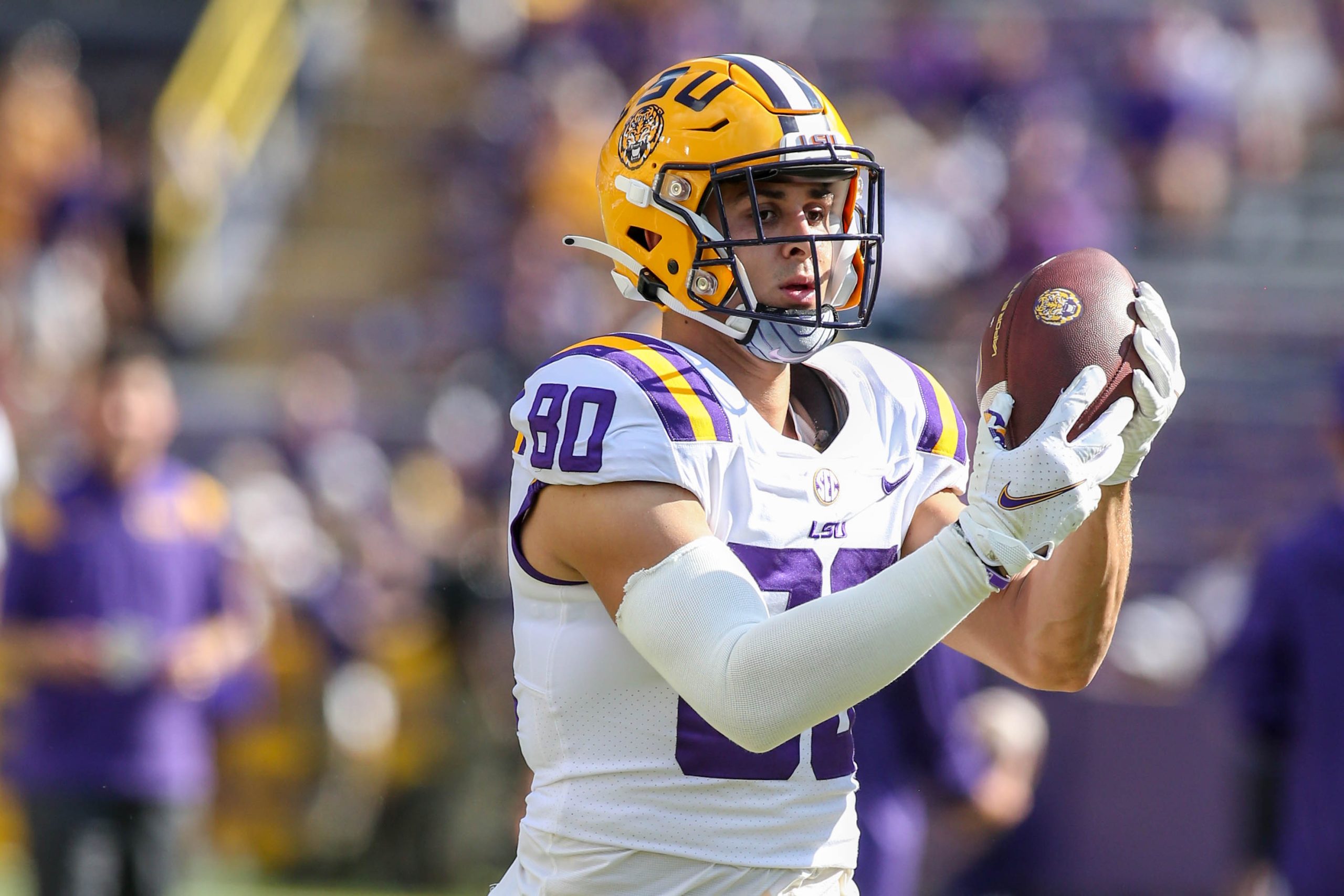
Wright, a tight end who has enrolled at LSU and begun practicing, testified that he earned more than seven figures through name, image and likeness compensation during his college career.
He signed with the Philadelphia Eagles after going undrafted, was waived, claimed by Cleveland and subsequently released by the Browns. Wright testified that he suited up for Cleveland but was not paid by the organization.
He said he wanted to “just be treated fairly” and receive the fifth season now available to athletes under the NCAA’s new eligibility structure.
Harris, a defensive tackle who signed with the New Orleans Saints after playing at Ole Miss, also testified that he earned seven figures during his college career but was not paid by the Saints.
Asked whether he wanted to return to college football if permitted, Harris answered, “Yes.”
Their testimony exposed one of the complications beneath the SEC’s attempt to preserve a traditional boundary between college and professional athletics: Both athletes made substantial money while playing in college but testified that they received no pay from the NFL organizations whose contracts or rosters could now disqualify them.
The plaintiffs contend that they entered the professional process only after being told their college eligibility was exhausted. The NCAA subsequently adopted a new structure allowing athletes five seasons of competition within five years, but it did not apply that rule retroactively to athletes whose eligibility previously expired.
The SEC maintains that it possesses independent authority as a voluntary association to establish and enforce its own membership requirements, even when a court prevents the NCAA from declaring an athlete ineligible.
The athletes are asking Jorden to continue preventing the SEC from punishing institutions, coaches or administrators who use players protected by the court while the underlying case proceeds. The conference wants that protection lifted.
The timing is particularly urgent for LSU. The university must submit its football roster to the SEC on Friday before Kiffin’s Tigers open the season against Clemson on Saturday night in Tiger Stadium.
Jorden had not ruled on the broader preliminary-injunction request as the hearing continued.
Be the first to comment