
By TODD HORNE, EXECUTIVE EDITOR
I have been asked several hundred times how I could sue LSU.
Sometimes the question is asked with honest confusion. Sometimes with disappointment. Sometimes with an edge, as if the act itself requires an explanation of loyalty.
How could you sue LSU?
How could you graduate from LSU, cover LSU, care about LSU, work in the LSU sports orbit, understand what LSU means to Baton Rouge and Louisiana, and still take LSU to court?
The answer is not as complicated as some people want to make it.
I did not sue LSU because I dislike LSU.
I sued LSU because LSU is a public institution, and public institutions do not get to decide that public records belong to them.
That distinction matters. It matters even more now.
The first hearing in our lawsuit is scheduled for May 27 in the 19th Judicial District Court in Baton Rouge. That timing is hard to ignore.
As the case approaches its first test in court, HB 608 seeks to do legislatively what LSU and its allies would prefer not to leave to litigation: build a more solid shield around athlete-compensation records, revenue-share expenditures and the financial structure now operating inside public college athletics.
That is why the bill matters.
HB 608 is not some abstract piece of legislation. It is part of the same fight over whether the public gets to see how a public university spends, commits, routes or structures money in the new era of college athletics.
The bill is being advanced as a way to protect competitive interests in a transformed college sports marketplace, where athlete compensation, revenue sharing, roster spending and financial structure have become part of the business of winning.
That is the argument for it.
But HB 608 also functions as something else.
It is a tell.
If the records at issue were already clearly private, if the expenditures were already clearly beyond the reach of Louisiana’s public records law, if the structure of how public money is being used in this new college athletics economy were already safely hidden from public inspection, there would be no urgent need to build a stronger legal shield around them.
That is what HB 608 seeks to do.
It seeks to create a more solid legal barrier around athlete-compensation records, revenue-share expenditures and the structure of how public money is being spent or routed inside modern college athletics. In doing so, it effectively acknowledges the central grounding of the lawsuit: this was always a legitimate public-records question.
That does not mean every private detail of every athlete’s life should be published. That was never the point.
The point is whether a public university can spend, commit, route or structure public resources in a way that places major financial decisions beyond public view.
That is not a small question.
That is the question.
And it is exactly the kind of question journalism is supposed to ask.
I have thought about that often lately because of a name I had not considered deeply enough for a long time.
James Featherston.
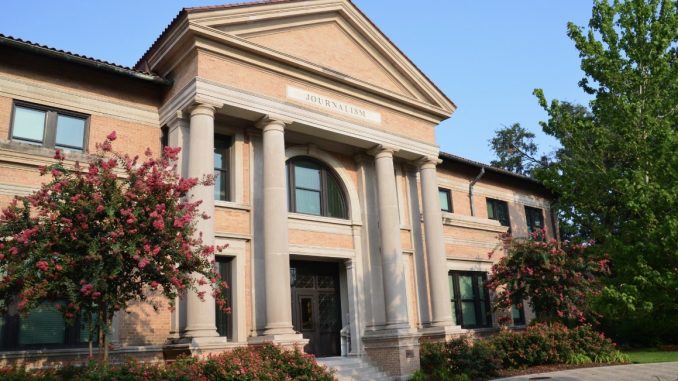
Featherston taught me journalism at LSU.
I was at LSU from 1983 until 1989. By then, Featherston had already been there more than a decade. He arrived in 1970 after a remarkable career as a working newspaperman in Mississippi and Texas. He would remain at LSU until his retirement in 1994, spending 24 years teaching students at what became the Manship School of Mass Communication.
I knew then that he had been a real newspaperman.
You could tell.
He had the bearing of someone who had worked on deadline, dealt with editors, chased facts, written under pressure and understood that journalism was not supposed to be casual work.
What I did not fully understand as a student was how much history he carried into that classroom.
James Shoaf Featherston was part of the Vicksburg Post-Herald staff that won the 1954 Pulitzer Prize for its coverage of the deadly tornado that struck Vicksburg, Mississippi, on Dec. 5, 1953. He covered the Emmett Till case. He covered the Little Rock integration crisis. He worked for the Dallas Times Herald and was along the motorcade route in Dallas on Nov. 22, 1963, when President John F. Kennedy was assassinated. He later reported on the Jack Ruby trial.
That is not merely a resume.
That is witness.
LSU’s Special Collections holds the James Featherston Papers, and the inventory reads like a map of hard American journalism: civil rights, presidential assassination, courtroom drama, disaster coverage, open meetings, public records, ethics, manuscripts, correspondence, photographs and teaching materials.
One item in particular stops me.
Among Featherston’s manuscripts is one titled, “What Really Happened at Sumner, Mississippi,” about the murder of Emmett Till.
Think about that.
The man teaching journalism at LSU had reported on one of the most consequential murder cases in American history. He had gone to Mississippi not as a historian looking back, not as a professor assigning the case years later, but as a working journalist in the middle of it.
To cover the Till case was not simply to cover a court matter. It was to stand inside a moral indictment. It was to see law, race, power, silence, fear and official process collide in a courtroom where the legal record and the truth were not necessarily the same thing.
A reporter who sees that does not forget it.
A reporter who sees that understands something about institutions. He understands that power has language. Power has procedure. Power has lawyers. Power has official explanations. Power has reasons it would prefer certain things remain unseen.
And that is why the record matters.
Not because records are paperwork.
Because records are accountability.
Featherston later taught LSU students about journalism ethics, feature writing, public records and open meetings. He brought into that classroom more than technique. He brought a standard formed by the hardest kind of reporting.
I did not recognize all of that then.
Students rarely know what they are being handed while it is being handed to them.
But I recognize it better now.
I am careful not to overstate the connection. I have not covered anything remotely comparable to Emmett Till, Little Rock, JFK or Jack Ruby. Those were defining American stories. My work now is different in scale and subject.
But journalism is built on habits before it is built on moments.
The habits are the same.
Get the record.
Read the record.
Question the official explanation.
Understand the law.
Write plainly.
Remember that public institutions do not own the public’s business.
That is where Featherston’s teaching feels most alive to me now.
When I write about LSU, HB 608, public records, revenue sharing, tax structures, Board of Supervisors decisions and the legal architecture being built around college athletics, I am not trying to stand above LSU.
I am trying to apply something LSU itself helped teach me.
The irony is hard to miss.
LSU helped teach me that public records matter. Now LSU is part of an effort to convince the Legislature that records involving the new economics of public college athletics should be moved further from public view.
That is not a reason to look away.
It is a reason to look closer.
People sometimes confuse accountability with betrayal. That is especially true in Louisiana, where LSU is not merely an institution. It is emotional property. People do not just attend LSU or cheer for LSU. They identify with it. They defend it the way families defend their own.
I understand that because I feel it, too.
I grew up in Baton Rouge. I was at LSU from 1983 until 1989. I wrote for The Reveille while I was there. I worked at Tiger Rag as a young man. I sat in LSU journalism classrooms. LSU did not just give me a diploma. It shaped the way I learned to report, write and think about public institutions.
But loving a public institution cannot mean surrendering the public’s right to know.
In fact, it should mean the opposite.
If LSU matters, then how LSU operates matters. If LSU is public, then its records matter. If LSU is spending, committing or structuring public resources in a new and largely untested college athletics economy, then the public has a right to understand what is being done, how it is being done and under what authority it is being done.
That is not anti-LSU.
That is pro-accountability.
And accountability is not an attack on a public institution. It is one of the ways the public keeps that institution honest.
Maybe I understand that more clearly now because of Featherston.
Not because he told me one day to sue LSU. Of course he did not. Not because I would claim to be carrying his mantle. That would be too much.
But because a good teacher leaves behind a standard.
Sometimes that standard waits on you.
Years later, when the room gets tense, when the public official dodges, when the institution offers a polished answer that does not quite answer the question, when someone asks why you will not simply let it go, the old lesson returns.
Do the reporting.
Get the record.
Ask the question.
Write it clean.
That is what Featherston taught, whether I understood it fully then or not.
So when people ask how I could sue LSU, I have a better answer now than I might have had a few years ago.
I could do it because LSU is public.
I could do it because the records are public.
I could do it because journalism is not supposed to stop at the campus gates.
And in some small but real way, I could do it because LSU once placed me in a classroom with James Featherston, a newspaperman who had seen enough history to know that the record matters most when powerful institutions would prefer silence.
That is not a contradiction.
That is the lesson.
Context note
James Featherston’s connection to the Emmett Till case is documented in James L. Hicks’ first-person account of the 1955 trial, later collected in Christopher Metress’ The Lynching of Emmett Till: A Documentary Narrative. Hicks described Featherston as one of the reporters present during tense efforts to identify missing witnesses, and also wrote that Featherston vouched for him when local law enforcement detained Hicks during the trial.
The point is not to compare LSU’s public-records dispute to the Till case. The point is narrower: Featherston’s career showed how often the truth depends on records, witnesses, persistence and reporters willing to challenge official accounts.


Be the first to comment