

NCAA Eligibility Litigation
Louisiana Appeals Court Denies SEC Bid to Halt Eligibility Injunction
The First Circuit denied both the SEC’s requested stay and supervisory writ, finding that the conference and Commissioner Greg Sankey failed to show an abuse of discretion by the Baton Rouge district court.
BATON ROUGE, La. — The Louisiana First Circuit Court of Appeal has rejected the Southeastern Conference’s attempt to suspend a preliminary injunction issued in the college eligibility lawsuit that became the center of the SEC’s confrontation with LSU.
In an order dated September 14, a three-judge panel denied both a stay and an application for supervisory writs filed by the SEC and Commissioner Greg Sankey.
“STAY DENIED; WRIT DENIED.”
Judges Penzato, Lanier and Fields comprised the panel in case No. 2026 CW 1195, which arose from the lawsuit filed in the 19th Judicial District Court in East Baton Rouge Parish by Jack Pyburn, Dae’Quan Wright, Zxavian Harris and dozens of other athletes against the NCAA.
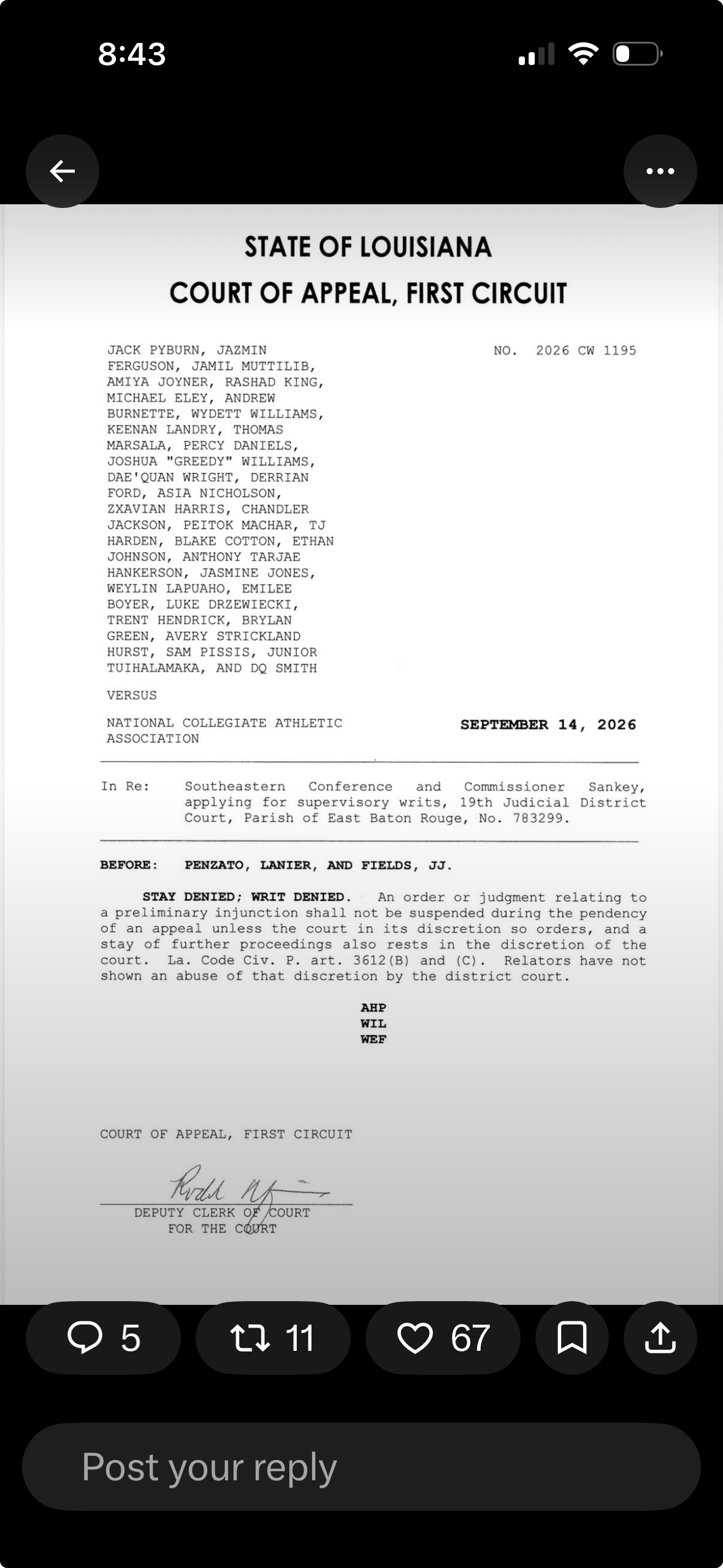
The First Circuit cited Article 3612 of the Louisiana Code of Civil Procedure, which provides that a preliminary injunction is not automatically suspended while an appeal is pending. Whether to suspend the injunction or stop further district-court proceedings rests within the court’s discretion.
“The relators have not shown an abuse of that discretion by the district court,” the appellate court wrote.
The decision leaves District Judge Will Jorden’s preliminary injunction in effect and allows the state-court litigation to continue. It is not a final appellate decision resolving every legal issue in the lawsuit, and it does not prevent the SEC from seeking additional review.
But the SEC did not obtain the immediate relief it requested. The conference asked a Louisiana appellate court to suspend the force of Jorden’s order while the larger dispute proceeded. The First Circuit declined.
Injunction Opened a Path for Wright and Harris
Jorden issued the preliminary injunction after a September 3 hearing in Baton Rouge, preventing the NCAA and SEC from blocking LSU from placing Wright and Harris on its football roster while their eligibility claims remained before the court.
The two players had briefly signed NFL contracts before seeking an additional college season. The SEC responded by adopting a policy prohibiting its schools from rostering athletes who had signed certain professional contracts, accompanied by possible penalties that included a half-season suspension for a head coach, loss of conference voting privileges and a fine equal to as much as 50 percent of the affected sport’s operating budget.
Sankey initially said the conference would comply with the Louisiana court order. As Tiger Rag reported in “The SEC Will Comply. Now We Find Out Where Its Authority Ends,” compliance did not resolve the larger question of whether the conference could punish one of its members for acting under protection of a state-court injunction.
SEC Opened a Separate Federal Front
The SEC later filed a federal lawsuit in Alabama against LSU, LSU President Wade Rousse, Athletic Director Verge Ausberry and football coach Lane Kiffin. Louisiana Attorney General Liz Murrill was subsequently added as a defendant.
The conference alleged that LSU and Kiffin helped conduct an “orchestrated campaign” to bring players back from NFL training camps through litigation. The SEC’s publicly filed complaint, however, identified no specific LSU communication, named witness or firsthand documentary evidence establishing that LSU initiated the athletes’ lawsuit, as examined in “SEC Moves to Kick LSU Out: What Evidence Supports Its Claim?”
The SEC expanded its federal action to seek protection for its claimed authority to expel LSU from the conference. Murrill characterized that lawsuit as a “collateral attack” on the Louisiana injunction during an appearance on Tiger Rag Radio.
LSU eventually filled its 105-player football roster without Wright and Harris, eliminating their opportunity to play for the Tigers this season. That decision removed the immediate roster dispute, but the SEC’s federal claims and the athletes’ Louisiana case did not automatically disappear.
Tiger Rag examined that continuing power struggle in “Liz Murrill Calls SEC Lawsuit Against LSU a ‘Collateral Attack’ as Tigers Fill 105-Man Roster.”
The federal hearing was subsequently postponed, and SEC presidents and chancellors did not conduct the anticipated vote on LSU’s membership.
Louisiana Injunction Remains in Effect
The First Circuit’s ruling now adds another development to the unresolved legal fight. The SEC has not obtained a Louisiana appellate order suspending Jorden’s injunction, and the conference has not received a federal ruling validating its eligibility policy, threatened sanctions or asserted power to remove LSU.
The conference’s response to the LSU controversy—and its emerging argument that the episode demonstrates the value of SEC self-governance—was analyzed Sunday in “SEC Self-Governance: LSU Crisis Exposes the Risk.”
For now, the Louisiana injunction remains standing. The SEC asked the First Circuit to stop it. The court refused.


Be the first to comment