
Todd Horne Commentary
The SEC Calls Its LSU Crackdown ‘Self-Governance.’ It Looked More Like Panic.
The conference is presenting LSU’s retreat as proof that SEC self-governance works. The past three weeks revealed something much less orderly—and considerably more troubling.
Now that LSU has filled its football roster without Dae’Quan Wright and Zxavian Harris, the Southeastern Conference has discovered a grander meaning for what it just did.
Apparently, this was self-governance.
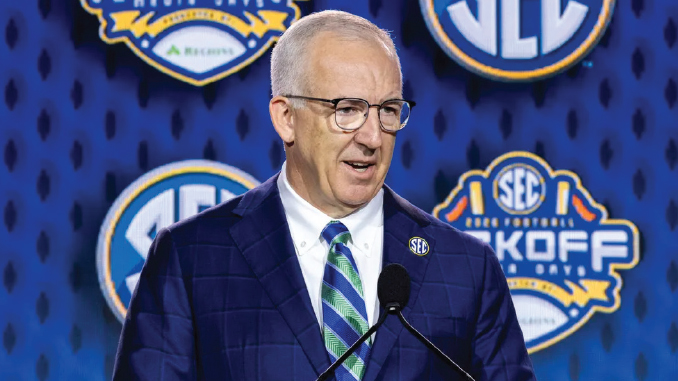
Georgia president Jere Morehead, speaking Friday after a meeting of the university’s athletic board, said SEC members increasingly support the conference creating and enforcing its own rules rather than continuing to depend entirely upon the NCAA.
“I think the members of the SEC support the notion of self-governance. I remain a strong advocate of the Southeastern Conference creating its own rules, and governing itself, and I’m going to be a strong supporter of commissioner Greg Sankey as he works to develop that model.”
Morehead has advocated SEC self-governance before, and there is little reason to doubt that he believes in it. The NCAA has spent years demonstrating that it is too slow, too fractured and too legally vulnerable to govern major college athletics effectively. The SEC and Big Ten have openly considered assuming greater control over eligibility, compensation and enforcement.
But presenting the LSU crisis as evidence that SEC self-governance works requires a remarkably polished retrospective view of what the conference has irresponsibly put on public display over the past three weeks.
The explanation is retrospective. The behavior was reactive.
The SEC did not calmly introduce a carefully constructed governance model. It reacted to LSU and LSU coach Lane Kiffin. It did not establish a prospective rule after months of open deliberation. It adopted an emergency policy as LSU explored adding two former players who had briefly signed NFL contracts and were seeking another season of college eligibility through the courts.
LSU abstained from the vote. The other 15 schools approved the policy.
The SEC attached extraordinary possible punishments to it: a coach’s suspension for half a season, a fine worth as much as 50 percent of a sport’s operating budget and the loss of an institution’s conference voting rights.
When Louisiana District Judge William Jorden issued a preliminary injunction opening a path for Wright and Harris to join LSU, the conference did not simply appeal the order through the Louisiana court system.
It sued LSU.
The SEC filed a federal lawsuit in Alabama against one of its own members, LSU president Wade Rousse, athletic director Verge Ausberry and Kiffin. It then amended the lawsuit and raised the possibility of expelling LSU from the conference.
The escalation went from two football players to LSU’s institutional control to the possible destruction of a conference relationship that has existed since 1932.
No former NFL player had appeared in a game for LSU. Wright and Harris were not on the active roster. LSU had not violated the new policy by using either man in competition. Yet the conference was prepared to convene its presidents and chancellors while asking a federal court to protect its power to throw LSU out.
That did not resemble a confident institution methodically testing a new governing structure. It resembled an institution that believed it was losing control and was willing to use every available weapon to recover it.
Once LSU filled its 105-player roster without Wright and Harris, Rousse wrote Sankey that the immediate issue was moot. The threatened expulsion vote did not occur. No punishment was imposed. The federal hearing was postponed.
Then came the intellectual explanation.
Morehead now says the LSU episode shows why the SEC should govern itself. The report from Athens went further, describing the controversy as an early test of whether a conference could make and enforce its own rules and concluding that, so far, the model appears to be holding up.
But what, exactly, has held up?
The SEC has not won an appeal of the Louisiana injunction. It has not obtained a federal ruling validating its new policy. It has not proved that LSU violated an existing rule. It has not established that the threatened punishments were reasonable or that expelling LSU would have been legally justified.
The SEC proved that it possesses enough economic power to make one of its members retreat. That is leverage. It is not yet a governing model.
LSU faced a choice that was hardly theoretical. It could continue pursuing two players and risk enormous financial penalties, the suspension of its first-year coach, the loss of its voice in conference decisions and, eventually, its SEC membership. Or it could fill the last two roster positions with other players and remove the immediate pretext for the conference’s assault.
LSU chose institutional survival.
The SEC can call the result compliance. It should not confuse coerced obedience with proof that its system is fair, stable or worthy of greater legal protection.
Responsible governance requires more than the ability to make members surrender. It requires clear rules adopted before a controversy begins. It requires consistent enforcement, proportionate penalties and a legitimate process through which a member can challenge the authority of the people imposing them.
The LSU episode offered very little of that. Instead, the conference adopted a policy amid active litigation, directed it at an immediate competitive controversy, threatened penalties wildly disproportionate to anything LSU had actually done and escalated toward expulsion before either player participated in a game.
The emotional character of the response was difficult to miss. There was alarm that Kiffin had found an opening. There was fear that other schools would follow. There was resentment that a Louisiana state court had asserted authority over the NCAA and SEC. And there was unmistakable urgency to force LSU to close the door before the opening became a national entrance.
Now the SEC wants Congress to strengthen its hand.
The Protect College Sports Act could grant antitrust protection not only to the NCAA but also to conferences and individual schools enforcing compensation and eligibility rules. The SEC has separately discussed establishing its own salary cap, possibly through collective bargaining with players.
That makes the conduct of the past three weeks more important, not less.
If the SEC is asking Congress to shield conference rulemaking from litigation, the public has every reason to examine how the conference exercises power when challenged. If the LSU affair is the example, the answer is not reassuring.
The SEC responded to a disputed eligibility question by threatening the place of one of its oldest members in the league. It used the possibility of expulsion before obtaining a final ruling that its position was correct. It placed LSU under extreme institutional pressure and then treated LSU’s retreat as validation of the pressure itself.
Morehead is right about one thing: The LSU case revealed what SEC self-governance could look like.
It revealed a conference powerful enough to write its own rules, interpret its own rules, select the punishment for violating its own rules and threaten any member that asks a court whether those rules are lawful.
The question is not simply whether the SEC can govern itself. The question is who will govern the SEC.
Three weeks of escalation should not be rewritten as a calm and successful demonstration of conference leadership. The SEC did not unveil a governing model. It exposed an institutional instinct.
It felt its authority threatened, used overwhelming force and called the resulting surrender governance.
The SEC—where its authority just matters more.


Be the first to comment