
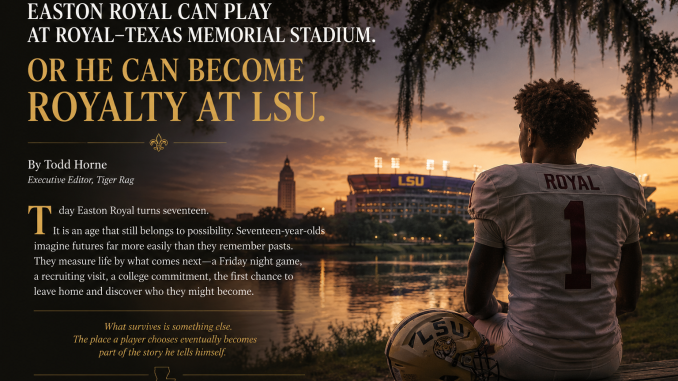
By TODD HORNE, EXECUTIVE EDITOR
Today Easton Royal turns seventeen.
It is an age that still belongs to possibility. Seventeen-year-olds imagine futures far more easily than they remember pasts. They measure life by what comes next—a Friday night game, a recruiting visit, a college commitment, the first chance to leave home and discover who they might become.
Royal has reached that moment under a spotlight few teenagers ever experience.
Every recruiting analyst wants to know whether the five-star receiver from Brother Martin will remain committed to Texas. LSU fans dissect every visit, every photograph and every rumor, searching for evidence that Louisiana’s top receiver may yet decide to stay home. Somewhere between Baton Rouge and Austin, a recruiting story has become daily conversation.
Those stories are fascinating. They are also temporary. Five years from now, no one will remember which prediction proved correct in late July. Recruiting eventually becomes history. What survives is something else.
The place a player chooses eventually becomes part of the story he tells himself.
For all the changes that have swept through college football—NIL collectives, revenue sharing, transfer portals and roster management—we still ask eighteen-year-olds one timeless question: Where do you belong?
Louisiana has always produced extraordinary wide receivers, but its greatest players often grew up imagining Tiger Stadium long before they imagined the NFL. That isn’t nostalgia. It’s culture.
Josh Reed. Odell Beckham Jr. Justin Jefferson. Ja’Marr Chase. Malik Nabers. Brian Thomas Jr. Every generation inherits those memories. Then it decides whether to add another chapter.
That is the decision before Easton Royal.
Lane Kiffin now stands at the beginning of a new era for LSU. The Tigers already possess one of college football’s richest receiver traditions. They have now paired it with one of the game’s most creative offensive minds.
If Easton Royal chooses LSU, he won’t simply be joining another football program. He will help write the opening chapter of the Lane Kiffin era.
I first covered LSU football in the late 1980s before spending nearly three decades building media companies outside Louisiana. When I returned in 2022, almost everything about college football had changed.
One thing hadn’t.
Louisiana was still producing extraordinary wide receivers.
Traditions survive because every generation decides they are worth continuing.
Easton Royal is free to choose whatever future he believes is best. But if he chooses LSU, he won’t simply be committing to a football program. He’ll be accepting an invitation that has been waiting for Louisiana’s next great receiver long before anyone knew his name.
Be the first to comment