By TODD HORNE, EXECUTIVE EDITOR
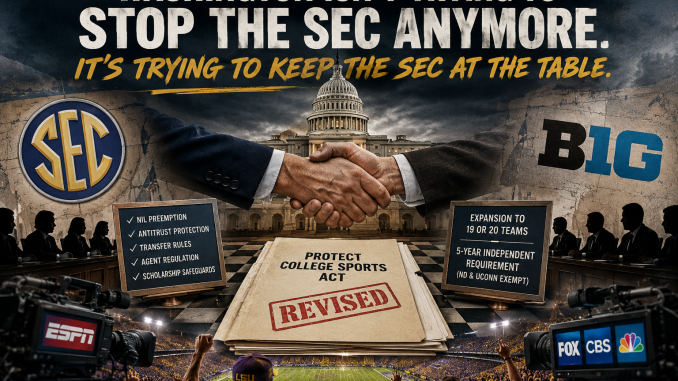
Washington rolled out the Protect College Sports Act professing to save college athletics by reining in the SEC and Big Ten. Now, just weeks later, it’s rewriting key pieces of its own proposal to keep those very conferences from walking away.
That shift—that recognition of where the power actually resides—is the real headline.
Forget Clemson or Florida State hopping in next. Ditch the chatter about Notre Dame finally joining a league or whether the “right” realignment map has 19 or 20 teams sketched out in some Senate office. What matters is that Capitol Hill has already begun adjusting the legislation in response to the realities of the marketplace.
The original draft would’ve effectively locked the Power Four’s doors shut—no adding members, no mergers, no super-league fantasies. But when the richest, most influential conferences objected, lawmakers returned with a revised proposal: allow up to 19 or 20 schools, provided any newcomer first spends five years as an independent, with Notre Dame and UConn exempt.
In theory, that looks like flexibility.
In practice, it’s a five-year cooling-off period that would make almost any expansion bid financially and competitively unrealistic.
Make no mistake: this isn’t primarily about fair play. It’s about keeping the SEC and Big Ten engaged in the process while Washington can still claim it established meaningful guardrails.
The irony?
The SEC and Big Ten wanted protection, not restraint.
That’s an enormous distinction, and one much of the national coverage has missed.
They want federal preemption of conflicting NIL laws. They want meaningful antitrust protection. They want consistent transfer rules, scholarship safeguards and a stable system for regulating agents.
What they don’t want is Washington deciding who belongs in their conferences or how the value they’ve spent decades creating should be distributed.
SEC Commissioner Greg Sankey has played this masterfully.
He has endorsed national NIL standards, agent regulation and scholarship protections while making clear that freezing conference membership or creating new legal exposure is a non-starter. He doesn’t need to threaten Congress or publicly flirt with a breakaway.
He simply points out the obvious.
Congress can pass legislation without SEC or Big Ten support.
It cannot realistically build a long-term governance system if those conferences ultimately decide not to participate in it.
That’s leverage.
And make no mistake: media rights remain the true nuclear issue.
Billions—not millions—are at stake.
NIL dominates headlines because it’s visible. Television contracts determine who actually controls college football.
That’s why the SEC and Big Ten are fighting harder over the bill’s media-rights language than almost anything else.
They fear provisions that could invite antitrust challenges, dilute the exclusivity they’ve built with ESPN, Fox, CBS and NBC, or eventually pressure them toward revenue-sharing models they neither want nor need.
Those conferences didn’t spend decades building the sport’s most valuable television inventory only to let Congress redefine how that value is controlled.
Washington writes laws.
The SEC and Big Ten own the inventory.
Meanwhile, talk of a breakaway super conference isn’t just locker-room folklore anymore.
Sankey has acknowledged that conversations about self-governance are real.
That’s a sea change.
Once the SEC and Big Ten begin treating departure from the NCAA as an operational option instead of an internet rumor, the NCAA’s leverage immediately weakens—and so does Congress’ ability to impose a structure those leagues simply refuse to inhabit.
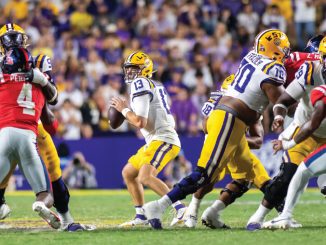
LSU fans should pay close attention.
We’re not sitting outside the room hoping someone saves us a chair.
We’re one of the reasons the room matters.
LSU brings one of college football’s strongest brands, one of its largest television audiences, one of its most passionate fan bases and recruiting territory every major program covets.
That isn’t incidental.
It’s leverage.
If the Protect College Sports Act survives with SEC and Big Ten support, LSU will compete inside a federal framework shaped in part by its own conference’s demands.
If the legislation stalls, LSU remains positioned inside the conference best equipped to chart its own course.
And if self-governance ultimately replaces today’s model, LSU won’t be asking for admission.
It will be one of the institutions that gives the new structure its value.
Congress can regulate interstate commerce.
It can preempt conflicting state NIL laws.
It can offer limited antitrust protections and establish national standards.
What it cannot do is manufacture television audiences, equalize institutional value or pretend every football program occupies the same economic universe.
It cannot legislate away market power.
So yes, Washington introduced the Protect College Sports Act intending to place guardrails around the SEC and Big Ten.
Today, it is revising portions of that proposal because those conferences have made clear they won’t simply accept whatever framework emerges.
That doesn’t mean Congress has surrendered.
It means Congress has discovered where the negotiating leverage actually resides.
The Protect College Sports Act may still pass.
It may ultimately stabilize college athletics.
But one fact has already become unmistakable.
The conferences Washington initially sought to restrain are now helping shape the legislation intended to regulate them.
If you want to know who holds the leverage in college football’s next era, don’t just listen to the speeches.
Watch the edits.
They’re telling the real story.
Be the first to comment