
Todd Horne Commentary
LSU’s Hands Were Not Tied. Its Own Agreement Required Law-Enforcement Notice of a Possible Felony
WAFB reported LSU did not refer an upheld forcible-rape finding for criminal prosecution. A signed East Baton Rouge Parish power-based-violence memorandum separately required LSU to notify law enforcement promptly when it received a report of a possible felony on campus. The public record does not establish whether LSU provided that notice.
LSU’s hands were not tied. The university joined LSU Police, Baton Rouge Police, the East Baton Rouge Parish Sheriff’s Office, the district attorney’s office and other local colleges and campus police departments in signing an East Baton Rouge Parish power-based-violence memorandum of understanding. The MOU requires an institution that receives a report of power-based violence involving a possible felony on its campus to notify the law-enforcement agency with jurisdiction promptly.
That notice could be provided without identifying the alleged victim or witnesses. Federal privacy law separately permitted LSU to disclose the limited final result after its Title IX office upheld a finding classified as sexual assault–forcible rape.
According to WAFB I-TEAM reporter Chris Nakamoto, LSU did not refer that administrative ruling to law enforcement for criminal prosecution.
Tiger Rag asked LSU whether it provided the notice required by the MOU or believed it had otherwise satisfied the agreement. LSU did not answer.
The MOU supplies an important fact missing from WAFB’s original report and from the legal explanation offered in it. LSU was not required to force an adult complainant into a criminal case or disclose her identity without consent. LSU was required by its own institutional protocol to notify law enforcement of a reported possible felony, and nothing in federal law prohibited the university from later disclosing the narrowly defined final result.
Nakamoto reported that LSU’s Title IX office investigated the allegation and conducted hearings before an administrative law judge. The university determined that conduct classified as sexual assault–forcible rape occurred, then upheld the finding after the respondent appealed. LSU modified the sanction to disciplinary probation without restrictions.
The finding is not a criminal conviction, but it is not an exoneration. LSU decided under its civil, preponderance-of-the-evidence standard that the conduct more likely than not occurred. A prosecutor would have to prove a criminal charge beyond a reasonable doubt.
Tiger Rag reported on Sept. 22 that the complainant had publicly identified herself as Kendall Danielle and had described her allegation in a Sept. 14 TikTok video. Tiger Rag embedded the video in its report. Danielle said the alleged rape occurred at approximately 4:30 a.m. on Oct. 18, 2025. Tiger Rag is identifying her by the name under which she told her story publicly.
LSU has now supplied Tiger Rag with the initial police report. LSU Chief Communications Officer Meg Sunstrom sent it after athletics communications director Zach Greenwell forwarded Tiger Rag’s questions to her. Sunstrom described the document as the initial report arising from “the student athlete’s outreach to police.”
LSU Police’s initial report identifies Damien Shanklin, then 19, as the student-athlete who initiated the Oct. 18 police contact and lists him as the complainant. LSU supplied the report in response to Tiger Rag’s questions about this case. Neither the report nor LSU’s accompanying email expressly identifies Shanklin as the respondent in the Title IX proceeding.
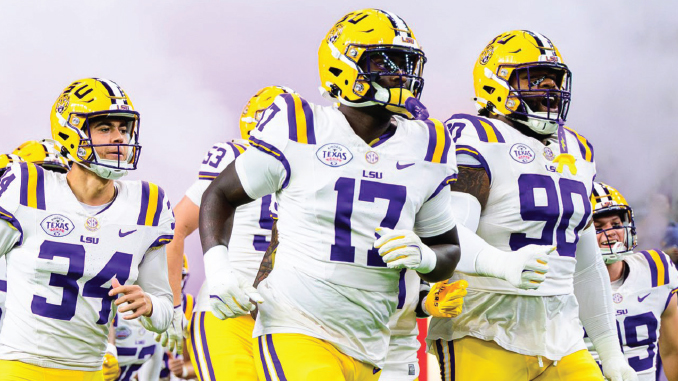
LSU’s official 2026 roster currently lists Shanklin as No. 17, a redshirt freshman defensive end. Tiger Rag reported on Aug. 10 that he was not practicing with the team; Tiger Rag’s roster archive records his return to the roster on Aug. 27.
LSU’s official season statistics list Shanklin with zero games played and zero starts through the first three games. He did not play against Clemson, Louisiana Tech or Ole Miss. Those records establish that he did not enter those games; they do not establish whether he practiced, dressed, traveled or stood on the sideline.
Shanklin last appeared for LSU on Dec. 27, 2025, against Houston in the Texas Bowl. LSU’s official game book lists him as a participant, and his LSU biography credits him with four defensive snaps. It was his fifth appearance of the season, but only four were regular-season games. An NCAA blanket waiver for the 2025-26 academic year excluded postseason participation from the four-game limit, allowing Shanklin to preserve his redshirt.
Interim coach Frank Wilson coached LSU in that bowl game. Wilson is now Ole Miss’ senior associate head coach and running-backs coach. His role in Shanklin’s bowl appearance does not connect Wilson to the allegation now under criminal review or to LSU’s subsequent Title IX proceeding.
Wilson does appear elsewhere in LSU’s recent Title IX history. Former LSU associate athletic director Sharon Lewis alleged in her amended federal complaint and testified at trial that Wilson entered her office in 2013, closed the door, exposed his erect penis and asked her to touch it. Lewis said she reported the incident to then-senior athletics officials Miriam Segar and Verge Ausberry and that neither investigated nor acted. Segar and Ausberry testified that Lewis never reported such conduct to them. Tiger Rag also reported former LSU intern Nikole Jessie’s testimony that Wilson forcibly kissed her on the lips “hard, very hard” against her will. Wilson denied Lewis’ accusations at trial, calling them “egregious and not true.” LSU defended Wilson and described the allegations as unsubstantiated. Wilson was not a defendant in Lewis’ suit. A jury ruled for LSU on Lewis’ employment claims, and the Fifth Circuit affirmed that judgment. Neither ruling adjudicated whether Wilson committed the alleged conduct.
Shanklin has not been arrested or criminally charged. Tiger Rag has not independently reviewed the confidential university records obtained by WAFB. The account of LSU’s investigation, finding, appeal and lack of a criminal referral remains attributed to Nakamoto’s reporting. The police report, memorandum, statutes and federal regulations cited here are public records.
The police timeline began before the Title IX process. LSU’s initial report says an officer responded to the football operations facility at approximately 12:13 p.m. on Oct. 18, 2025. LSU’s game at Vanderbilt had kicked off at 11:07 a.m. in Nashville.
The officer wrote that Shanklin wanted to document an encounter at Riverbend Hall because he was concerned about potential accusations by Danielle. That was Shanklin’s account to police, not an adjudicated finding. After receiving information raising concerns about Danielle’s mental state, the officer contacted her at her campus residence and transported her to Baton Rouge General for an evaluation.
LSU Police classified the report as a noncriminal mental-health matter. The initial report does not document a sexual-assault allegation. It says Shanklin provided a voluntary statement and refers to a supplemental report; neither document was included in the material Sunstrom sent Tiger Rag. The unredacted report also contains Danielle’s residential address and physical descriptors. Tiger Rag is not republishing those unrelated personal details.
Nakamoto reported that LSU’s Title IX office did not receive the police report until Dec. 9, nearly two months later. The subsequent administrative investigation produced evidence, hearings, a finding of responsibility and an appellate decision preserving that finding. WAFB reported that the final ruling was not referred to law enforcement for criminal prosecution.
The initial police contact does not establish whether the Title IX office later notified law enforcement after learning of the sexual-assault allegation. LSU Police knew that Shanklin had reported an encounter and that the officer treated the matter as a mental-health call. The public record does not establish when, or whether, the department was later told that LSU was evaluating the incident as alleged power-based violence involving a possible felony.
The agreement LSU signed is now publicly accessible through Baton Rouge Community College’s website. The East Baton Rouge Parish memorandum includes LSU, LSU Police, Baton Rouge Police, the East Baton Rouge Parish Sheriff’s Office, the district attorney’s office, BRCC, Southern University and their campus police departments.
LSU’s 2022 Title IX progress report said the parties signed the comprehensive agreement in November 2021. The public copy contains signatures extending into January 2022, including those of then-LSU President William Tate and then-LSU Police Chief Bart Thompson.
The BRCC compilation, identified by its filename as a June 2025 document, says a new East Baton Rouge Parish agreement was “in progress” and publishes the previous agreement on the following pages. That agreement says it remains effective until all parties terminate it or one party provides 30 days’ written notice. The compilation contains no termination notice.
The operative language appears on Page 3:
“Each Institution shall promptly notify the Law Enforcement Agencies” of reported power-based violence involving a possible felony.
The next sentence protects the complainant. An institution does not have to identify alleged victims or witnesses when providing that notice. A separate provision says a person reporting power-based violence will be referred to law enforcement or the appropriate Title IX office upon that person’s consent.
Those provisions perform different jobs. An adult complainant controls whether to make a personal criminal complaint and participate in a police investigation. The institution still must provide prompt notice of a reported possible felony, even if that notice omits identifying information.
After Tiger Rag contacted Baton Rouge defense attorney Franz Borghardt Wednesday night, he said WAFB had not asked him to interpret LSU’s signed memorandum. Borghardt said his remarks addressed federal requirements and that the memorandum presents a separate contractual question. He is not involved in the case.
Within that federal-law context, Borghardt correctly explained that adult complainants are not subject to the mandatory-reporting laws generally applied to minors. WAFB quoted him as saying, “There is no mandatory reporting to law enforcement at LSU.” His answer did not address whether LSU had assumed a separate notification obligation through the interagency agreement.
The memorandum supplies that additional layer. It does not require a named criminal complaint or compel an adult complainant to participate in a police investigation. It requires institutional notification of reported power-based violence involving a possible felony.
Borghardt also told WAFB that LSU could ask state officials to change the law, ending with: “Untie my hands. Unshackle me.” Because he was not asked about the memorandum, that quotation should not be read as his conclusion that the agreement left LSU powerless. It raises a separate federal question: Did privacy law prevent LSU from disclosing the limited final disciplinary result? The Family Educational Rights and Privacy Act regulations say it did not.
FERPA generally protects student education records, including much of a university disciplinary file. LSU could not freely transfer every interview, document and item of evidence without consent, a subpoena or another recognized legal basis. But FERPA contains a specific exception for final results in disciplinary proceedings involving crimes of violence.
Under 34 CFR 99.31(a)(14), a university may disclose the final result after determining that a student committed an institutional violation in connection with an alleged crime of violence. Section 99.39 expressly includes forcible sex offenses.
The permitted disclosure is narrow. It may include the respondent’s name, the institutional violation, the sanction and essential findings supporting the conclusion. LSU could not identify the complainant or another student witness without that person’s written consent.
Section 99.31(d) says the exception permits disclosure but does not require it. FERPA therefore left LSU with discretion over the final result. It did not bind the university to silence.
Louisiana law reinforces the same boundary. Louisiana Revised Statute 17:3399.13.4 protects an alleged victim’s identity but allows disclosure to a law-enforcement officer when necessary to conduct a criminal investigation. Louisiana Revised Statute 17:3399.14 requires the interagency memorandum to address investigative responsibility, notification, communication, evidence preservation and information sharing.
The public record does not establish whether LSU supplied the prompt notice required by the memorandum after the sexual-assault allegation reached the Title IX office. The agreement establishes the obligation. It does not establish compliance.
Tiger Rag also reported that a formal criminal complaint had been filed. East Baton Rouge Parish District Attorney Hillar Moore said his office first received the matter for review this week and requested reports, interviews, evidence and other records from LSU, LSU Police, Baton Rouge Police, the East Baton Rouge Parish Coroner’s Office and any other agency possessing relevant information.
Moore’s review is independent of LSU’s administrative proceeding. The Title IX finding does not compel prosecutors to file charges, and prosecutors must assess admissible evidence under the substantially higher criminal burden of proof.
“Disciplinary probation without restrictions” is LSU’s term for a conditional disciplinary status, not a suspension or loss of university privileges. Under LSU’s Code of Student Conduct, another violation during the specified probationary period can jeopardize a student’s status with the university. But a student on probation without restrictions may participate in student-organization leadership, intramurals, LSU study-abroad programs and other specified co-curricular activities. The status ordinarily is not recorded on the student’s academic transcript.
The sanction itself does not prohibit participation in football. LSU Athletics could impose a separate restriction, but the available record does not establish whether it did. WAFB did not identify the original sanction, so the public record also does not establish whether the appeal reduced the penalty or changed it in another way.
LSU President Wade Rousse said the university followed its policies, procedures and best practices and will cooperate now that a criminal complaint has been filed. Tiger Rag’s questions also asked whether the final ruling was referred for criminal review and whether FERPA prohibited limited disclosure. Sunstrom sent Rousse’s previous statement and the initial police report. Neither addressed the MOU, criminal referral or FERPA questions.
The university has not explained why disciplinary probation without restrictions was considered appropriate or whether LSU Athletics imposed a separate restriction.
Separately, LSU’s response establishes that Shanklin initiated the original police contact. LSU’s official roster currently lists him on the football team, and its statistics establish that he has not played in 2026. LSU has not explained his absence from preseason practice or his return to the roster on Aug. 27.
LSU may be able to show that it satisfied the memorandum through a prompt, de-identified notice. It has not done so publicly. What the available law and LSU’s own agreement already establish is that the university had a duty to notify, the authority to disclose a limited final result and no legal basis for the claim that it was powerless.

Be the first to comment