

What on God’s green earth is going on between LSU, the SEC, Louisiana Attorney General Liz Murrill, a federal judge in Birmingham and a basketball player named RJ Luis?
That is the fair question because several different disputes have been mashed together publicly as if they were one lawsuit with one strategy and one person pulling every string.
They are not.
There is a federal lawsuit in Alabama involving the SEC and LSU officials. There is a separate state-court case in Baton Rouge brought by Luis. There is a contempt request filed by Luis’ attorneys. There is a fight between Murrill and a federal judge over the language used in a court filing. And now there is anger around the conference because LSU coach Will Wade put Luis on the floor.
The easiest way to understand this is to slow down and separate who did what, where they did it and what each court has actually ordered.
LSU did not file the RJ Luis lawsuit
Start there.
Luis filed his own lawsuit in the 19th Judicial District Court in Baton Rouge. His attorneys challenged the restrictions that kept him from playing college basketball after his professional experience.
There is no verified evidence that LSU secretly arranged that lawsuit, directed Luis’ lawyers or used him as a legal proxy against the SEC.
LSU had an obvious interest in the result because Luis is on Wade’s roster. An interest in a case, however, is not proof that LSU created or controlled it.
On Nov. 13, the state judge issued a preliminary injunction against the SEC. The court denied Luis’ requested relief against the LSU Board of Supervisors.
The injunction temporarily restrained the SEC while the case continued. It did not decide the entire lawsuit. It did not permanently declare every SEC eligibility rule invalid. And it did not order Wade to put Luis into a game.
What the $100 “security” means
The judge required Luis to post $100 in security before the preliminary injunction took effect. Luis posted it Nov. 16.
That money was not a fine, a penalty or a payment to the SEC.
It was an injunction bond. Louisiana procedure allows a court to require the party receiving temporary protection to put up money as security. If the injunction is later found to have been wrongly issued and the restrained party proves it suffered legally recoverable harm, the bond can provide a source of compensation.
The amount was only $100 because that was the amount the judge set. Posting it activated the temporary injunction. It did not prove Luis had won the underlying case.
The court cleared a path, but Wade chose to walk it
After the injunction became effective, the SEC provided written assurance that LSU would not be fined or punished for playing Luis while the order remained in force.
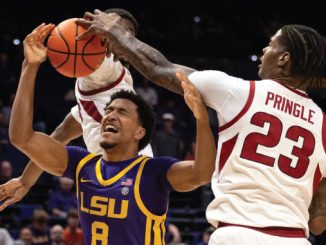
Wade then added Luis to the active roster and played him Nov. 18. Luis scored 11 points and grabbed nine rebounds in LSU’s 79-67 victory over Louisiana-Monroe.
LSU can fairly say it acted inside the protection created by the court order and the SEC’s written assurance. But the order did not force LSU to play Luis. Wade and LSU still made the basketball decision to use him.
That is why some people around the SEC describe it as an “LSU move.” They are reacting to the school’s decision to take advantage of the protection immediately instead of waiting for an appeal, further clarification or a final judgment.
Still, saying LSU made a choice is not the same as saying LSU defied the court, violated an SEC punishment or orchestrated Luis’ lawsuit. No verified court record establishes any of those claims.
Why the SEC is angry
The SEC’s concern is larger than one player in one November game.
If athletes can obtain injunctions in different state courts and then play under those orders, the conference may struggle to enforce one set of eligibility rules evenly across 16 member schools.
Other schools may ask why they should follow a conference restriction if a player at another school can go to court, obtain temporary relief and immediately compete.
That is a real governance problem for Commissioner Greg Sankey and the conference. It is not, by itself, proof that LSU violated an enforceable rule by playing Luis while the injunction was active.
Reports quoting anonymous conference administrators and describing possible retaliation are reporting signals, not official SEC action. No verified court filing or formal conference notice reviewed here establishes that LSU has been sanctioned, that opponents have been authorized to boycott games or that the SEC has expelled or suspended LSU.
The contempt filing is Luis’ request, not a court ruling
Luis’ attorneys filed a motion asking the Baton Rouge judge to hold the SEC and Sankey, in his official role as commissioner, in contempt.
They contend the conference’s response to the injunction amounted to continued pressure against LSU and Luis.
That is the position of Luis and his attorneys. It is not yet a finding by the court.
As of this writing, no verified order has been produced showing that the judge found the SEC or Sankey in contempt. No verified ruling has been located granting the requested punishment or setting the full terms of a show-cause hearing.
The court must still decide whether the SEC’s conduct violated the actual wording of the injunction. Criticism of LSU and concern about conference consequences are not automatically contempt. The controlling question is what the signed order prohibited and whether the SEC disobeyed it.
The Birmingham case is a different lawsuit
The federal case is The Southeastern Conference v. Wade Rousse et al., No. 2:26-cv-01586-ACA, in the Northern District of Alabama.
That lawsuit concerns the SEC’s broader dispute with LSU officials over eligibility decisions, conference authority and the school’s handling of former professional athletes.
LSU has asked the federal court to dismiss the case. That dismissal question remains unresolved.
The federal lawsuit is related to the same institutional fight, but it is not the RJ Luis state-court case. The Birmingham judge did not issue the Baton Rouge injunction that temporarily protected Luis.
What happened in Judge Annemarie Carney Axon’s courtroom
The Nov. 18 federal hearing focused largely on language used by Louisiana’s lawyers in a filing. They had accused the SEC of “hallucinating” legal citations or authority.
According to courtroom reporting, Judge Annemarie Carney Axon sharply rebuked LSU’s lawyers and demanded a correction and public expressions of regret. She warned that another similar episode could bring serious sanctions.
The hearing did not produce a reported merits ruling on whether Luis was eligible, whether LSU violated SEC rules or whether the SEC may ultimately prevail in its federal lawsuit.
A signed written order memorializing every reported element of the judge’s oral directive was not publicly available in the material reviewed for this column. Until one appears, the demand for public statements should be described as a reported oral directive rather than a final written sanctions order.
Why Liz Murrill refused to apologize
Murrill agreed to remove or revise the disputed wording. She did not agree to make the public apology the judge wanted.
Her stated position was that a federal judge should not compel the State of Louisiana and its attorney general to deliver a government-approved public statement. She characterized that demand as improper compelled speech.
Her incentive is not hard to see.
An apology could look like an admission that her office unfairly attacked opposing lawyers or exercised poor professional judgment. It could weaken her position in the courtroom, damage her office’s credibility and hand political opponents a ready-made quotation.
Refusing also lets Murrill recast the dispute. Instead of arguing only about whether the word “hallucinated” was appropriate, she can argue about federal power, state sovereignty and whether a judge may order a state official to speak publicly.
That may be a useful legal or political strategy for the attorney general. It may not be equally useful to LSU.
LSU must continue operating inside the SEC after these cases end. It needs working relationships with Sankey and 15 other member schools. Murrill can afford a sharper constitutional confrontation because her institutional role and political incentives are different.
That does not prove Murrill is acting in bad faith. It means her end game may not be identical to LSU’s.
What was LSU’s end game?
There is no verified evidence of one master LSU plan connecting every athlete, lawyer and lawsuit.
LSU’s conduct looks more like a series of decisions made under changing legal conditions.
When Dae’Quan Wright and Zxavian Harris faced eligibility problems, LSU backed away rather than force an immediate showdown with the SEC.
With Luis, LSU initially kept him out while the process continued. After Luis obtained the injunction, posted the required security and received written protection against conference punishment, LSU chose to play him.
The incentive was straightforward: LSU wanted to use a talented player when its lawyers and administrators believed the immediate legal risk had been reduced.
The potential reward was having Luis available. The risks were angering the conference, creating resentment among other schools and becoming the test case for how much authority the SEC retains when a state court blocks enforcement.
LSU did not have to engineer Luis’ lawsuit to benefit from its result. It only had to decide what to do after the result arrived.
What cannot be undone
Luis has now played.
A later court ruling could dissolve the injunction, reject his claims or restore the SEC’s ability to enforce its rules going forward. An appellate court could change the legal landscape. The SEC could pursue other lawful remedies if permitted.
But nobody can take back the minutes Luis played, the 11 points he scored or the nine rebounds he collected against ULM.
That practical reality increases the pressure on every court and every party. Temporary orders in sports can create permanent real-world consequences before the full merits are decided.
What on God’s green earth is going on?
Several people with different incentives are fighting several battles at once.
Luis is fighting to play. Wade is trying to win games. LSU is trying to use the protection it currently has without losing its place inside the SEC. Sankey is trying to preserve conference authority. Other SEC schools are watching for competitive inequity. Murrill is defending Louisiana’s legal position and her office’s independence. Judge Axon is policing conduct in her federal courtroom. And the Baton Rouge judge must decide what the state injunction actually requires.
Those interests overlap, but they are not the same. There is no verified basis to reduce the whole thing to a secret LSU plot or to say one court has finally decided every issue.
LSU took advantage of a temporary legal opening. The SEC believes the consequences could reach far beyond one basketball game. The courts have not finished deciding who ultimately has the authority to close that opening.
That is where things stand — messy, unsettled and nowhere close to over.

Be the first to comment