

Federal judge rebukes LSU lawyers, but does not rule on eligibility or SEC authority
LSU must retract its “hallucinated” accusation and express regret. The larger SEC lawsuit—and the fight over RJ Luis—remain unresolved.
BIRMINGHAM, Ala. — Start with what did not happen Wednesday.
A federal judge did not rule that RJ Luis is ineligible. She did not authorize the Southeastern Conference to punish LSU. She did not decide whether the SEC can expel LSU. And she did not rule on LSU’s motion to dismiss the conference’s lawsuit.
What happened was narrower, but serious.
U.S. District Judge Annemarie Carney Axon sharply rebuked LSU’s lawyers for accusing SEC attorneys of using case citations that were “negligently supplied or hallucinated.”
Axon directed LSU’s side to retract that language, acknowledge that its use reflected poor professional judgment and submit public statements expressing regret.
She also warned LSU attorney Bruce Rogers that another incident could produce sanctions.
No sanctions were imposed Wednesday.
Why LSU was in court
Wednesday’s hearing involved the SEC’s Oct. 22 motion asking Axon to strike language from LSU’s reply supporting dismissal of the federal lawsuit.
The SEC filed its lawsuit Sept. 3 in the Northern District of Alabama. The conference claims LSU’s attempts to roster former professional athletes threatened the SEC’s First Amendment right to govern its membership and disassociate from conduct that violates conference rules.
LSU has asked Axon to dismiss the case. LSU argues, among other things, that the original football dispute became moot when the school did not roster former NFL players Dae’Quan Wright and Zxavian Harris.
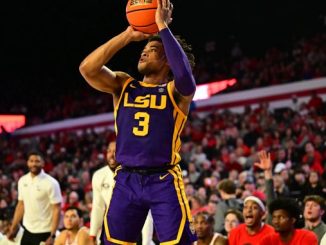
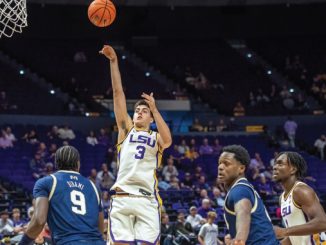
The SEC says the dispute remains alive, particularly after LSU added former NBA contract player RJ Luis to its basketball roster Tuesday.
But Wednesday’s hearing was not held to decide those larger questions. It was held because of one phrase in LSU’s Oct. 20 filing.
The citations were real
The SEC disclosed that its lawyers used the legal artificial-intelligence program Harvey to assist in preparing an Oct. 13 brief. The SEC’s lawyers also certified that they independently reviewed the document for accuracy.
LSU’s reply later accused the SEC of using citations that appeared to have been negligently supplied or hallucinated.
According to ESPN’s Alex Scarborough, Axon questioned Rogers extensively about that accusation. Rogers acknowledged that the cited cases were real.
“They’re not made-up cases,” Rogers said, according to Scarborough’s courtroom account.
Rogers maintained that LSU used “hallucinated” more broadly because it believed the cases did not support the legal proposition for which the SEC cited them.
Axon did not accept that explanation. She viewed the wording as an attack on opposing counsel’s professional character instead of a conventional argument over how the cases should be interpreted.
LSU remains free to argue that the cases do not support the SEC’s position. But its lawyers may not suggest that opposing counsel fabricated cases or failed to verify them without a proper basis for making that accusation.
What Axon required
Rogers told the court LSU would file a request to remove the disputed wording.
Axon reportedly directed that the filing acknowledge LSU’s use of the language reflected “poor professional judgment.”
She also required proposed public statements from Rogers, LSU and the Louisiana Attorney General’s office. Those statements were to be emailed to Axon’s chambers by 3 p.m. Central for her approval and were supposed to be “heartfelt” and “robust.”
The deadline has passed.
As of Wednesday afternoon, none of the statements had been released publicly. LSU’s promised corrective motion also had not appeared on the publicly accessible docket.
That does not establish that LSU or the Attorney General missed the deadline. Because the proposed statements were sent directly to the judge’s chambers for approval, they could have been submitted without immediately appearing in the public court record.
There is no public document confirming submission, approval or noncompliance.
What happened to the SEC’s motion
Axon reportedly said she could not strike the disputed language because LSU’s reply was not a pleading.
The SEC therefore did not receive the exact relief it initially requested.
But the court reportedly allowed the SEC to file a limited sur-reply addressing the three disputed cases, how the conference characterized their holdings and whether they support the SEC’s argument.
The SEC will get another opportunity to defend its legal authorities before Axon considers LSU’s dismissal motion.
Where the federal case stands
The case is Southeastern Conference v. Wade Rousse et al., No. 2:26-cv-01586-ACA, in the U.S. District Court for the Northern District of Alabama.
The publicly available docket still ends with Docket No. 35, the Oct. 27 order setting Wednesday’s hearing. No minute entry, transcript or written order memorializing the hearing had appeared by Wednesday afternoon.
LSU’s motion to dismiss remains pending.
Axon has not decided:
whether the SEC has standing;
whether the dispute is moot;
whether the Alabama court has jurisdiction over all the Louisiana defendants;
whether sovereign immunity protects LSU officials;
whether the SEC possesses the First Amendment right it claims;
or whether the conference may sanction or remove LSU without interference from Louisiana officials.
Where RJ Luis stands
Luis’ immediate status comes from a separate case in Baton Rouge—not Wednesday’s Birmingham hearing.
A state judge entered a preliminary injunction preventing the SEC from blocking Luis’ participation or punishing LSU for rostering and playing him during the 2026-27 season. LSU added Luis to its official roster Tuesday.
The SEC has said it will comply with the injunction while it remains in effect, even as the conference describes LSU’s decision as deeply concerning.
Wednesday’s federal hearing did not dissolve, stay or modify the Baton Rouge injunction.
The bottom line
LSU took a significant public loss Wednesday, but not a legal loss on eligibility or conference governance.
Its lawyers were forced to retreat from an accusation that angered the federal judge. They now face a clear warning that similar conduct could bring sanctions.
But the core lawsuit remains alive and unresolved. Axon has not ruled on LSU’s request to dismiss it, the SEC’s governing authority or Luis’ eligibility.
The next documents to watch are LSU’s corrective filing, the court-approved statements of regret, the SEC’s permitted sur-reply and Axon’s eventual ruling on dismissal.
Be the first to comment