
By GLENN GUILBEAU, Tiger Rag Editor
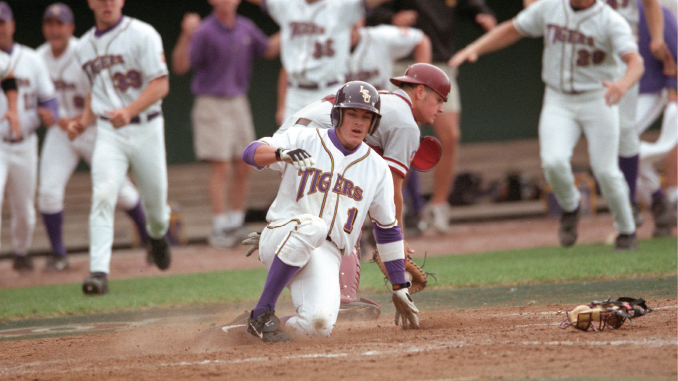
The first thing former LSU national champion shortstop Ryan Theriot thinks of when asked about the plight of the current Tigers baseball team is the 2001 team he played on at LSU.
This season is the 25th-year anniversary of that team, but there will be no reunions.
“It looks a lot like 2001 to me,” Theriot – a hero of the Tigers 2000 national championship team as he scored the walk-off run on Brad Cresse’s single in the ninth to beat Stanford, 6-5 – said on Tiger Rag Radio Tuesday night.
Like this year’s team, the 2001 Tigers were coming off a national championship with huge expectations and were ranked No. 3 entering the season.
The 2026 Tigers entered this season No. 1 in the nation, but were not ranked at all for several weeks recently before a No. 24 position last week that didn’t last seven days because of a sweep at the hands of Ole Miss last weekend.
“Yeah, that was probably the best pitched game we’ve had in a while.”
— Glenn Guilbeau (@SportBeatTweet) April 15, 2026
– Jay Johnson:https://t.co/XzdsQF4ChF
LSU (23-15, 6-9 Southeastern Conference) enters a critical home league series as far as its No. 67 RPI this weekend against No. 10-ranked Texas A&M (28-7, 9-5 SEC) after snapping a four-game losing streak on Tuesday with a 4-2 win over Northwestern State.
Also like the 2026 team, LSU’s 2001 team was considered hugely talented, particularly because of transfers.
The current team has the No. 9-ranked portal hitter by D1 Baseball in senior infielder Brayden Simpson of High Point, the No. 13-ranked portal hitter by D1 Baseball and No. 30 overall portal player by Baseball America in junior infielder Trent Caraway of Oregon State, the No. 19 portal first baseman by D1 and No. 34 overall transfer by Baseball America in senior Zach Yorke of Grand Canyon, the No. 23 portal hitter by D1 in senior infielder Seth Dardar of Kansas State and the No. 21 portal pitcher in sophomore Danny Lachenmayer of North Dakota State.
The above transfers have underachieved, though, and that has been a major part of this team’s problem.
In 2001, it was not called the Transfer Portal, but there was a unique, short-lived NCAA rule in place at the time in college baseball. Players could transfer from upper level programs to upper level programs without sitting out a year – like now – in addition to the traditional junior college transfers.
LSU coach Skip Bertman had announced his retirement a month after the 2000 national championship season as coming after the 2001 season when he could take over as athletic director. And assistant coach/recruiting coordinator Turtle Thomas went all out to send Bertman out as a national champion or with one last trip to Omaha, Nebraska, for the College World Series.
A precursor to LSU football coach Lane “Portal King” Kiffin this past portal season, Thomas scoured the country for transfers and found them.
“We had just an uber-talented team in 2001, and Big Leaguers all over the place,” said Theriot, who was a third round pick by the Chicago Cubs in 2001 and played eight seasons in Major League Baseball. He won World series titles with St. Louis in 2011 and San Francisco in 2012.
No less than eight players in all from the 2001 LSU team reached the Majors – outfielder Todd Linden, outfielder Sean Barker, second baseman Mike Fontenot, infielder Aaron Hill, Theriot and pitchers Roy Corcoran, Shane Youman and Brian Wilson
Linden, Barker and Corcoran each played one season at LSU.
Linden was a transfer switch hitter from Washington who hit .313 with 20 home runs, 25 doubles and 76 RBIs. He may be the only player in LSU history to hit home runs from both sides of the plate in the same game, which he did at Alabama in 2001. Barker, a transfer from Bakersfield Community College, hit .338 with three home runs and 16 RBIs.
Corcoran, a transfer from Mississippi Gulf Coast Junior College, was 8-4 with a 5.48 ERA.
Catcher Matt Heath was an immediate transfer from Florida. He hit .293 with 10 home runs and 47 RBIs. A transfer from Indian River Community College in Florida, first baseman Bryan Moore hit .373 with seven homers, 25 doubles and 50 RBIs in his one season at LSU in 2001. And designated hitter Zeph Zinsman of Mission Junior College in California hit .302 with 16 homers and 45 RBIs.
A lot of talent. A lot of numbers.
“But we just couldn’t quite get it all together,” said Theriot, who hit .353 in 2001 with 18 doubles, 48 RBIs, three triples, a home run and 17 stolen bases in 20 attempts.
The 2001 team was never 6-9 in the SEC or close to it. It finished 44-22-1 and 18-12 in the SEC and was ranked No. 1 in early May. But this team was prone to major inconsistencies, like an 11-6 loss to Southern on March 6 that was the Jaguars’ first win over LSU after going 0-for-36 in the series that began in 1970. After going into SEC West last place Arkansas at No. 1 in the nation, LSU was swept. Then after beating Auburn, 20-5, in the first game of a home series, it lost the next two to finish the SEC season with five losses in six games.
Then LSU reached the SEC Tournament title game, but fell to Mississippi State, 4-1. Because of the late regular season slide, the Tigers had to travel to a Super Regional at Zephyr Field in Metairie against host Tulane. LSU won the first game, 4-3, in LSU-dramatic fashion in the 13th on a Fontenot walk-off homer, but the Tigers had nothing left, losing the next two, 9-4 and 7-1.
Suddenly, Bertman’s career was over, but he was not that surprised.
“We have a Forrest Gump team,” he said in March after a sweep of Florida that followed a 1-4 slump with the loss to Southern. “You know, a box of chocolates. We never know what we’re going to get.”
Looking back on his last season, years later, Bertman said, “There were a lot of great players, but they weren’t always competitive. That kind of stuff means a lot to me. Those guys – winning every pitch meant something to them.”
Basically, LSU is too often not playing its brand of baseball. Column:https://t.co/AEglinJ6Gg
— Glenn Guilbeau (@SportBeatTweet) April 11, 2026
It means a lot to LSU coach Jay Johnson, too. It didn’t mean a lot to several of the stars on the 2001 team. And perhaps not to members of this team.
“I see a lot of guessing offensively, to be honest,” Theriot said. “I don’t see a ton of grind-it-out at-bats.”
And Theriot hopes the 2026 team doesn’t write the same script as it appears it is doing now with top transfers like Yorke and Caraway each hitting .250, Dardar .266 and Lachenmayer at 1-0 with an 8.10 ERA in only 10 appearances. Defensive, pitching and base running issues keep rising up again and again.
“I’m still holding out some hope for this team,” Theriot said. “We definitely have some good pieces out there, but baseball’s a funny game. It takes more than talent to win games. I see the same things over and over again from a losing standpoint.”
LSU fans and Johnson know those all too well.
“You’ve got to be able to throw strikes,” Theriot said. “You can’t give away free passes (walks, errors, wild pitches, passed balls). You’ve got to catch the ball and play good defense. There are 27 outs, and as you give opponents more opportunities to score runs, bad things happen. That’s really been the M.O. (modus operandi) from the beginning. And inconsistency on defense hasn’t allowed the pitchers to get in a rhythm.”
![Red-uniform football player is tackled by a white-uniform defender on a turf field midair during a game, with the ball carrier clutching the ball.]","A red team ball carrier is brought down by a white team defender as they collide on the sideline turf.](https://www.tigerrag.com/wp-content/uploads/BroderickSanders_BSandersTwitter-326x245.jpg "BroderickSanders_BSandersTwitter | TigerRag.com")
Be the first to comment