
By TODD HORNE, EXECUTIVE EDITOR
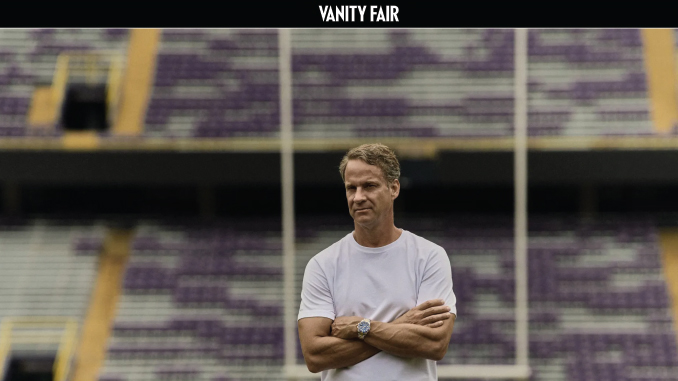
A few weeks ago, a Vanity Fair writer (Chris Smith) walked into a South Louisiana poboy shop and found a copy of Tiger Rag’s Money Issue.
Not online. Not pushed through an algorithm. Not handed to him by an LSU administrator.
A physical copy sitting there in Louisiana.
He picked it up and read it.
Later, when he sat down in Lane Kiffin’s office for what would become one of the most talked-about college football magazine profiles in years, Kiffin handed him Tiger Rag’s December issue with Kiffin on the cover.
According to the writer, Kiffin told him:
“There’s all kinds of info in here I didn’t even know.”
Think about that for a second.
Vanity Fair came to Louisiana looking for Lane Kiffin, but what it really found was LSU’s gravitational pull. It found the modern economics of college football. It found Baton Rouge. It found a program that now sees itself less as a regional power and more as a national institution with Southern roots instead of Southern limitations.
And in the process, it accidentally detonated Ole Miss fans.
Not because Lane Kiffin left.
Because of why he said LSU was different.
The comments that triggered the backlash were Kiffin’s observations about recruiting and diversity. Ole Miss fans heard betrayal. National media heard honesty. LSU fans mostly heard confirmation of what they already believed: LSU is operating in a different universe now.
Kiffin later apologized on On3, saying he never intended to disparage Ole Miss.
He probably meant that sincerely.
But apologies are often less revealing than the thing that required one.
What Kiffin said was not particularly elegant. It was blunt. But blunt does not automatically mean false.
Ole Miss fans did not react because Kiffin claimed LSU had more NIL money. Everybody knows LSU has more money.
They did not react because he claimed LSU recruits better players. Everybody knows LSU recruits better players.
They reacted because Kiffin touched the deepest insecurity Mississippi football has carried for generations: the fear that history still walks into living rooms before coaches do.
That is the part people do not want discussed in public.
Especially not in Vanity Fair.
Especially not by the former Ole Miss coach now standing on LSU’s sideline.
This is where the conversation becomes uncomfortable for everybody involved, because the truth requires nuance instead of tribal screaming.
Louisiana is not morally pure. Baton Rouge is not some enlightened utopia floating above Southern history. LSU has its own racial scars, political battles and institutional contradictions. Every Southern flagship university does.
But LSU football became something larger than Mississippi football culturally decades ago.
Broader recruiting pipelines. Broader identity. Broader institutional ambition. Broader national acceptance.
That matters in modern recruiting.
It especially matters in an era where athletes are brands, families are businesses and perception moves almost as much as scheme or tradition.
Lane Kiffin did not create that reality. He described it.
Poorly? Maybe.
Too candidly? Probably.
But not inaccurately.
And that is why the reaction became emotional so quickly.
Because Ole Miss fans did not hear analysis. They heard judgment.
The irony is that Kiffin probably understands Ole Miss better than most outsiders ever will. He won big there. He modernized the program. He gave the school national relevance it desperately wanted. But in the end, even his Vanity Fair profile reads like a man who viewed Oxford as a place he successfully managed rather than a place he completely belonged.
That distinction matters.
The profile also exposed something else LSU fans should notice.
National media no longer covers LSU merely as a football program. It covers LSU as a cultural force. A power center. A symbol of where college football is heading financially, politically and institutionally.
That is why Vanity Fair showed up in the first place.
And that is why this story exploded beyond sports pages.
By the time Kiffin walks back into Oxford on Sept. 19 wearing purple and gold, this game will already be carrying six months of emotional baggage.
Vanity Fair did not create that tension.
It simply printed what college football’s new reality already looks like when nobody remembers to keep the quiet parts quiet.


Be the first to comment