
TIGER RAG NEWS SERVICES
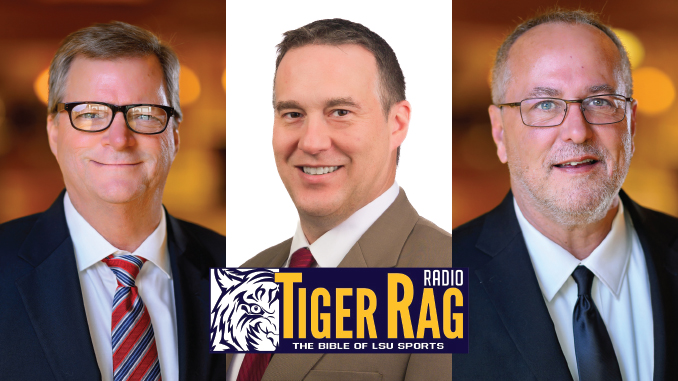
Two minutes before Tiger Rag Radio went live Tuesday night, the show had already started.
Not officially. Not on the stream. Not yet from the Super Chevy Dealers Studio.
But the argument was already underway.
Todd Horne and Glenn Guilbeau were talking about Lane Kiffin, Twitter, Vanity Fair, Ole Miss, LSU damage control and whether anybody around the LSU football program had quietly told the Tigers’ new coach to put the phone down for a while.
Guilbeau had the clean version.
Kiffin stopped tweeting because Kiffin decided to stop tweeting. LSU athletic director Verge Ausberry had just told WAFB’s Jacques Doucet he did not tell Kiffin to stay off social media. Case closed, or at least close enough for Guilbeau.
Horne heard that and nearly reached for a whistle.
Because Horne was not buying it.
Not after the Vanity Fair comments. Not after the Ole Miss blowback. Not after LSU’s new football coach — one of the most online, most quotable, most combustible social-media personalities in college football — suddenly went quiet.
Maybe nobody at LSU called it a gag order. Maybe nobody put it in an email. Maybe Ausberry was being technically accurate.
But Horne’s position was simple: after the Vanity Fair mess, somebody around Kiffin almost certainly made it clear that the circus had gone far enough.
It could have come from LSU. It could have come from representatives. It could have come from people close to him. But Horne did not believe Kiffin simply woke up one morning and decided, on his own, to stop doing something that had become such a large part of his public identity, recruiting style and daily rhythm.
Guilbeau pointed back to Verge.
Horne looked at him and said, essentially: And you believe that?
Then he gave him the nickname.
“If you believe Verge, I’m going to start calling you Glenn Gullible.”
Seconds later, the red light came on.
Jeff Palermo opened the show. The theme music faded. Tiger Rag Radio was live.
And Horne did not leave the joke in the hallway.
“That’s Glenn Gullible,” Horne said.
Guilbeau fired back immediately.
“There’s nothing to get to. That’s fake news, by Todd. Wrong.”
Palermo laughed. The show lurched forward. And before LSU recruiting, before Jay Johnson’s transfer-portal rebuild, before Congress and the Protect College Sports Act, Tiger Rag Radio had already revealed something true about itself.
The argument did not begin on the air.
It merely followed the hosts there.
“That’s pretty much how it happens,” Palermo said later. “We’re getting ready for the show, the open is playing, and all of a sudden Glenn and Todd get into a back-and-forth. There’s name-calling, and then we’ve got to turn the mics on and act civil. Then it bleeds over into the show.”
Palermo laughed when asked about the nickname itself.
“It’s creative,” Palermo said. “You only have to transfer just a few letters to go from Guilbeau to Gullible, so it actually kind of fits.”
Then Palermo added the larger point.
“There are a lot of times I’m like, ‘God, are you really believing that?’” Palermo said. “And I’m naive, too. I’m not throwing Glenn completely under the bus. But in this case, I find it hard to believe that Lane just decided to do this on his own.”
That was the real disagreement underneath “Glenn Gullible.”
Did Verge literally order Kiffin off Twitter? Ausberry says no.
Did Kiffin simply decide to step away from Twitter because he felt like it? Guilbeau was open to that explanation.
Did somebody around Kiffin, formally or informally, tell him the Vanity Fair/Ole Miss noise had gone far enough?
Horne’s answer was yes.
Palermo’s answer was not far behind.
“I don’t think this was something Lane wanted to do,” Palermo said. “This has been such a big part of his life and the way he talks to recruits.”
That is why the exchange worked.
It was funny, but it was not fake.
Tiger Rag Radio did not manufacture the nickname in a production meeting. It did not workshop the bit. Nobody handed Horne a line. Nobody told Guilbeau to push back.
The show simply opened a door and let a real argument walk through it.
“It was a great interaction between Glenn and Todd,” Palermo said, “because Glenn fired back, as he typically can, because he’s quick on his feet.”
That is part of the show’s current chemistry.
Palermo is the point guard. He gets the ball across half court. He knows where the breaks are. He knows when the guest is waiting. He knows when the show needs to move.
Guilbeau is the old warhorse. He has covered everything. He remembers everything. He can pull an LSU recruiting anecdote, coaching comparison or ancient SEC grievance out of thin air and drop it on the table like evidence in a trial.
Horne is the institutional skeptic. He is the one asking what the official statement leaves out. He hears the denial and starts looking for the incentive behind it. He sees LSU language and tries to translate it into plain English.
So when Ausberry says he did not tell Kiffin to stop tweeting, Guilbeau hears a quote.
Horne hears a loophole.
Palermo hears two co-hosts already bickering before the show begins and knows he may have to keep the whole thing from jumping the tracks.
That is not a problem. It is increasingly the point.
“Glenn and Todd are, in a sense, like a married working couple,” Palermo said. “They bicker over stuff, and they like to throw it back at each other when they can. Those are probably the best moments of the show.”
Palermo said the disagreements are not just tolerated. They are necessary.
“I think it’s healthy,” Palermo said. “I don’t think you want somebody that’s always saying, ‘I agree with that.’ You need different opinions and different viewpoints, coming at it from different directions.”
That push and pull has become part of Tiger Rag’s larger identity.
The website has become faster and sharper. The magazine has become more polished and more ambitious. The radio show, meanwhile, has become the live voice of the operation — less scripted, more argumentative and increasingly comfortable turning LSU’s official version of events into the beginning of the conversation, not the end of it.
“That’s why Tiger Rag’s flourishing with Glenn and Todd at the controls,” Palermo said.
Tuesday’s show gave several examples.
The “Glenn Gullible” exchange opened the night with Kiffin, Twitter and LSU messaging.
Then the show moved to LSU’s major recruiting weekend, with elite 2027 prospects on campus and Ed Orgeron back in his element, firing up recruits and families as if he had stepped straight out of an old LSU hype video.
Andre Champagne of 247 Sports later joined the show and said the thing recruits are noticing around LSU right now is culture — more excitement, more connection and a different feel around Kiffin’s staff.
Then Hunt Palmer joined to discuss LSU baseball’s transfer-portal rebuild after one of the program’s worst seasons in recent memory. Horne asked whether Jay Johnson was shopping for arms, bats, defense, maturity or toughness. Palmer’s answer, essentially, was all of it.
Then came the larger college-sports question.
Before Blake Toppmeyer of USA Today came on to discuss the Protect College Sports Act, Palermo read the SEC and Big Ten’s official statement opposing the bill as drafted.
The statement was polished conference language. It talked about national frameworks, transfer portals, eligibility standards, enforcement, litigation and athlete protections.
Then Horne translated it.
His version was blunt: the SEC and Big Ten want federal help, but they do not want federal control. They want protection from lawsuits and state-law chaos, but not if Congress starts limiting their autonomy, media power or future options. They want order, but they want to be the ones ordering it.
Palermo, after the show, agreed with Horne’s broader assessment.
“I think it’s accurate,” Palermo said. “You beg for five, six years, ‘We need the federal government to get involved in this. The only one that can fix it is Congress.’ And then you don’t like what the suggestions are.”
To Palermo, the issue is not merely one bill or one conference statement. It is the larger problem swallowing college athletics: everyone is protecting turf.
“The problem is everybody is trying to protect their own turf,” Palermo said. “The Big Ten and the SEC don’t want somebody to tell them how to do their own business.”
Palermo said college sports may need some kind of national football commissioner or centralized authority to stop the sport from drifting further into chaos. He mentioned that Tim Brando has made a similar argument, and said Jeff Duncan recently made a comparable point on Tiger Rag Radio.
“You need someone to say, ‘This is what we’re going to do,’” Palermo said.
But getting there is the problem.
The SEC and Big Ten are powerful. Greg Sankey and Tony Petitti are not likely to surrender control easily. The schools are making more money than ever. Athletes are making more money than ever. Congress is trying to intervene. Conferences want protection. Coaches want players. Players want leverage. Fans want something they can still recognize.
Palermo said he is not convinced the SEC and Big Ten break away within two years, as Horne predicted on air. He thinks it may be more plausible closer to 2031 or 2032. He also wonders how such a split would work for sports beyond football.
Football may be able to operate like a separate industry.
But what about baseball? Softball? Women’s basketball? Golf? Track? Gymnastics? The non-revenue sports that still define the college athletic model?
That is where Palermo’s thinking went deeper than the original “Glenn Gullible” joke.
The nickname started with Kiffin’s Twitter silence.
The conversation ended with a much larger fear.
“I’m starting to really worry about what college athletics will look like in five years,” Palermo said. “Will it even be recognizable?”
That is the question beneath almost everything Tiger Rag Radio discussed Tuesday night.
Kiffin’s Twitter silence is part of it. Recruiting is part of it. NIL is part of it. Revenue sharing is part of it. Congress is part of it. The SEC and Big Ten are part of it. LSU baseball’s roster rebuild is part of it.
The whole system is moving.
Nobody is entirely in control.
Palermo called it a runaway train.
And somewhere inside that runaway train, two minutes before air, Todd Horne and Glenn Guilbeau were arguing over whether Lane Kiffin really decided to stop tweeting on his own.
That is Tiger Rag Radio at its best.
It starts with a joke.
It ends up somewhere bigger.
The microphones came on.
The argument was already there.
Be the first to comment