
By GLENN GUILBEAU, Tiger Rag Editor
Trying to emulate the NFL is a good idea sponsored by Senator Ted Cruz, R-Texas, and Maria Cantwell, D-Washington, in a bipartisan bill called the Protect College Sports Act that is aimed to save college sports from itself.
There are some good elements to the bill, such as limiting college athletes to one free transfer (without having to sit out a season), as many athletes are transferring three or four times, favoring gap-year wanderlust and cash over any development with the same coach or – heaven forbid – any semblance of an education.
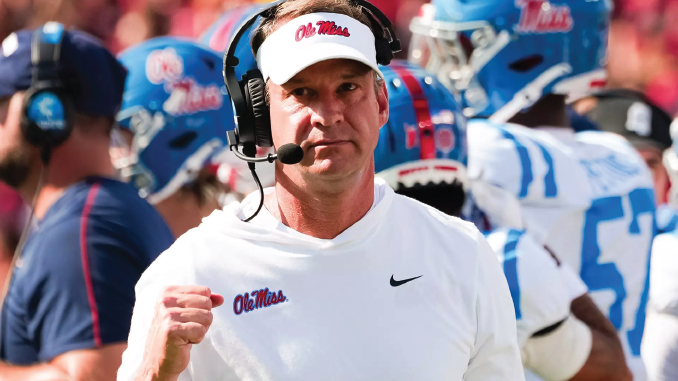
A ridiculous part of the bill tries to regulate coaching movement during the season. It is being called the “Lane Kiffin Rule,” because Ole Miss head coach Lane Kiffin left the Rebels after six seasons following the 2025 regular season and was introduced as LSU’s coach on Dec. 1 just before Ole Miss was to compete in the College Football Playoff.
Tulane coach Jon Sumrall became the Florida coach at about the same time as Kiffin went to LSU, but Tulane didn’t mind him remaining as its coach through the playoffs while he hired a staff and recruited a roster. James Madison coach Bob Chesney did the same thing after accepting the UCLA job.
Kiffin wanted to coach Ole Miss through the playoffs while double dipping as LSU’s coach, but Ole Miss’ collective ego just couldn’t handle that as it lost its coach to its bitter rival. Sumrall’s and Chesney’s moves were more drastically upwardly mobile in level of play and conference, whereas Kiffin switched from one Southeastern Conference school to another one and to its border rival.
“I know you wanted that line.”
— Glenn Guilbeau (@SportBeatTweet) May 27, 2026
-Lane Kiffin to a question about Ole Miss at SEC Spring Meetings Tuesday. But he didn’t bite. … Maybe, he’s learning.https://t.co/HLo0yFV6mz
Still, Kiffin’s type move has happened frequently throughout college football over the last several decades. Ole Miss coach Tommy Tuberville left for fellow SEC school Auburn after the 1998 regular season. Michigan State of the Big Ten lost its coach, Nick Saban, to LSU after the 1999 regular season.
The difference in recent years is that a 12-team College Football Playoff just started in 2024 in mid-December. Before there was a month-long gap between the end of the college football regular season and the bowl season and the early years of two- and four-team college playoffs.
Saban correctly blamed the college football postseason schedule for Kiffin’s untimely exit from Ole Miss more than Kiffin. It will keep happening in high level college football, so the name of the “Kiffin Rule” may be changing on an annual basis until it is enacted, which is not likely to happen.
Congress has been talking about making changes in college football for several years. President Donald Trump even recently got into the act and held a major meeting with Saban and many other college football officials. As is often the case with meetings, though, they’re just that, and often nothing substantial ever happens.
Too often, senators, presidents and the like do not always know what they’re talking about.
“It’s not fair or right to poach a coach in the middle of the season, while the team is still competing,” Cruz said in a briefing with the Associated Press this week. “There’s a reason the NFL has a rule that you can’t do that. Obviously, NFL teams hire coaches away from each other, but they don’t do so in the middle of the season.”
Ok, that would mean schools couldn’t fire coaches during the season. Let’s see how that enforcement works.
And what Cruz seemed to forget about the NFL is that those coaches do not recruit year round, and they do not have new recruit signing days in December. The Dec. 3 signing date last year was the main reason LSU hurriedly hired Kiffin and introduced him on Dec. 1. Over the next few days, he was busy convincing committed high school prospects to stay at LSU.
An NFL head coach doesn’t need to start working at his new head coaching job until February with free agency not until March and the NFL Draft not until April. Cruz is comparing apples and oranges.
The “poaching” rule should not be called the “Kiffin Rule” anyway. It should be called the “Keith Carter” rule. He is the Ole Miss athletic director who just couldn’t handle his coach leaving for LSU as Ole Miss has long had an inferiority complex about LSU, much like LSU has toward Alabama.
LSU athletic director Verge Ausberry was fine with Kiffin remaining Ole Miss’ coach through the playoffs. That would have clearly given the Rebels their best chance of winning their first real national championship in football in its history. But Carter and company succumbed to pride and paranoia instead. They feared that if Kiffin had been coaching Ole Miss and recruiting for LSU simultaneously through the playoffs, he would have poached all kinds of Ole Miss players.
In the end, that happened anyway as four Rebels of their own free will transferred to LSU. Maybe, Kiffin could have gotten more had he coached Ole Miss to the national title, but that was a short term and petty concern by Ole Miss. The big picture was a national championship, and the Rebels may never have a better chance again.
In the end, defensive coordinator Pete Golding moved up to head coach and did well in winning two games over Tulane and Georgia with Kiffin’s assistant coaches and players to reach the semifinals before losing to Miami.
Coaches will never go for “Kiffin Rule” because they all want to better themselves and make more money at what they view as a better job as Kiffin did. With the “Kiffin Rule,” schools will be forced to hire lesser qualified coaches so they can have a coach locked in for the key months of December and January, which is when the critical NCAA Transfer Portal window falls.
Nice try, Mr. Crews. It’s not going to happen and shouldn’t happen.
People in all sorts of careers finish the job they’re leaving in good faith while preparing for the new job. It will have to be same way in college football.
Be the first to comment