
By GLENN GUILBEAU, Tiger Rag Editor
Dale Brown truly was “Billy Graham in sneakers,” as the great Peter Finney of the Times-Picayune once wrote.
He was also a true humanitarian for the Everyman. After Hurricane Katrina in 2005, when Brown noticed stranded people or families, he actually rented cars and gave them to these storm victims. Sometimes, he heard back from them and got his money back. Sometimes he didn’t.
When he was coaching LSU basketball from 1972-97, players often said you never knew who was going to be on the team bus or at practice or at the games.
“He picked up strays,” former guard/center Ricky Blanton (1984-86, 1987-89, Final Four in ’86) said at The Celebration of Life for Dale Duward Brown Wednesday night at the Pete Maravich Assembly Center, a place he would so often fill with life like a sold-out performance on Broadway. That’s how it was on this night. Stirring, emotional, poignant, dramatic and hilarious at times – like the program he ran.
Brown died at age 90 on Oct. 23 at his home in Baton Rouge with his wife of 67 years, Vonnie Brown, near.
“Every day, somebody new would be at practice,” Blanton said. “Or somebody new on the plane or at the shoot-around, the pre-game meal, on the bus. He taught us how to treat people. All we had to do was look and watch him.”
Brown signed the dirt poor Jose Vargas, a 6-9 center from La Romana in the Dominican Republic, before the 1984-85 season. Vargas developed into a dominant player and was a second round pick of the NBA Dallas Mavericks in 1988 before playing 18 years overseas.
“Dale Brown never met his father, but he knew what a father was,” Vargas said.
Brown helped the downtrodden because he was that and then some in Minot, North Dakota. He was raised by his mother, a saint of a woman named Agnes Marie Hennessy Brown, along with older sisters Lorraine and Eleanor after his father Charles Brown skipped town two days before Dale was born on Oct. 31, 1935, into scary conditions in a tiny apartment on welfare and ostracized.
“But he never used that upbringing as an excuse to fail,” said John Brady, the man who had the difficult task of replacing Brown in 1997. “He used that upbringing as a reason to succeed. And boy did he.”
Wherever somebody’s fightin’ for a place to stand
Or a decent job or a helpin’ hand.
Wherever somebody’s strugglin’ to be free,
Look in their eyes ma you’ll see me.”
From Bruce Springsteen’s “Ghost of Tom Joad,” that’s how Brown lived. Coaching college basketball was his profession, and at times he loved it. But very often, it was more of a platform. He gave and gave to those less fortunate.
“Never forget to do something for someone who needs a helping hand, he always said. Everybody gets a second chance,” said former LSU forward Bernard Woodside, a New York City native who transferred to LSU in 1985 from George Washington University in Washington D.C. and played on the 1986 Final Four team and 1987 Elite Eight team.
“My mother turned him down,” Woodside said. “She didn’t want me going to the racist South. ‘And that Coach Brown guy thinks he’s a preacher.’ But she was wrong. I wanted to transfer, and I’m so glad I did. He was such a great man. He had a heart for people. Coach Brown treated his players like men, and we played like men.”
But do not forget that this “Billy Graham in Sneakers” was for much of his life a street fightin’ man.
There was the story from his early years at LSU, which included four straight losing seasons overall and in the SEC after his hopeful first year of 14-10 and 9-9 in 1972-73. At a hotel in Nashville, he was seen running down the lobby after a Vanderbilt fan who had said something to him.
“I tell you what, I would’ve hated to fight Dale Brown or get into an altercation with him,” guard Howard Carter (1979-83, SEC Tournament champs, Elite Eight in 1980, SEC champs, Final Four in 1981), told Tiger Rag this week. That’s 6-foot-5 Howard Carter at a chiseled and thick 215 pounds in his prime. Brown was 6-foot-2 and about 180 pounds and in his mid-40s at the time.
“Dale Brown ain’t backin’ down from nobody,” Carter said. “I’m talking about nobody. I saw him get in Greg Cook’s face.”
Cook was a genuine bad ass center for the Tigers (1976-81, SEC champs in ’79 for the first time since 1954) from Newark, New Jersey, who was listed as 6-8 and 225 pounds. He was closer to 6-7 or 6-6 and played like he was about 6-11, particularly while intimidating Kentucky’s 7-foot-1 Sam Bowie with elbows and everything else.
“Yeah, the Cookie Man,” Carter said. “Coach Brown didn’t care. I saw him get in DeWayne Scales’ face, too.”
Scales was a 6-8, 208-pound forward for LSU from 1977-80 with a screw loose at times whom Brown had to eventually kick off the team before the 1980-81 season. With Scales (16.3 points, 7.9 rebounds in 1979-80), LSU might have absorbed star forward Rudy Macklin’s finger injury suffered in the NCAA Regional title win in New Orleans and handled Indiana in the national semifinal at the 1981 Final Four a week later.
“He’s not backing down,” Carter said. “That’s one thing about him. He ain’t backin’ down from nobody.”
That included the late Indiana coach Bobby Knight, a 6-5 former forward at Ohio State. Where most coaches were too fearful to ever confront Knight, a true emperor without any clothes as time would tell decades after he won three national championships from 1976-87. But Brown stood up to Knight in his heyday and criticized his bullying, abusive ways and how Knight unfairly tended to knight coaches he liked and ripped others.
“We should wrestle naked in a ring until only one of us is left alive,” Brown famously said at the height of their feud after LSU’s loss to Indiana in the 1987 NCAA Regional final.
“I was worried about losing until I looked down the floor and saw Dale Brown,” Knight, a noted cheap shot artist, said after a fortunate 77-76 win over Brown in the 1987 game in Cincinnati, breaking the coaches’ code. “Then I knew we had a chance.”
LSU did blow a signficant lead late, but in truth Knight was fortunate to win as LSU point guard Fess Irvin missed the front end of a one-and-one free throw opportunity that would have likely iced the game. Knight had famously thrown a childish and embarrassing temper tantrum in the first half, banging his hand on the scorer’s table and smashing a phone. Amazingly, no technical foul was called, and Indiana got several close calls the rest of the half.
“Didn’t back down to no one,” Carter said. “That was his mentality. That was him.”
Vargas found that out one night at the Popeye’s on Higland Road.
“I was robbed by about four four five guys,” he said at the ceremony. “They took my money, my chains, a bracelet, and earring.”
Vargas told no one, but Brown noticed something was off with him at practice and spoke to him later. As soon as Vargas explained what happened, Brown sprung into action. Vargas said he knew where one of the young perpetrators lived. So, he and Vargas walked to the Broussard Hall athletic dormitory, went to the floor where the baseball players lived and promptly borrowed two bats.
“He had a bat, and I had a bat,” Vargas said simply.
They arrived at the home off Highland Road where Vargas led Brown. They didn’t have to use the bats, but the show of force to the young man’s father got Vargas’ valuables and his money and an apology.
“That’s Dale Brown,” Vargas said. “And Dale Brown was the first man who said to me, ‘Jose, I love you.’ That is difficult to say, but he said it after every phone call. I could hardly speak English when I was at LSU. Today I speak seven different languages. Dale Brown changed my life.”
JOSE VARGAS PRAISES DALE BROWN AT 1986 FINAL FOUR REUNION
Shaquille O’Neal, LSU’s 7-foot center from 1989-92, noticed that fight as well in 1992 with Brown still in good shape at age 56.
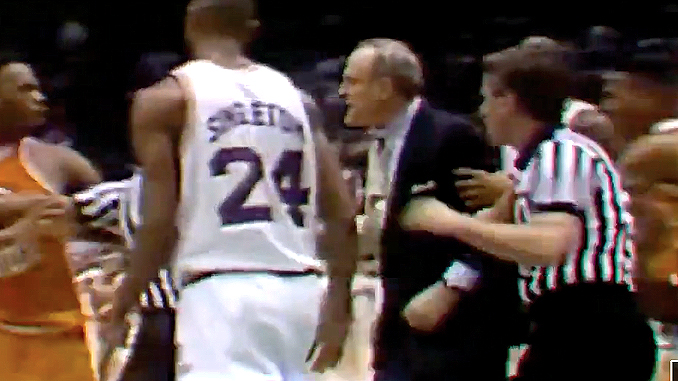
It was the infamous O’Neal-Carlus Groves fight as LSU played Tennessee in the SEC Tournament in Birmingham, Alabama. Groves tried to pull O’Neal down after O’Neal just dunked on him again in a blowout. O’Neal swung his arm back and hit Groves. But officials about had the fight settled down.
And THEN! The Man From Minot exploded off the bench and went after Groves because he went after O’Neal, who wasn’t exactly downtrodden. But Brown had been doing a slow burn for weeks because of what he saw as Shaq Attack fouls.
“He didn’t let us do a lot of things. He didn’t like us to fight,” O’Neal said Wednesday night at the podium. “Every time me and Stanley Roberts (7-foot teammate of Shaq) would fight, we’d get in trouble. And I got a flagrant foul (against Tennessee). I broke coach Brown’s rule, and I was getting ready to fight. I saw him run off the bench, and I was like, ‘Damn, I’m in trouble.’ And then I see him go toward Carlus Groves. And he hit Carlus with a two piece (or tried to with a quick two-punch combination). I was like, ‘Yeah, coach. This guy’s a fighter.'”
There was another infamous fight at Broussard Hall between O’Neal and several members of the football team. O’Neal said his teammate – guard Clarence Ceasar – was beat up by some football players over a woman, so O’Neal went after those players.
“I’m talking a brawl for about 20 minutes,” O’Neal said. “The cops come and they’re getting ready to start arresting people. Coach Brown got there so fast and busts in and says, ‘If you take him, you’re taking me.'”
Some football players were arrested, mainly because Brown got there before then-football coach Curley Hallman did. No basketball players were arrested, and neither was Brown. His program was in the midst of 10 straight NCAA Tournaments (1984-93), while football was in the throes of six straight losing seasons (1989-94).
“That’s just the type of guy he was,” O’Neal said. “He was a sacrificer. He was a fighter. He was a lover. He cared for everyone.”
Brown fought the NCAA for decades, famously calling the organization “Gestapo Bastards” in the 1980s and repeatedly saying the NCAA “legislated against human dignity.”
The NCAA beat him and his program first toward the end of his career for his recruitment of Baton Rouge star Lester Earl, who received cash from an LSU booster to play for the Tigers. And LSU landed on probation for three years while Brady was the coach.
But in the end, Brown beat the NCAA as it began compensating players in 2015 with cash stipends for basic necessities – something Brown campaigned for since the 1980s. Then in 2021, much larger payments to players began via Name, Image & Likeness. Brown thought NIL got out of hand recently, but it was still a victory for him against the NCAA.
David Didion, the NCAA’s enforcement director during Brown’s time at LSU, estimated to noted author Trent Angers that “500,000 student-athletes per year in all 1,100 NCAA colleges and universities in this country are benefiting today because of those rule changes pushed by Dale Brown.”
Angers wrote the book, “Dale Brown Court: And The Battle For Human Dignity.”
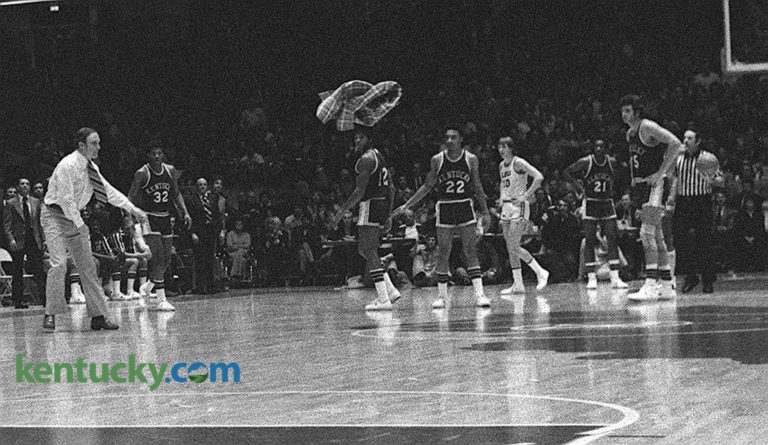
Brown was also a dreamer. He constantly talked of overtaking kingpin Kentucky, which had won 27 SEC regular season titles and four national championships before Brown took over at LSU in 1972. Kentucky was 35-2 against LSU when Brown took over.
Hey, think the time is right
For a palace revolution
That’s the Rolling Stones’ “Street Fighting Man.” And Brown beat Kentucky, 95-84, in his second season. From Feb. 11, 1978, through Jan. 19, 1981, LSU was 6-2 against Kentucky – one of the best runs against the Wildcats by any SEC school in history. There was another 3-0 run in the 1980s. Brown finished his career at 19-33 against Kentucky – more wins over Kentucky than any other coach in history at the time.
Brown also handed the Wildcats their worst loss at treasured Rupp Arena in history – 76-41 on Jan. 18, 1987. It was Brown who also delivered one of the biggest and most damaging upsets of Kentucky in NCAA Tournament history when the No. 11 seed Tigers knocked off No. 1 seed and No. 1 ranked Kentucky, 59-57, in the NCAA Regional final in Atlanta. That made LSU the worst seed to ever reach the Final Four, and it kept Kentucky out of it. And Kentucky had beaten LSU twice in that regular season and again in the SEC Tournament.
“Beating Kentucky meant so much to him,” Bo Bahnsen, a manager and assistant to Brown for decades. “That was one of his main goals when he got here.”
In the nearly three decades since Brown left, LSU has defeated Kentucky a mere nine times.
Brown spoke of winning the SEC regular season title and did it in 1979 after LSU hadn’t done that since 1954. And yes, he had the championship banner dropped from the Assembly Center rafters before the clinching win over Alabama was done. He won three more, and at the time he retired only Kentucky’s Adolph Rupp had won more league crowns than Brown’s four.
He spoke of the Final Four, and he got LSU there in his ninth season in 1981 after LSU hadn’t been since 1953 and did it again in 1986 and damn near did it again in 1987.
And he constantly talked of winning a national championship, though that never happened.
“He taught us how to dream,” said Blanton, who was on that 1986 team that upset Kentucky to reach the Final Four.
“The belief he instilled in all of us was just unbelievable,” said Blanton, who hit the layup for the 59-55 lead in that game in the final seconds off a feed from Don Redden.
“When I think about all that going on in the world now, Coach Brown was way ahead of his time when it came to diversity,” Blanton said.
Yes, Brown didn’t integrate LSU basketball, but he was the first to start five black players at LSU in the 1970s.
Tune in live to the Celebration of Life for Coach Dale Brown on SECN+ and the @LSUsports Facebook/YouTube channels 📺 – https://t.co/J4ks75VtDk https://t.co/eV0QFdQTNm
— LSU Basketball (@LSUBasketball) November 12, 2026
Collis Temple Jr., who at the center of the above tweet stands with members of Brown’s first LSU team in 1972-73, was the first black basketball player at LSU in the 1971-72 season under coach Press Maravich a year before Brown. Temple said he and his teammates didn’t know what to think of this fast talking Washington State assistant coach in his first college head coaching job.
“When we were 17, 18, 19 years old, we thought he was crazy,” said Temple, who addressed the crowd first on the main floor Wednesday. “But he was a special cat. He was a real change agent.”
Temple and other members of Brown’s first team in the 1972-73 season – Ed LeBlanc, William Whittle and Randy Herring were there Wednesday.
“We came here 50 years ago,” LeBlanc said. “And he never let up on us. I’m going to miss those calls every year on my birthday.”
That’s what Brown told Anthony Wilson of Plain Dealing, Louisiana, north of Shreveport, when he visited his home on a recruiting trip in 1982.
“He told my mother, ‘I’ll be with him for the rest of his life,'” Wilson remembered Brown saying in his cinderblock home in the piney woods.
Wilson picked up a loose ball and hit a last-second jumper to beat Memphis State, 83-81, in the Assembly Center in the second round of that magical NCAA Tournament run in 1986, sending LSU to Atlanta for the Sweet 16. LSU won two more and reached the Final Four.
Brown left such strong impressions on so many of his players as his mentor and father figure, legendary UCLA coach John Wooden, left on him.
“Dale Brown was my John Wooden,” former Brown player (1980-84) and assistant coach Johnny Jones (1984-97) said at his turn on the stage. “I ended my last call with Coach Brown with ‘I love you.’ And I used to never end a phone call like that. I used to never hug people. And I’ve been hugging people and telling them I love them ever since. Love you Coach Brown, see you on the other side. Go Tigers.”
O’Neal summed up the evening.
“As I look at all these players, he created men,” Shaq said. “And I appreciate the men that all you guys have become. My only regret about today is that I wasn’t good enough to help him win a national championship. He will be missed, but he’s inside all of us. He will definitely be inside of me until I see him on the other side.”
Then he left a message to carry the “Love Like Dale” theme of the night long after this night, and to fight like hell not to make the same mistakes he did.
“I was working, and I was saying to myself, ‘I’m going to call him the next day,'” O’Neal said. “And he passed away. For me, this is the third time this has happened to me. My sister passed away. I forgot to tell her I love her. Kobe Bryant passed away. I forgot to tell him I love him. And now my Daddy Dale is gone, and I forgot to tell him I love him.”

Be the first to comment