
By GLENN GUILBEAU, Tiger Rag Editor
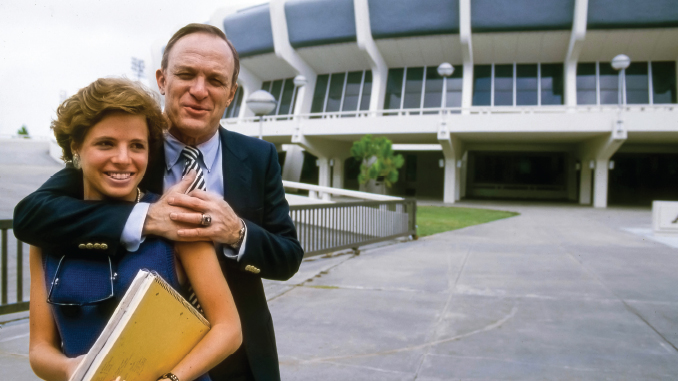
Robyn Brown was 9 years old when her father Dale Brown left an assistant coaching job at Washington State to be LSU’s head basketball coach before the 1972-73 season. He and his wife, the former Vonnie Ness of Columbus, North Dakota, and Robyn moved to the Westminster/Pine Park subdivision in Baton Rouge. Robyn graduated from LSU, where she met her husband Chris Prudhomme. They have three children – Christopher, Peyton and Cameron.
Robyn sat down with Tiger Rag executive editor Todd Horne and Tiger Rag Editor Glenn Guilbeau on Nov. 9 at her home in Baton Rouge to discuss the life and times of her dad.
Dale Duward Brown, born on Oct. 31, 1935, in Minot, North Dakota, passed away on Oct. 23, 2026, at age 90 at his home in Baton Rouge with his wife Vonnie of 67 years near.
TIGER RAG: What are some of your memories from the final weeks and months with your dad?
ROBYN BROWN: I was just thinking of the funny things. Over the summer, we saw these men in his neighborhood installing fiber optic cable, and it was really hot. And he goes, “These work conditions are ridiculous.” So, he goes out there and gives them Gatorades and says, “I need to find out who your supervisor is.” And he went through the supervisor, and the next guy and then the next guy. “These are terrible work conditions,” he told them. The next day, they had umbrellas. He was so concerned about people all the time.
TR: How was he over the last days?
ROBYN BROWN: He was in good spirits. He could not believe he won that John Wooden Legends of Coaching Award (just three days before he died). He was so humbled by that. And he kept saying, “Can you go for me to accept the award?” Dad had not been leaving the house much because of his health. I told him I would go (to Los Angeles in April), and Dad was so happy.
TR: But he usually didn’t keep a lot of his awards and trophies?
ROBYN BROWN: He just didn’t want them. “You want that Final Four trophy? Take it.” So, for him to know about this latest one, he was so happy about that.
NOTE: The Legends of Coaching Award recognizes the lifetime achievement of coaches who exemplify Coach Wooden’s high standards of coaching success and personal achievement. The committee considers a coach’s character, success on the court, graduating rate of student athletes (which Brown improved upon drastically as his career went on and after it ended) and his or her philosophy. Among the winners since the first – Dean Smith in 1999 – are Mike Krzyzewski, Pat Summitt, Denny Crum, Geno Auriemma, Billy Donovan, Tom Izzo, John Calipari, Mark Few and Dawn Staley. The late Bobby Knight, a nemesis of Brown’s who came under fire on several levels late in his career and afterwards, has not won the award.
ROBYN BROWN: He was so proud of that award, because that’s quite a company he’s in. He was so happy. John Wooden was his idol, and he became his father figure, too.
TR: What was it like being the only child of the man they called “Daddy Dale?”
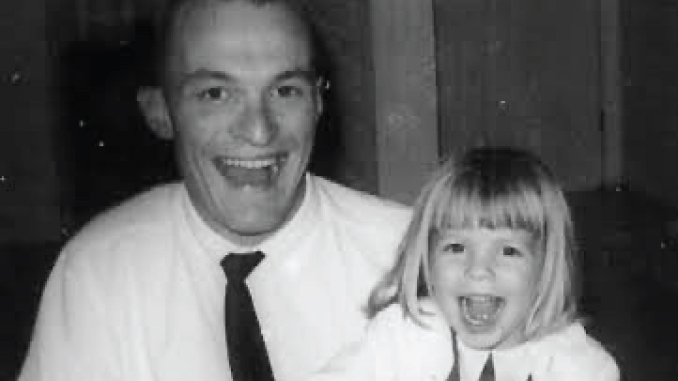
ROBYN BROWN: That picture when I was a little girl (above) sums up my dad and our relationship. We were kind of kindred spirits. I was very appreciative of all the experiences that my parents provided – all the travel. I went on a lot of the road trips during the season and vacations. How much fun they were. I mean there were some belly laughs on those road trips. Those were great times.
TR: What did you find so inspiring about your dad?
ROBYN BROWN: I don’t want to say he was my idol, but he was such a great example. Just watching him on a daily basis, he would just light up everybody’s day. He just had a presence about him. I always use the example of the grumpy checkout clerk we’d see. They’d be in a bad mood, and he would say, “I heard, only the most beautiful and most talented and intelligent people can work here? Is that true?” And they’d be like, “What?” And they would start smiling, and they’d start talking to each other. That was what he was really famous for. He was just an ordinary man who just loved extraordinarily well. That was who he was. He was resilient. He was an eternal optimist. He really was like that. That’s how he lived. He is the happiest person I know. Always in a good mood. He loved people. And that’s really how he was.
TR: Why do you think he was that way, considering he grew up poor. His father (Charles Brown) abandoned him and his mom (Agnes Marie Hennessy Brown) and his sisters (Lorraine and Eleanor) two days before your dad was born.
ROBYN BROWN: I guess grace, I don’t know. He could’ve been bitter, considering his circumstances growing up. He had such a wonderful mother. I know that that’s what drove him as far as his social justice causes. Any time he saw an injustice, he felt compelled to speak. I guess everybody comes to a crossroads in their lives – if you’re going to be bitter, or you’re going to be better. And he chose better. He made a decision. He told me this. He was 9 years old. He was sitting on the fire escape in Minot. He said, “There were two things I want to do in my life. I want to travel the world, and I want to have a child. And I’m going to be the best father I can be. And he was. I haven’t really cried much yet. I’m sorry.
TR: What was he like around the house, growing up?
ROBYN BROWN: He was a voracious reader. Many years ago, way back, when he started at LSU. He just devoured information. And he went to go take an Evelyn Wood speed reading course, and the person told him, ‘You don’t need this. You’re already a speed reader.’ He could’ve had a library. Of course, every time he read a book, he’d give it to someone. He was up until his last days, he was trying to give me stuff. That was how he was. He had insatiable curiosity about everything. Basketball was boring to him at times. It was just the vehicle. It provided the platform for him to do all these other things. That was just the platform to reach people. That’s what people never got about my dad. He would always say, “I love life. I love people. And I want to make a difference.” And that’s really how he was.


Be the first to comment