
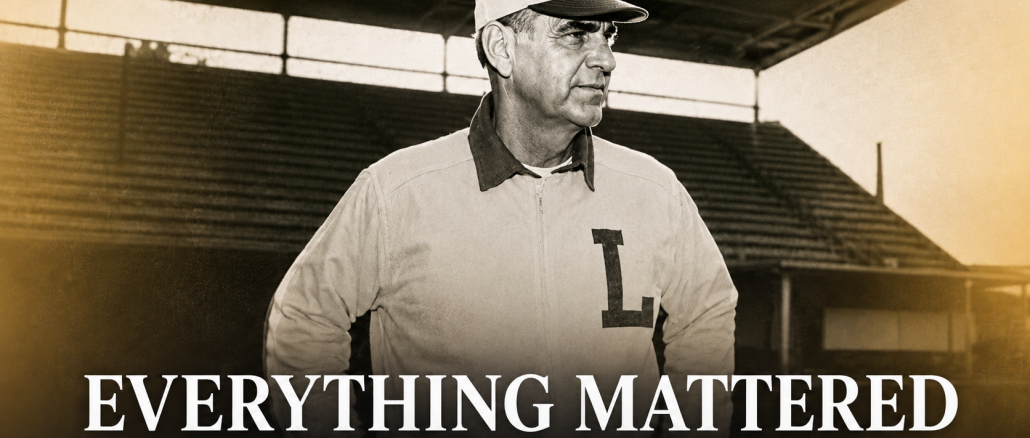
EVERYTHING MATTERED
Skip Bertman won 870 games and five national championships at LSU. Over the final years of his life, Tiger Rag had unusual access to the coach who built the program. What he talked about most was not what he had won, but how people and teams become something more than they were.
Skip Bertman coached baseball at LSU from 1984 through 2001. He won 870 games, took the Tigers to the College World Series 11 times and won five national championships. He later spent seven years as LSU’s athletic director, where he hired four coaches who would win national championships at LSU in four different sports.
Quite simply, Skip Bertman won.
Yet when Bertman died in Baton Rouge on August 14, 2026, at 88, and the men who played for him, coached with and against him and worked alongside him began talking about his life, the championships were rarely where their memories stayed.
Hunt Palmer gathered reactions from across the LSU baseball family and college baseball following Bertman’s death. Read together, they tell you something about the man behind one of the most extraordinary résumés in college sports. Again and again, people began with the coach and ended somewhere else.
They talked about the teacher. The mentor. The friend. The man who coached them hard and called them years later. The man who remembered them after they were no longer players.
Those of us at Tiger Rag had been fortunate enough to see much of that ourselves.
Tiger Rag Editor Glenn Guilbeau wrote the definitive book on Bertman, Everything Matters in Baseball: The Skip Bertman Story, after spending extensive time reconstructing the life, methods and thinking of the coach who transformed LSU baseball. Over the past four years, Glenn, I and Tiger Rag enjoyed essentially unfettered access to Bertman’s mind and, perhaps more importantly now, his heart.
He gave us hours.
Bertman talked about baseball, of course, but baseball with Skip was rarely just baseball. He talked about players and coaches, leadership and motivation, failure and confidence, Sandy and LSU and teams from decades ago. He could begin with a pitching change and somehow end up explaining human nature.
And he never really stopped coaching.
I learned that again in January 2023, when Bertman sat down with me at Mike Anderson’s in Baton Rouge. We had planned to talk for about an hour. Four hours later, we were still there.
Jay Johnson had coached only one season at LSU. His first team went 40-22 and reached an NCAA Regional final. Johnson’s second LSU team had yet to play a game, although expectations were enormous and the Tigers would begin the season ranked No. 1.
I asked Bertman what he thought about the direction of the program.
“I’m real pleased with Jay,” he told me. “In fact, I couldn’t be more pleased with him.”
Then he explained why.
“Whatever it takes, he figures it out. He’s a tough, tough guy.”
Bertman had identified something in Johnson that he understood intimately.
LSU had a problem in Johnson’s first season: pitching.
Bertman knew it. Johnson knew it.
Johnson didn’t rationalize the weakness or wait for it to disappear. He went into Major League Baseball and hired Wes Johnson away from the Minnesota Twins to run LSU’s pitching staff.
Bertman had already gone down to the bullpen and watched the pitchers work under their new coach.
“They can pitch,” he told me.
Then he told me what to watch.
“Watch what an impact Jay’s adding a pitching coach has on this team this year.”
That was January. Paul Skenes had not thrown a pitch for LSU. Dylan Crews had not played his final college season. The Tigers had not spent 12 weeks ranked No. 1, endured the pitching injuries that eventually made them vulnerable, fought their way through Omaha or been beaten 24-4 by Florida one night before beating the Gators 18-4 the next.
None of that had happened. Bertman did not predict it. What interested him was the construction.
A weakness had been identified. The coach had attacked it. The players were responding. Bertman had gone to see the work himself, and he recognized something.
That was how his mind worked.
“Whatever it takes, he figures it out” could just as easily have been Bertman describing himself.
When LSU didn’t have the resources he wanted, he found them. When the baseball yearbook wasn’t good enough, he sold advertising and helped build a better one. When LSU didn’t possess a culture that expected Omaha, Bertman started talking about Omaha until the expectation became so deeply embedded that generations of LSU fans would eventually have difficulty imagining a time when it had not existed.
He understood that champions are constructed long before anybody hands them a trophy. In 2023, he saw Johnson constructing one.
LSU eventually won the national championship.
Two years later, I heard Bertman recognize another championship team while it, too, was still composing itself. This time the lesson was different.
THE LONG SEASON
Bertman joined us in May 2025 for Tiger Rag’s On Base With Skip Bertman podcast. LSU was preparing for a huge series against Arkansas and was not swinging the bat particularly well.
The Tigers were good. Everybody knew that. But this was May, and their offensive struggles were becoming difficult to ignore.
I asked Bertman what he saw.
He didn’t pretend to have identified some mechanical flaw nobody else could see. He said he couldn’t give me anything specific. Instead, he explained what decades of baseball had taught him about judging a team in the middle of a season.
“My belief is that teams go up and down through a long baseball season,” Bertman said. “The pitching goes up and down. The hitting goes up and down.”
LSU had hit extraordinarily well earlier in the year. Now it wasn’t. Bertman wasn’t dismissing the problem. He was putting it in the context of a season. What mattered was when the next move upward occurred.
The conversation carried him back 25 years to his final national championship team.
LSU’s 2000 team had been excellent, but it had not been perfect. Bertman remembered how difficult it had been to complete weekend sweeps. Then the postseason arrived and everything changed.
“We had a great team,” Bertman said, “but we did get hot around tournament time.”
LSU went 13-0 through the SEC Tournament, NCAA Regional, Super Regional and College World Series.
Bertman’s point was not complicated. Baseball seasons are long. Great teams struggle. Pitching rises and falls. Hitting rises and falls. The champion is not necessarily the team that avoids every downturn. The important question is what the team becomes when the games become elimination games.
Then Bertman started talking about Trey Hodges.
And there, perhaps better than anywhere, was Skip Bertman’s philosophy about building champions reduced to one player.
Hodges entered the 2000 season coming off surgery on his throwing arm. Early in the year, he wasn’t very good. Opponents hit him. The results said one thing. Bertman believed something else.
“I knew Trey Hodges was an outstanding pitcher,” he said.
He believed Hodges’ arm simply wasn’t ready. So Bertman waited. He didn’t confuse what the player was early in the season with what the player might become when his arm was healthy and the games mattered most.
The breakthrough Bertman remembered came in a late-season SEC game against Alabama at LSU. The Tigers were behind when Hodges entered, settled the game down and gave LSU a chance to respond offensively. Bertman remembered it as an important turning point, the moment when the pitcher he had expected to see began to emerge.
From there, Hodges became one of LSU’s most important pitchers in the postseason and ultimately the Most Valuable Player of the College World Series. Against Stanford in Omaha, he delivered four innings, allowed two hits and a walk, struck out four and earned the victory.
Bertman had a word for what happened to players like Hodges. He called it “graduating.”
“You went to a higher level,” he explained.
One great performance wasn’t necessarily enough. Bertman wanted to see it again. He wanted evidence that the player had not simply experienced a great night but had become something different.
Sitting there in May 2025, he was watching another LSU pitcher for exactly that reason.
Anthony Eyanson had just thrown a complete game at Texas A&M, allowing three hits and a run while striking out 14. Bertman called it the best game an LSU pitcher had thrown all season. But he wanted another one.
“If Anthony pitches well this weekend,” Bertman said before the Arkansas series, “that would be an example of what I called graduating.”
Eyanson went out against Arkansas and threw six scoreless innings with 11 strikeouts. He had done it again.
Kade Anderson had already reached another level in Bertman’s mind. He called Anderson “really a superstar.” Casan Evans was developing. The pitching staff was getting better.
“Our pitching is coming on,” Bertman said.
Our.
That word catches me now.
Bertman had coached his final LSU game nearly a quarter-century earlier. Jay Johnson had his own program, his own players, his own coaches and his own methods. Bertman understood all of that. He had never expected Johnson to become another version of him.
But LSU baseball was still “we.”
When the conversation turned to how good Arkansas was, Bertman acknowledged it. “But so are we.”
Still we.
Six weeks later, LSU won the national championship. Again.
Bertman hadn’t predicted that one, either. He had seen it composing.
He understood the long season. He recognized which players were moving to another level. He understood that a team struggling offensively in May could become something different in June because he had watched that transformation happen before and had helped create it himself.
In 2023, he saw a coach building a champion by attacking a weakness. In 2025, he saw players and a team becoming championship-caliber as the season moved toward the moment when it mattered most.
Those conversations mean more to me now because they preserve Skip doing something he had done all his life: seeing not only what was there, but what it might become.
And that ability was never confined to baseball teams. It was how he saw people.
HIS BOYS
Ben McDonald was one of the greatest pitchers Bertman ever coached, an All-American who became the No. 1 overall selection in the Major League Baseball draft.
When McDonald learned Bertman had died, he began with the coach.
“My heart is broken this morning,” McDonald said. “We have lost Coach Bertman, the best to ever fill out a lineup card … the man who changed college baseball forever and the man who built the best baseball program in the country, LSU.”
Then he moved immediately beyond baseball.
“As great a coach as he was, even a better man that touched countless lives,” McDonald said. “So thankful I got to see him last night and tell him how much I loved him one more time.”
That became the pattern in the reactions Hunt Palmer gathered.
Eddy Furniss called Bertman “a giant” who made everyone better — his teams and his opponents.
Lloyd Peaver remembered a “visionary, master motivator, and community organizer,” but what he said next sounded remarkably similar to everything Bertman had been telling us about development.
“He wanted to be the best on the field but also prepared his ‘boys’ for life outside the lines of baseball.”
His boys.
Doug Thompson said those relationships were among the things Bertman valued most late in his life.
“The thing he was most proud of is how close he was to so many players 30-40 years later,” Thompson said. “His favorite thing to do was sit with ‘his boys’ and listen to all of the stories.”
I had heard Bertman say essentially the same thing himself during that 2025 podcast.
He had recently attended the 25th anniversary reunion of his 2000 championship team. Players from other LSU teams were there as well, and he estimated he had seen 25 or 30 former players.
“It was just wonderful for me,” Bertman said.
Then he told us why.
“I have a memory attached to every guy.”
There is the coach who remembered Trey Hodges before Hodges became the College World Series MVP. There is the man who understood that the pitcher struggling in front of him wasn’t necessarily the finished pitcher. And there is the 86-year-old Bertman, decades later, still carrying individual memories of the young men who had once occupied those uniforms.
They remembered him just as vividly.
MORE THAN A BASEBALL COACH
Brad Cresse drove in the winning run in Bertman’s final national championship game, LSU’s 6-5 victory over Stanford in 2000.
When Cresse remembered his coach, he didn’t talk about the hit.
“Skip Bertman was far more than my baseball coach,” Cresse said. “He was a mentor who taught me how to be a teammate, a leader and a man, and his impact on my life will last forever.”
Mike Fontenot called Bertman “the most influential person in my life other than my dad.”
“Not just for baseball, but for every aspect of life.”
Ed Yarnall said Bertman’s impact on him as a baseball player was significant, but his influence as a person was greater.
“As a son, brother, father and husband,” Yarnall said.
Blair Barbier put it plainly.
“I would say his true legacy is far less about his many accomplishments and much more about the deep personal impact he had on so many.”
These are men who played for a coach with five national championship rings. When asked what remained, they talked about becoming men.
Todd Walker remembered how the relationship changed with age.
“Skip went from the most intimidating person I’ve ever known to one of the best people I’ve ever known,” Walker said.
The young Walker knew the demanding coach who controlled his place in the lineup and expected excellence. The older Walker knew the man who remained in his life after baseball no longer required either of them to maintain a relationship.
Justin Hill saw Bertman from the other end of the roster.
Hill was a walk-on trying to earn an opportunity when Bertman met with him and his father in the first-base dugout of the old Alex Box Stadium.
Hill asked him for one thing: give me a chance to prove myself.
“He was a man of his word,” Hill said. “He coached me hard, treated me with respect and let my play, not my walk-on status, determine my opportunities.”
Bertman demanded much from his players. He also believed the demands created an obligation for the coach: pay attention, tell the truth, keep your word, believe in the player and give him an opportunity to become more than he is today.
That is not very far removed from waiting on Trey Hodges.
“NATIONAL CHAMPION RAY WRIGHT”
Ray Wright remembers getting on the bus in Omaha after LSU had won a national championship.
Bertman was waiting.
As Wright climbed aboard, his coach greeted him personally.
“National Champion Ray Wright.”
More than three decades later, Wright still remembers the feeling.
“It was an incredible feeling, but more than that, it put into perspective what we had just accomplished,” Wright said. “That was Skip. He made everyone around him believe they could accomplish something special.”
There is something wonderfully Bertman about that story. LSU had just won a national championship, the largest collective accomplishment available to a college baseball team. Bertman handed it back to the individual.
National Champion Ray Wright.
Warren Morris understood the confidence Bertman could create. Morris authored the most famous ending in College World Series history when his two-out, two-run home run in the bottom of the ninth beat Miami for the 1996 national championship.
Yet when Morris remembered Bertman, he talked about the comfort of knowing who was in LSU’s dugout.
“As a player at LSU, I always felt like we had a huge advantage because he was in our dugout calling the shots and the other team didn’t have that same expertise.”
Then he went where so many of Bertman’s former players went.
“He taught us how to win in baseball and in life.”
Rick Greene still repeats one of Bertman’s instructions because, he says, it applies to much more than sports: “Humble in victory, gracious in defeat.”
Trey McClure remembers the language Bertman used to build belief.
“If it is to be, it is up to me.”
“I’m going to play my best nine players, not my nine best players.”
“Anything you can vividly imagine, ardently desire, enthusiastically act upon must absolutely come to pass.”
And: “You play for your father, mother, your maker, LSU Tigers tonight, let’s play like champions.”
Bertman used words as tools. Before players could consistently perform like champions, he wanted them to believe they were capable of becoming champions.
Before LSU could become Omaha, somebody had to imagine LSU in Omaha. Before Trey Hodges could become a College World Series MVP, somebody had to look beyond the struggling pitcher with the surgically repaired arm.
That was coaching to Bertman.
THE TEAM OUTLIVED THE SEASON
Chris Demouy remembers something else Bertman built.
Thirty years later, some of Demouy’s closest friends remain his LSU teammates.
“His ability to create a bond within a team was unmatched,” Demouy said.
He credited Bertman with creating “the trust, the belief, the love for your teammates through the ups and downs in a season.”
“And that bond remains to this day. I’ve never experienced it anywhere else.”
Baseball teams are temporary. Every season ends. Players graduate. Professional careers begin and end. Men marry, have children, build careers and become people who no longer look much like the college kids whose names once appeared on Bertman’s lineup card.
The lineup disappears. The relationships often didn’t. Neither did Bertman.
Patrick Coogan remembered “a father figure, a friend, a mentor and someone who’d call you in the moment you needed to hear from him most.”
“Of course the baseball counted,” Coogan said, “but it was more than that.”
He described what Bertman created as “a culture, one of dreaming, aspirations, hard work, fun, brotherhood, love and yes, winning.”
For Coogan, Bertman’s influence eventually crossed three generations — his father, himself and his three sons.
Ron Polk experienced another side of it.
Polk spent years trying to beat Bertman at Mississippi State during an era when LSU-Mississippi State became one of college baseball’s great rivalries.
When LSU prepared to close the old Alex Box Stadium, numbers along the left-field line counted down the remaining games. Bertman asked Polk to remove one. He was the only non-LSU person afforded the honor.
Polk remembers climbing into a golf cart with Skip and Sandy Bertman and riding down the left-field line during the game, in front of the LSU crowd, to take the number down.
After all those years competing against each other, that is one of Ron Polk’s enduring memories of Skip Bertman.
KNOWING WHEN TO LET GO
Paul Mainieri heard warnings when LSU approached him about leaving Notre Dame.
Why would you want to coach there?
Bertman had built LSU baseball. His presence remained enormous. People told Mainieri that Bertman had such proprietorship over the program that he would never allow another man to truly run it.
Mainieri believed they misunderstood Bertman.
“Skip Bertman is the reason I would want to take the job at LSU,” Mainieri remembered saying, “because I could have another mentor and another person I could continue to learn from.”
Mainieri took the job. What he found was not interference.
“Working for Skip as his baseball coach, he never interfered, always offered encouragement, positive advice, and he instilled a greater level of self-confidence in myself because I knew that I was the guy he wanted and believed in.”
Mainieri won the 2009 national championship.
Years later, Johnson developed his own relationship with Bertman. That brought Bertman back to where I found him in 2023 and 2025 — no longer LSU’s coach, but still deeply engaged with the process of coaching.
He didn’t need Johnson to coach like him. He wanted to understand what Johnson was doing. He watched the pitchers. He talked with him. He saw Johnson identify a problem and fix it. He watched Anderson, Eyanson and Evans develop. He recognized when a pitcher “graduated.” He understood that LSU’s offensive struggles in May did not have to define LSU in June. And he still called them “we.”
That may be one of the most generous things a builder can do.
Bertman constructed LSU baseball so completely that his fingerprints remain everywhere, then understood that loving what he had built did not require possessing it forever. It meant wanting the next man to succeed.
EVERYTHING MATTERED
Mike Bianco played catcher for Bertman before becoming one of the most successful coaches of his own generation.
Asked how to describe him, Bianco wondered where to begin.
“Maybe at the end,” he said. “He’s the G.O.A.T.”
Coach. Athletic director. Ambassador for college athletics.
“There are very few, if any, you could even mention in the same breath,” Bianco said.
Then he ended where almost everybody else did.
“He has impacted countless lives. I know I speak for many when I say I would not be where I am today without Coach.”
Bill Franques spent the morning of August 14 thinking about the same thing.
“I’ve spent the entire morning thinking about how remarkable it is that one man could make such a significant impact upon so many lives,” Franques said. “His standard of excellence set LSU athletics on the course to becoming the global powerhouse it is today.”
The institutional evidence of Bertman’s life is everywhere.
It is visible at Alex Box Stadium and on the field bearing his name. It is visible in the crowds, the championship banners and in generations of LSU fans who now consider Omaha an expectation.
It is visible throughout the SEC, where baseball facilities, attendance, investment and ambition bear little resemblance to what Bertman encountered when he became LSU’s coach in 1984.
And it is visible in LSU’s 2023 and 2025 national championships.
Those championships belong to Jay Johnson and his players and coaches. Bertman would have understood that better than anyone.
But I find myself thinking about those two conversations now.
In January 2023, before Johnson had won anything at LSU, Bertman sat across from me for four hours and told me why he liked him. Johnson was tough. He identified problems. He figured things out. Bertman had gone down to the bullpen himself and could see what was changing.
A few months later, LSU was national champion.
In May 2025, with LSU struggling offensively, Bertman explained that baseball seasons are long and teams rise and fall. He reached back to 2000 and talked about a team that found its best baseball late. He told us about Trey Hodges, the pitcher coming back from surgery whom he believed in before the results justified that belief, and about the late-season SEC game against Alabama at LSU when Hodges began to emerge into the pitcher Bertman knew was there. He explained “graduating” and pointed toward players on Johnson’s team who were doing it.
“Our pitching is coming on.”
“But so are we.”
Six weeks later, LSU was national champion again.
Skip Bertman didn’t predict either championship. He saw them composing.
He could recognize the pieces moving into place because he had spent a lifetime putting those pieces together himself.
And perhaps that explains why the remembrances Hunt Palmer gathered fit so naturally beside the Bertman we had come to know at Tiger Rag.
The same man who could look at a baseball team and see what it might become looked at people that way, too.
He saw Hodges beyond the bad outings. He saw Hill beyond the walk-on label. He saw Johnson beyond a first season that ended in a Regional. He saw Mainieri as the man who should run LSU baseball after him and then gave him room to do it. He saw players as something more than the numbers they produced for him.
Years later, when the games no longer mattered at all, he still wanted to sit with them and hear their stories.
“I have a memory attached to every guy,” Bertman told us.
Doug Thompson tells us what happened on the other side of those memories.
Skip loved sitting with his boys. They loved sitting with him.
Glenn Guilbeau gave his biography exactly the right title: Everything Matters in Baseball.
Skip Bertman spent a lifetime proving it.
The pitching coach mattered. The bullpen session mattered. The slump mattered, but so did understanding that the slump would not last forever. Knowing when to wait on Trey Hodges mattered. Knowing when Anthony Eyanson had graduated mattered. The walk-on mattered. The rival coach mattered. How you won mattered. How you lost mattered. What happened to the player after his last game mattered.
The 870 wins mattered. The five national championships mattered.
But when Skip Bertman was gone and the people whose lives he touched began telling us what they remembered, something else became unmistakable.
They mattered to him. And he mattered to them.
Everything mattered.


Be the first to comment