
By Todd Horne | Executive Editor
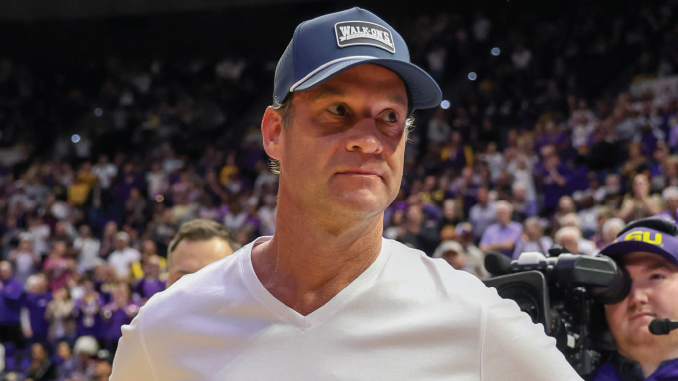
When LSU severed ties with Brian Kelly on October 26, 2025 — following a soul-crushing 49–25 evisceration by Texas A&M that left the Tigers reeling at 5–3 — the move had zero to do with cultural missteps, botched accents, or any inability to navigate Louisiana’s traditions.
Kelly posted a glossy 34–14 overall record (19–10 in SEC play), delivered two 10-win seasons, and captured a 2022 SEC West title. Yet none of it ever pierced the College Football Playoff bubble. His teams limped to a 5–11 record against ranked opponents and staggered to a 7–6 finish in 2025, sealed by a gut-punch 38–35 Texas Bowl loss to Houston on December 27.
At a program where Saban, Miles, and Orgeron all seized crystal within four years, steady competence without trophies is simply unacceptable. LSU demands championships.
Kelly’s downfall was a cascade of self-inflicted wounds: repeated talent-evaluation blunders, maddening roster imbalances, and a rigid philosophy that grew fossilized amid college football’s tectonic upheaval.
LSU’s 2025 offense became the starkest indictment.
Kelly stubbornly clung to a scheme built for a mobile, dual-threat quarterback who could sell RPOs and keep defenses guessing — yet he jammed fifth-year senior Garrett Nussmeier, a pure pocket statue with no credible run threat, into that mismatched mold. Behind an offensive line that was porous in pass protection and utterly inept at run blocking (104 rushing yards per game, dead last in the SEC), Nussmeier was left dangling in the wind. Defenses loaded the box, dared LSU to run, then teed off on a stationary target. Nussmeier absorbed punishing hit after hit, forced into hurried throws or heroic scrambles he was never built for. The running game, predicated entirely on quarterback pulls and keeps, evaporated without that element, turning the Tigers into a sitting duck. A once-promising attack devolved into a predictable, one-dimensional mess averaging a paltry 22.8 points per game. Nussmeier, for all his arm talent and grit, never had a prayer.
Kelly’s preseason bravado (and/or delusion) only sharpened the irony.
In 2023, he painted glowing pictures of defensive renewal — third-down stops, fortified interiors — only to watch LSU hemorrhage yards (101st nationally, 409 per game) and cough up 30+ points in eight contests, squandering Jayden Daniels’ transcendent Heisman season on a hollow 10–3 campaign.
By 2025, he anointed his offensive line “really good” and “potentially elite,” touting cohesion around center Braelin Moore. Instead, it crumbled week after week, emblematic of a regime that misread talent, hesitated on NIL aggression, and patched holes rather than rebuilding foundations.
Imagine Kelly as a once-brilliant architect clutching prized Notre Dame blueprints — elegant designs that yielded NFL offensive linemen and reliable 10-win edifices in calmer climates. Those plans looked impressive on the drawing board. But dropped onto the SEC’s active war zone — NIL fault lines shifting beneath, portal explosives detonating rosters overnight, opponents swinging sledgehammers every Saturday — his structures buckled catastrophically. Load-bearing walls in the trenches collapsed, critical beams were woefully underspecified through repeated evaluation errors, and the final buildings swayed dangerously: offensively dazzling one year, defensively sieve-like the next, never engineered for the hurricane-force winds LSU demands its champions withstand.
Lane Kiffin is the polar opposite: a battle-hardened field commander who revels in chaos.
He doesn’t demand pristine blueprints; he reads the shifting terrain instantly, repositions troops via portal lightning strikes, turns overlooked soldiers into decorated heroes, and unleashes adaptive tactics –blazing tempo, veer-and-shoot RPOs, quarterback-tailored explosiveness — that carve through enemy lines while shoring up his own.
Where Kelly’s inflexible drafting table produced handsome but brittle monuments in the SEC theater, Kiffin’s fluid generalship transformed resource-starved Ole Miss into a perennial victor.
Now commanding LSU’s vastly superior firepower, he is primed to prosecute the rapid, resource-ruthless war the modern conference requires.
With the transfer portal now open, Kiffin has already mobilized and started to work.
Facing an exodus of 22–25 players — including six offensive linemen (Carius Curne, Ory Williams, DJ Chester, Coen Echols, Tyree Adams, Paul Mubenga) — he has called the 2025 offensive line LSU’s clearest weakness and framed the departures as liberation, not crisis. He intends to “hunt” aggressively for athletic, scheme-perfect replacements, turning a depleted front into a battering ram.
Kiffin’s veer-to-spread offense — a sleek evolution of classic veer principles fused with modern spread concepts — thrives on tempo, spacing, RPOs, and vertical shots, but its beating heart is a punishing, balanced run game that forces defenses to honor every gap and opens the playbook wide. A dominant ground attack isn’t optional; it’s the oxygen that sustains everything else in SEC slugfests. LSU’s electric backs — freshman Harlem Berry with his dizzying vision, soft hands, and track-star burst, plus sophomore Caden Durham’s emerging RB1 upside — are custom-built for this machine. They’ll thrive in rotations that stress defenses horizontally and vertically, turning good gains into house calls.
Kiffin’s trench mastery stands in glaring relief to Kelly’s collapse.
He rebuilt Alabama’s front to unleash Derrick Henry’s Heisman rampage and a national title, then repeatedly retooled Ole Miss lines through the portal into top-10 rushing juggernauts with stingy sack rates. With offensive line coach Eric Wolford at his side, he will import physical, agile maulers to impose dominance on both sides of the ball.
Quarterback alchemy is Kiffin’s signature. He and offensive coordinator Charlie Weis Jr. — reunited from Alabama, FAU and Ole Miss days — seek hard-working, high-ceiling arms with dual-threat leanings, then sculpt the entire offense around that player’s DNA: amplifying arm talent, mobility, or processing speed while masking limitations.
Weis calls it Kiffin’s “special ability” to develop quarterbacks by refusing cookie-cutter schemes.
Blake Sims rewrote Alabama records; Jake Coker went 14–0 to a ring; Matt Corral and Jaxson Dart chased Heismans at Ole Miss. The crowning 2025 example: Trinidad Chambliss, fresh off a D-II title at Ferris State, portal-jumped to Oxford, beat out veterans, and piloted the Rebels to an 11–1 regular season, 12–1 overall, and a CFP spot — delivering elite efficiency.
With Michael Van Buren Jr. currently LSU’s lone scholarship QB, expect Kiffin to flood the room with portal competition — Sam Leavitt, Brendan Sorsby, perhaps Chambliss — creating a meritocracy that accelerates ascension.
Kiffin’s command of NIL firepower, portal warfare, and roster fluidity — paired with Weis Jr.’s scheme flexibility — guarantees offenses built to the personnel, not the other way around.
LSU tolerates no perpetual bridesmaids.
Brian Kelly kept the lights on but never stormed the altar.
Lane Kiffin arrives not as a cultural fix but as the decisive general whose relentless roster engineering, trench supremacy, and battlefield brilliance match the moment perfectly.
With the portal now open, Kiffin’s blueprint will prove its not just promising structural integrity — it’s engineered for trophies.
Brian Kelly’s Preseason Predictions vs. Actual Outcomes
Brian Kelly’s optimistic preseason assessments at LSU repeatedly clashed with on-field reality, exposing significant misjudgments in talent evaluation and unit potential. Below is a direct comparison of his key quoted predictions to the actual statistical performances.2023 Defense: Preseason Confidence vs. Historic Collapse
Kelly’s Key Quotes (Preseason 2023):
“I think what you’ll see more than anything is that we will get off the field on third down. We couldn’t last year and it limited our possessions.”
Additional comments emphasized improvement “up the middle” at linebacker and defensive tackle, better safety play, and overall progress despite acknowledging cornerbacks as a “work in progress.”
Actual 2023 Defensive Statistics (National Rankings out of ~130 FBS teams):
Category Ranking Per Game Allowed Key Notes Total Defense 101st 409 yards Major regression from 2022 (~355 ypg); one of LSU’s worst in modern era. Scoring Defense ~85th ~28 points Allowed 30+ points in 8 of 13 games, including blowouts. Third-Down Defense ~100th+ ~42% conversion Directly contradicted Kelly’s primary prediction; opponents sustained drives routinely. Rushing Defense ~85th ~164 yards Vulnerable interior despite predicted strength. Passing Yards Allowed Bottom 30 High explosive plays Secondary struggles led to big-pass vulnerability. The defense became a glaring liability, undermining Jayden Daniels’ Heisman-winning offense and limiting LSU to 10–3 without playoff contention.2025 Offensive Line: Preseason Hype vs. Dismal Performance
Kelly’s Key Quotes (Preseason 2025):
“I’ve coached for a long time, had a lot of guys in the NFL, a lot of first round draft picks. I think I’ve got a pretty good eye for what an offensive line looks like. And this group is going to be really good.”
“We don’t have a Will Campbell, but we have five guys that play well together.”
“Braelin Moore kind of sets up the rest of the group for success, his combination work is outstanding, his recognition of fronts… If you have a center that can kind of set the stage for that, it allows everything else to kind of fall into place… to be an elite offensive line.”
Actual 2025 Offensive Line & Run Game Statistics (National Rankings out of ~134 FBS teams):
Category Ranking Per Game/Rate Key Notes Rushing Offense ~120th 104 ypg, 3.6 ypc Among the worst in FBS; chronic inability to open holes despite predicted cohesion. Total Offense ~100th+ 333.5 ypg Lowest output in years; lacked balance Kelly anticipated. Scoring Offense ~100th+ 22.8 ppg Inefficient red-zone and drive-sustaining issues tied directly to line play. Sacks Allowed Bottom half Frequent pressures Pass protection regressed sharply; e.g., 4 sacks and 7 TFLs in Texas Bowl loss alone. The line’s failure contributed to Garrett Nussmeier being pressured constantly in a scheme ill-suited to his pocket-passer style, resulting in a stagnant offense and Kelly’s mid-season firing.
Summary Contrast: Kelly’s predictions reflected overconfidence in group synergy and individual anchors (e.g., third-down stops in 2023, Moore-led cohesion in 2025), but both units ranked near the national bottom in core metrics. These repeated disconnects between expectation and execution underscored broader issues in evaluation, development, and adaptation during his LSU tenure.
Be the first to comment