
By TODD HORNE, EXECUTIVE EDITOR
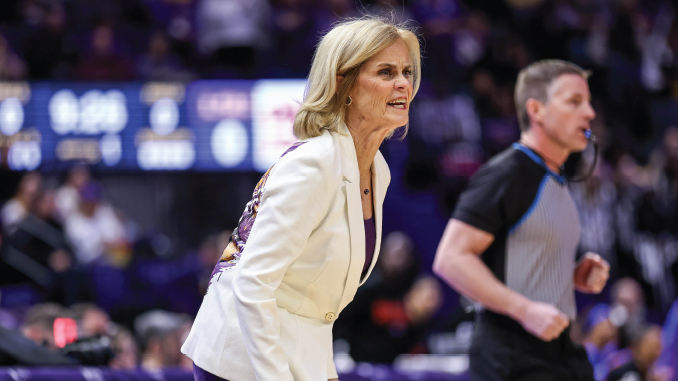
LSU’s annual women’s basketball deficit—roughly $8 million—has drawn scrutiny ever since head coach Kim Mulkey inked a $3.35 million salary following the Tigers’ 2023 national championship. But athletic director Verge Ausberry insists that, in the world of high‑major women’s hoops, Mulkey’s price tag is not a loss but an investment in brand equity and revenue upside that rivals private‑sector ROI. “Every top women’s basketball program across the nation is in the same boat—South Carolina, UConn, Tennessee,” Ausberry told Tiger Rag. “They’re all paying up, and they’re all seeing value that far exceeds the dollar figure on the ledger.”
That value, he argues, is rooted in LSU’s broader institutional priorities. Title IX and competitive ambition have made women’s sports a central pillar of the athletic department’s business model. Without Mulkey’s recruiting clout and national profile, Ausberry calculates, LSU would face an $11 million hole annually instead of $8 million. “Ticket sales drop off a cliff if she’s not here,” he says. “Corporate partners lose visibility. Broadcast interest wanes. That brand cachet is priceless, and you can’t buy it on the open market.”
The same logic applies to LSU’s baseball franchise, which operates near breakeven despite Jay Johnson earning the highest coaching salary in the SEC—well north of $2 million annually. “Most Division I baseball programs bleed $5 million to $6 million a year,” Ausberry notes. “Jay’s number pushes us close to a red zero, but his championships and postseason runs drive ticket sales, sponsor activations, and national TV revenue that more than offset the payroll line.” In other words, LSU’s on‑field success mitigates what otherwise would be a multimillion‑dollar drain.
Layer in Lane Kiffin’s $13‑million‑plus football contract, and LSU’s coaching payroll looks daunting on paper. But Ausberry argues the triumvirate of Mulkey, Johnson, and Kiffin has forged one of the most powerful brands in college sports. At sponsor roundtables in New York and Atlanta this spring, he says, corporate executives were clamoring for inventory. “We’ve got the top‑three brand in college athletics right now,” he asserts. “Firms that distribute seven‑figure gifts elsewhere are coming to us, saying, ‘We want a piece of LSU.’ That demand translates into premium ticket packages, enhanced donor levels, and higher media rights fees.”
That demand is already showing up in the numbers. LSU’s football ticket sales for 2023 topped 32,000 new requests—double the previous year’s pace. Corporate sponsorships are running 25 percent above budget, and donor contributions are “through the roof,” according to Ausberry. Even so, he insists the department must budget as if it will end the fiscal year in the red and build contingencies accordingly. “The reality is, we’re going to operate at a deficit,” he admits. “But we can’t let costs spiral out of control. We have to be disciplined about head count, salary structures, and the purpose behind each hire. If we can promote internally, leverage existing talent, and stretch budgets by doing more with one fewer FTE, that’s what we’ll do.”
That mindset reflects a broader shift across collegiate athletics: financial stewardship married to competitive ambition. While Mulkey’s salary pushes LSU’s women’s basketball program into the red, her recruiting prowess and national championships have already generated millions in incremental value—measured in seats filled, sponsorship deals renewed, and television ratings that buoy network affiliate fees. In Auburn, Fayetteville, and Knoxville, other athletic directors are making the same calculus: big salaries, bigger returns.
By the numbers, LSU’s sports portfolio may not show a profit line for several seasons. Yet the athletic department—armed with a triple‑crown coaching lineup and emboldened by Title IX imperatives—believes the red ink is an investment in long‑term brand dominance. “We’ll tighten belts elsewhere,” Ausberry says. “But we’ll pay what it takes to keep Kim Mulkey, Jay Johnson, and Lane Kiffin under one Tiger flag. Because if you’re serious about championship culture and national visibility, that’s where the real return on investment lies.”
In the modern arms race of college athletics, LSU has chosen to invest where the returns are exponential: star power, national visibility, and competitive permanence. The department will trim costs around the edges, but it won’t bargain‑hunt on the leaders who drive its brand. That’s not recklessness — it’s disciplined ambition. And in this industry, disciplined ambition wins.



Be the first to comment