
By KACE KIESCHNICK, Tiger Rag Staff Reporter
LSU led McNeese State 35-0 at halftime. The Tigers had outgained the Cowboys 347 yards to 31 yards and converted 20 first downs to their two.
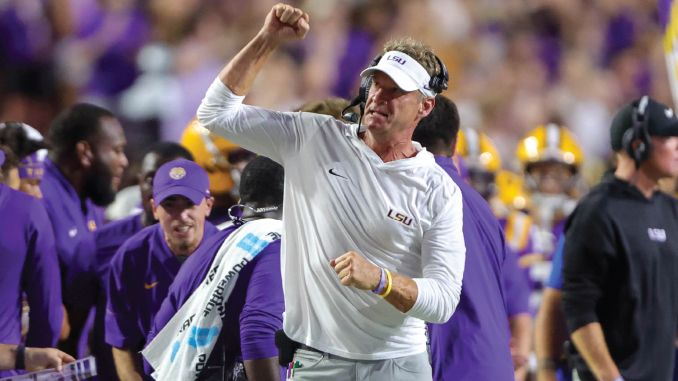
But after the opening kickoff of the second half, Lane Kiffin called a timeout, gathered his team at the 30-yard line and delivered a speech so passionate you could see his neck straining from the press box.
The message: We are not running the clock in the second half.
“Not as long as I’m the f——- head coach,” Kiffin said. “We don’t let you out.”
It was a Nick Saban-esque display of fierce leadership and a dedication to a standard that persists for four quarters, no matter the opponent. But at what point does the allegiance to that mission become reckless?
Does the chance to evaluate reserves outweigh the risk of enduring even more injuries on a roster that has already suffered major losses?
“I think we didn’t have any major injuries for the first game, so that was really big,” Kiffin opened his press conference after the game. “We obviously pulled people really early with concern of our depth.”
The early-season injuries LSU has faced were again the first thing Kiffin mentioned after a 63-14, record-setting win.
Not the Tigers’ 63 points.
Not their 731 yards of offense, 101 plays or 39 first downs.
Not even the performances of the backups who benefited from the extra reps.
Because, at the end of the day, Kiffin knew that, beyond just its record, the biggest win LSU could have come away with against McNeese was not a statistical milestone or a better understanding of the depth of its roster.
It was health.
And, sure, that is why the starters only played in the first half. The Tigers made it out unscathed, and by piling on in the second half, they were not risking injuries to any more stars like Trey’Dez Green, Whit Weeks or Dashawn Spears.
But the same coach that pledged to never let a team out the door – even if it meant adding unnecessary risk to the health of his second or third units – preached the significance of how injuries affect the whole roster, including the reserves, just five days prior.
“Everyone knows the one for one, which person starts in place of these guys like Whit, but it’s much more than that,” Kiffin said in his press conference leading up to the game. “Some of those guys maybe were starting on multiple special teams. Now, they may come off of that, so now the backup special teams guys got to step up to play that. Then some guy on service has to step up to be the backup special teams player. So, it’s a lot of people needing to do their job when these significant injuries happen.”
He emphasized the concerns he had of his overall depth.
“These injuries are more significant than they used to be because you don’t have the great players at the bottom of your roster that you used to be able to have,” Kiffin said.
That concern culminated in a more apprehensive version of Kiffin that struggled to move on from spontaneous, season-ending injuries that wide receiver Phillip Wright III and linebacker Charles Ross II suffered on kickoff coverage.
“That just freaked me out,” he said. “We’ll be extremely cautious this week all around.”
So why risk straining that already shallow depth any further?
Maybe an injury to a backup linebacker does not usually affect a team enough to sacrifice a coach’s sacred standard and relentless pursuit of perfection, but what if that injury came to a roster that has already lost its No. 1 and No. 4 linebackers?
What if a coach that spent an offseason criticizing the depth of his offensive line was forced to promote a third-string offensive tackle with seven Southeastern Conference games remaining, or if a defensive back room already stretched near its limit lost its next man up?
The “extreme caution” Kiffin testified to on Monday was all-but forgotten on Saturday.
Quarterback Sam Leavitt still played almost the entire first half despite dealing with a hamstring injury. Kiffin said he was limited in his mobility, and he commended offensive coordinator Charlie Weis Jr.’s effort to scheme up protections they felt comfortable with, considering the injury. Right tackle Weston Davis, right guard Aliou Bah and safety Jhase Thomas were the only Tigers to play more than half of the team’s total snaps.
But the only thing better than limiting risk is eliminating it altogether.
Still, Kiffin said he does not believe in resting starters.
“I just don’t think you do that, and you got to take every game serious,” he said postgame.
And he obviously sees no merit in playing the second half with a running clock during a blowout of an FCS team, which he could’ve done Saturday. In his five games against FCS competition at Ole Miss, his teams won by a combined 311-27.
Kiffin is certainly right for his reverence to the sanctity of his team’s weekly process and his dedication to instilling a killer instinct in his players, no matter their position on the depth chart. It is that commitment to excellence that makes him one of the best coaches in college football. But nuance is required when identifying the biggest needs of a team in the moment.
The extra roster evaluation Kiffin’s staff got from running up the score in the second half could be critical down the stretch if depth is tested, but even more essential to the team’s success is doing everything within your power to ensure that test is never faced.
Injuries happen. Every team deals with them, and Kiffin has not and will not use them as a crutch or an excuse if LSU comes up short of its goals later in the season.
Those are out of his control.
This was a direct decision he made to prioritize 73 second half snaps, 384 yards and 28 points in the name of an aggressive mentality over drastically reducing the risk of additional injuries by shortening the game. And if the rationale is that it was that necessary to give reserves those extra reps, then why not pull the starters sooner?
Caution does not equal cowardice.
That killer mentality is not compromised by making wise, conservative decisions when they are required.
It worked out positively this time. The team responded well, backups got extra reps, Kiffin got to reinforce a message critical to his coaching style and no Tigers got hurt. Several Cowboys did. LSU was lucky. That may not always be the case.
I am all for demanding the most out of your players and refusing to let your standard drop just because the backups are in or the game is out of hand, but entering the final seven conference games of the season, LSU faces no greater challenge than the one posed by injuries.
Kiffin said it himself after beating Texas A&M.
“Those things are going to catch up to you. I don’t care what plays you draw up.”
Be the first to comment