
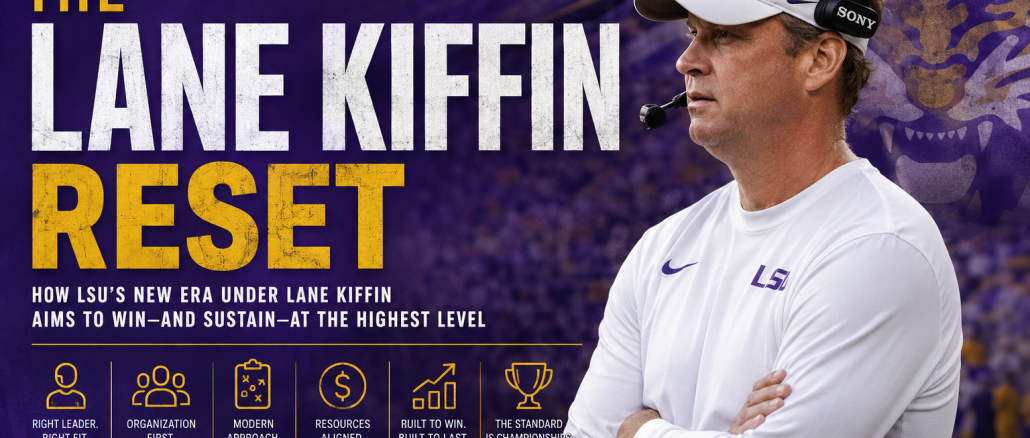
The Lane Kiffin Reset
LSU’s transformation extends far beyond the headset worn on Saturday afternoons.
Photo: LSU Athletics
For more than a century, Tiger Stadium has been savage and sublime, a cauldron of noise and expectation that feels less like a building than a living, breathing organism.
Ask the locals and they’ll tell you it doesn’t merely sit there stoic and timeless; it remembers.
It remembers the roar of Billy Cannon turning on Ole Miss, the poetry of Bert Jones carving defenses apart, the fearless swirl of Tommy Casanova in flight, Kevin Faulk refusing to let a game slip away, and Joe Burrow conducting one of the greatest seasons college football has ever seen. It remembers moonlit triumphs and silent, empty mornings after unexpected defeat. But it does not remember excuses.
Tiger Stadium remembers triumphs and defeats. It does not remember excuses.
That lesson is etched into the limestone columns and concrete ramps that saw their first leather-helmeted fans in 1924. Over the last hundred years, the game has evolved—plastic helmets, unlimited substitution, television blasting regional rivalries into national spectacle, scholarship caps, integration, the BCS and the College Football Playoff, the blurring of conference lines, the birth of the transfer portal and NIL. Yet no era in the modern game has rewritten its own rules as radically—or as rapidly—as the four years between Brian Kelly’s arrival in December 2021 and his departure on October 25, 2025.
When Kelly walked into LSU’s football operations building, the landscape he inherited barely resembled the one Nick Saban confronted 25 years earlier. Before dawn, recruiting calls from agents and prospects in the portal; by lunch, personnel meetings that sounded more like balance-sheet reviews: What’s the market value of a veteran left tackle? Can you afford to keep both starting cornerbacks? Is the next million better spent on a quarterback, two defensive linemen, or retaining a sophomore receiver? Decisions once reserved for NFL general managers now consumed Wednesday mornings on Skip Bertman Drive.
Kelly’s final ledger was solid if unspectacular. But Scott Woodward, LSU’s then athletic director, wasn’t evaluating play-calling proficiency when he met with Kelly on that fateful (and dreadful) night when Texas A&M embarrassed the Tigers in a second half dismantling. He was diagnosing organizational structure: Was LSU equipped to dominate the version of college football that exists today? That question matters far more than any Saturday result because the sport’s transformation has been systemic. The transfer portal is infrastructure, not anomaly; revenue sharing is budget, not headline; roster construction mirrors asset management; NIL collectives function like strategic operations. The head coach remains the face of the program—and also its chief executive, generating tens of millions of dollars, employing hundreds, making roster decisions year-round.
Kelly’s dismissal on October 25—and Woodward’s departure four days later—didn’t fit the tidy, linear narrative most coaching changes follow. The man who decided Kelly would not coach another game never hired his successor. That responsibility shifted almost immediately to Verge Ausberry. And though the title athletic director confers authority, it would miss the story to focus on hierarchy rather than on the man. Ausberry had walked through those hallways for decades. Administrators and boosters and coaches might come and go, but the university endures. Its flagship program needed a leader who understood LSU’s truth: Football is built around LSU, not the other way around.
Ausberry understood that the search could not become a referendum on Brian Kelly. Too many athletic departments hire not on vision but reaction: If one coach was reserved, hire someone brash; if one preferred structure, chase the maverick. LSU’s challenge was different. The question wasn’t Who is the opposite of Brian Kelly? It was Who can lead LSU through the version of college football that exists today? That perspective narrowed the field faster than most realized.
Recruiting prowess, quarterback development, locker-room command and SEC composure remained non-negotiable. But so did six newer imperatives:
Six imperatives for modern LSU football
- Overseeing a roster that effectively reopens twice a year.
- Operating in an environment where personnel moves resemble investment decisions.
- Building an organization that thrives even when the head coach is off campus.
- Embracing a general manager as a competitive advantage.
- Aligning coordinators, analysts, recruiting, player development, sports science, nutrition, NIL strategy and roster management.
- Preserving institutional standards over individual ego.
When you view Lane Kiffin’s résumé through that lens, it stops reading like a series of one-year pit stops. Instead, it unfolds as an education in football leadership:
The education of Lane Kiffin
Oakland
At age 31, Kiffin became the youngest head coach in the modern NFL. He inherited a roomful of seasoned professionals who owed him little respect based on age or résumé. Authority had to be earned daily. The experiment ended painfully, but no success could have taught him what failure did.
Tennessee
A crucible of relationships—high school coaches, former players, boosters, administrators, a rabid fan base. The role of a college coach became clear: manager of people, politics and perceptions.
USC
Tradition without direction is a prison. USC had talent and resources; what it lacked was alignment. Dozens of small disconnects snowballed. Kiffin learned that unchecked history can be a burden.
Alabama
As Nick Saban’s offensive coordinator, Kiffin watched an organizational juggernaut operate Monday through Friday. He saw recruiting tied to roster planning, analysts integral to game prep, accountability baked into systems. The Crimson Tide’s Saturday domination was the byproduct of daily discipline.
Florida Atlantic
A true test of ownership. No inherited infrastructure, no Saban to shield the pressure. Every standard came from Kiffin’s hires, his expectations, his willingness to reinforce or tolerate discipline. FAU bore his fingerprints from foundation to roofline.
Ole Miss
An incubator for modern roster construction. The portal and NIL had become reality. Resources demanded precision; staff hires had to matter; development wasn’t optional. Rebels learned to find value before anyone else, to retain wisely, to spend when necessary and wait when prudent.
Seen cumulatively, Kiffin’s stops taught authority (Oakland), institutions (Tennessee), humility (USC), systems (Alabama), ownership (FAU) and efficiency (Ole Miss). When LSU’s reset committee evaluated candidates, they didn’t ignore his play-calling genius—they realized it was table stakes. They were looking for an architect of organizations.
Within days of accepting the Baton Rouge challenge, Kiffin’s blueprint became visible not in an offensive install but in structural moves. Billy Glasscock’s title expanded to general manager. In elite football circles, GM roles have become indispensable: high school recruiting, portal evaluation, roster retention, NIL budgets and long-term scholarship planning all intersect in one ecosystem. Glasscock doesn’t simply scout players; he evaluates the interconnected tapestry that forms LSU’s roster today and six months from now.
Then came the decision to convince and keep Blake Baker as defensive coordinator. A conventional reset would have seen every assistant replaced, new names on every door. But Baker was already one of the nation’s premier DCs. Retaining him wasn’t convenience—it was confidence. LSU didn’t need Baker to morph into Kiffin’s man; it needed Baker to remain LSU’s man.
Because the Lane Kiffin Reset isn’t about replacing every piece. It’s about making sure every piece fits the same, larger picture. Activity without purpose is noise. True progress happens on Tuesday mornings in personnel meetings, in hard conversations with players weighing the portal, when assistants leave the room aligned despite disagreements, when a GM tells a head coach a talented player simply doesn’t fit the long-term plan—and the coach listens.
Those moments don’t trend on social media, but championships often begin there. Kiffin isn’t the reset; he is its most visible expression. The reset is organizational: LSU deciding that the next decade demands a different kind of football operation. Whether it pays off in wins or losses is a story for the scoreboard; the decision itself was made long before the first kickoff of the 2026 season.
Kiffin didn’t inherit a roster ready for championships; he constructed one capable of becoming one. LSU has rarely struggled for talent; its challenge has always been molding gifted individuals into teams that can survive four SEC months without one bad Saturday becoming two. That requires leadership, depth, quarterback play, health—and a hundred variables no coach fully controls. Organizational sophistication can’t erase those realities; the best structures simply make good decisions more likely.
So when more than 100,000 people walk toward Tiger Stadium this fall—grandparents parking in lots their parents used, children experiencing the pilgrimage for the first time—few will ponder portal valuation models or retention strategies over jambalaya. Their privilege as fans is to believe. Inside the building, the work is infinitely more complex: protect the standard, adapt without losing identity, honor the past without being captive to it, prepare for a future that won’t stand still.
That is LSU’s assignment. Not to win an introductory press conference or an offseason splash, but to build something capable of enduring. Tiger Stadium has seen too much to expect guarantees. It has watched legends rise and stumbles that no one predicted. It teaches that predictions are among sports’ least valuable currencies. What endures are standards—facilities, budgets and recruiting rankings mean little without them.
Each generation inherits those standards and interprets them anew. Every era asks the same question: Can you carry this place forward? Bernie Moore, Paul Dietzel, Charles McClendon, Nick Saban, Les Miles, Ed Orgeron and Brian Kelly all faced it. Now it belongs to Lane Kiffin. His answer will not be found in headlines or highlight reels or even in his first season. It will be measured years from now by whether LSU’s program remains stronger than he found it.
That is the story of The Lane Kiffin Reset.

Be the first to comment