
By TIGER RAG NEWS SERVICES
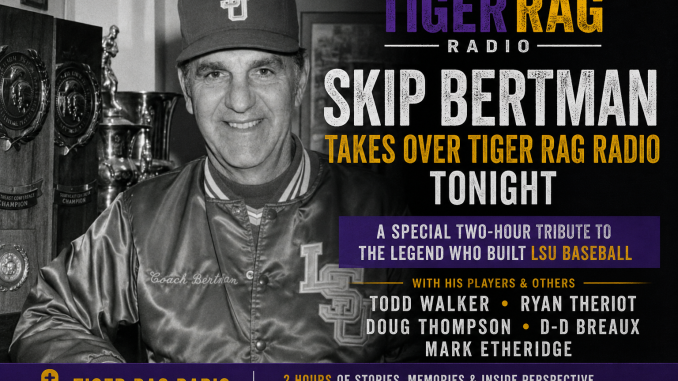
There are plenty of ways to explain what Skip Bertman accomplished at LSU.
Five national championships. Eleven trips to the College World Series. Eight hundred seventy victories. A baseball program transformed from an afterthought into one of the signature programs in college sports. Then came seven years as LSU’s athletic director and another transformation that reached far beyond baseball.
But on Tuesday night, Tiger Rag Radio found a better way to explain Bertman.
Let the people who knew him tell stories.
The special two-hour tribute to Bertman, who died Friday at age 88, brought together former LSU stars Ryan Theriot, Doug Thompson and Todd Walker, legendary LSU gymnastics coach D-D Breaux and D1Baseball’s Mark Etheridge.
The result was less a conventional sports-talk show than an oral history of one of the most consequential figures LSU Athletics has ever had.
LISTEN TO THE COMPLETE TIGER RAG RADIO SKIP BERTMAN TRIBUTE BELOW.
Glenn Guilbeau Opens The Bertman Story
Tiger Rag Radio host Jeff Palermo was joined in studio by Tiger Rag editor Glenn Guilbeau, author of Everything Matters in Baseball: The Skip Bertman Story.
Tiger Rag Executive Editor and regular co-host Todd Horne made the decision to sit out the program because of the unusually deep guest lineup and Guilbeau’s unique history with Bertman.
That history became important immediately.
Guilbeau recalled spending hours with Bertman at his kitchen table over several years while working on the biography and described a coach with an extraordinary memory and an almost uncanny ability to anticipate what would happen in baseball games.
The conversation also moved beyond baseball to Bertman’s years as LSU athletic director, including his role in establishing the Tradition Fund and helping modernize the financial foundation of LSU Athletics.
Then the players began talking.
Ryan Theriot: Bertman Was Teaching More Than Baseball
Theriot, a member of LSU’s 2000 national championship team, grew up in Baton Rouge watching Bertman’s program before eventually playing for him.
What stayed with him was not simply Bertman’s baseball instruction.
Theriot talked about trust, love for teammates, visualization and the extraordinarily high standard Bertman demanded from his players. The lessons that helped LSU win baseball games, Theriot said, eventually became principles that translated into everyday life.
He also remembered the other side of Bertman’s demanding personality.
After Theriot committed four errors in a game as a freshman, Bertman let him know exactly how poorly he had played. But Bertman put him right back into the lineup. After Theriot responded with a strong game, his coach gave him the game ball, put an arm around him and told him he loved him in front of the team.
That combination — demand more, then make sure the player understood why — surfaced throughout the night.
Doug Thompson Tells The Story That Explains Skip Bertman
Then came one of the strongest stories of the show.
Thompson took listeners back to LSU’s 1997 series at Alabama.
LSU needed one victory in the three-game series to win the SEC championship outright. Thompson started the second game and struggled. Bertman removed him early and told him something that sounded almost absurd in the moment.
The game was going to get bad, Bertman told him. But Thompson needed to trust him because Bertman planned to bring him back the next day to help LSU win the SEC.
It got very bad.
Alabama won 28-2.
Thompson assumed Bertman’s promise had simply been an attempt to keep his pitcher from dwelling on a terrible outing.
It wasn’t.
The next day, Thompson was sitting in tennis shoes when Bertman ordered him to get his spikes on and get ready. Thompson came out of the bullpen and carried LSU deep into the game without allowing a hit.
When Thompson finally surrendered one with two outs in the ninth, Bertman walked to the mound.
He had told Thompson before entering that one hit would end his outing.
Bertman kept his word.
LSU finished the victory and won the SEC championship.
It was vintage Bertman: psychology, preparation, trust, accountability and an uncanny conviction about what his players could do before they necessarily believed it themselves.
Thompson And Todd Walker Turn The Show Into A Conversation
Thompson stayed for the beginning of the second hour when Walker joined the show, and the interview quickly became something better than an interview.
The two former LSU stars began talking to each other.
Walker, whose father also recently died, spoke about how loss suddenly changes a person’s relationship with memories that once seemed permanent. His three seasons at LSU still feel recent to him, he said, even though decades have passed.
Bertman had become a father figure.
Then the stories started flying.
Thompson recalled Bertman’s unusually direct recruiting pitch. Another coach had essentially told Thompson he could be the missing piece needed to reach Omaha. Bertman’s message was different: LSU was going to Omaha with him or without him.
Thompson loved it.
Walker remembered arriving at LSU with other scholarship opportunities and considerably more money available elsewhere. At LSU, he entered a program that had just won the national championship and found himself buried on the depth chart.
Bertman initially intimidated him.
Walker described the coach as almost Caesar-like to an incoming freshman. Three years later, the intimidating figure had become a father figure and one of the most important people in his life.
That evolution said as much about Bertman as another championship statistic ever could.
D-D Breaux Explains What Bertman Changed Beyond Baseball
Breaux provided another essential piece of the story.
When Bertman became LSU athletic director in 2001, he inherited more than the football and baseball programs. He inherited coaches in sports that had spent years fighting for resources.
Breaux remembered those fights.
Then Bertman changed the conversation.
Instead of making her fight him for what gymnastics needed, Breaux recalled Bertman essentially telling her to explain what she needed and they would figure out a way to get it.
Equipment mattered. Resources mattered. Expectations mattered.
And Bertman’s influence extended across LSU’s Olympic and women’s sports.
Breaux described an administrator who brought the same standard of excellence he had demanded from himself in baseball into the entire athletic department.
It was another version of the same Bertman the players had been describing all evening.
Mark Etheridge Remembers The Coach Calling A Young Reporter
Etheridge supplied the perspective from outside LSU.
Before becoming one of college baseball’s leading national voices, he was a young journalist trying to establish a baseball publication in the late 1990s.
He needed to cover LSU.
So he tried to arrange an interview with Bertman.
Bertman did not know him. Etheridge was simply a young writer trying to get started.
Then his phone rang.
Skip Bertman was on the other end.
The story fit perfectly with everything that had come before it. Bertman could be one of the most powerful people in college baseball and still make time for someone who had very little stature at the time.
Players remembered that quality.
Coaches remembered it.
So did reporters.
Doug Thompson Wants LSU Fans To Show Up One More Time
Some of the most emotional moments came when Thompson discussed Bertman’s final years.
He described Bertman as one of the most important men in his life, alongside his own father, and talked about how difficult it had been to receive calls from former teammates after Bertman’s death because he knew how deeply they were hurting, too.
What Bertman valued most late in life, Thompson said, was not the 870 victories or five national championships.
It was the relationships.
His players were still around.
They still called.
They still went to lunch with him.
They were still his boys.
Thompson then turned toward Bertman’s celebration of life, scheduled for Tuesday, Aug. 25, at the Pete Maravich Assembly Center.
LSU fans have always shown up, Thompson said. They show up in Omaha. They show up for road games. They show up when LSU matters.
He wants them to show up for Bertman.
One more time.
The Stories Became The Tribute
Tiger Rag Radio eventually touched briefly on LSU football before Palermo and Guilbeau closed a night that also included a remembrance of longtime broadcaster and former Tiger Rag Radio guest Joe Dean Jr.
But the two hours belonged overwhelmingly to Bertman.
And perhaps the most telling thing about the show was how rarely the conversation stayed with trophies.
Theriot remembered what Bertman taught him.
Thompson remembered what Bertman believed about him.
Walker remembered how intimidation became love.
Breaux remembered an athletic director who listened and supplied what her program needed.
Etheridge remembered the powerful coach who returned a young reporter’s phone call.
Different people. Different relationships. Different decades.
The same Skip Bertman kept appearing.
The championships explain why Bertman became famous.
The stories explain why, so many years later, the people who knew him still call him Coach.
Listen to the complete Tiger Rag Radio tribute to Skip Bertman in the player above.
Be the first to comment