
By GLENN GUILBEAU, Tiger Rag Editor
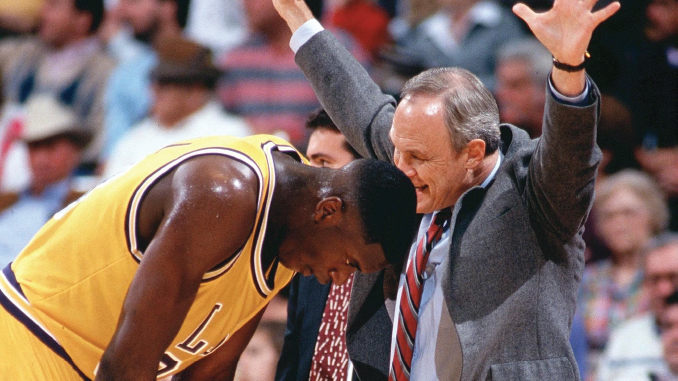
It was fitting that Shaquille O’Neal presented Dale Brown with the last of his voluminous coaching awards last Tuesday via video.
One of Brown’s favorite players during his 25 years as LSU’s coach from 1972-97 was Shaq, if not his most favorite.
Brown, who was LSU’s basketball coach from 1972-97 and took the Tigers to 13 NCAA Tournaments, two Final Fours, two Elite Eights and four SEC regular season championships, died on Friday at the age of 90. Just three days before that, O’Neal sent Brown him a video message to his home in Baton Rouge, where Brown had been ill for months.
“My coach, my mentor, coach Dale Brown,” O’Neal said to open the video message. “I can remember the first time I met Dale Brown. It was at a gym in the mountains of Germany.”
Brown was doing what he usually did during the off-season – traveling the world. And he noticed a very tall youngster. Brown went up and introduced himself as the LSU basketball coach.
This was 1985, and O’Neal already was 6-foot-6 and 220 pounds, but to Brown’s surprise, he was not a college or high school athlete.
“I told him I was only 13 years old,” O’Neal said.
And the next thing Brown said was, “Take me to your father.”
O’Neal’s stepfather was Phillip Arthur Harrison, a sergeant in the U.S. Army who lived throughout the world with Shaq and his mother, Lucille O’Neal.
Like Brown, O’Neal was abandoned as a young child by his natural father. That commonality would help lead to a lifelong friendship. But first, Brown the recruiter came to life.
“After I told him I was only 13, the way he hugged and grabbed me, it was like he found the biggest piece of gold nugget in a mountain you could find,” O’Neal said.
Brown met Sergeant Harrison and continued talking to him and O’Neal. Before they parted, O’Neal told Brown he wanted to strengthen his lower body, and if there was anything he could do. Brown soon mailed him a strength and conditioning exercise and weight program.
“I wasn’t very good in basketball at the time,” O’Neal said. “After I did all the workouts, I still didn’t make the team. And I sent coach Brown a tearful letter. Then coach Brown responded by sending me a scholarship to LSU. ‘You come and sit next to me. You can be whatever you want to be. I just want you to go to college.'”
Harrison later moved his family to San Antonio, where O’Neal grew and developed into one of the top players in America at Cole High School. He signed with LSU before the 1989-90 season and became one of the greatest college players of all time. O’Neal led Brown to his fourth SEC regular season title in 1991 and was named the Associated Press and UPI Player of the Year. He led the Tigers to three straight NCAA Tournaments and was a first team All-American in 1991 and ’92 and the SEC Player of the Year and SEC Male Athlete of the Year in 1991 and ’92. After becoming the first player picked in the NBA Draft in 1992, he later helped take the Los Angeles Lakers to three NBA titles and won another with the Miami Heat.
“I decided to follow that man and go to LSU,” O’Neal said. “And he made me one of the best basketball players ever. Daddy Dale, we call you Daddy for a reason. I love you and congratulate you. I am so proud of you, coach. Well deserved.”
Brown’s first great player at LSU was Durand “Rudy” Macklin of Shawnee High in Louisville. Brown outrecruited Louisville coach Denny Crum to get Macklin to sign before the 1976-77 season. Macklin was the key to Brown turning around the program from mediocre under Brown in the early years to a national contender. He was one of only four three-time first team All-SEC players with O’Neal, Pete Maravich and Bob Pettit. Macklin was the 1980-81 SEC Player of the Year and an All-American as he led the Tigers to their first Final Four since Pettit in the 1952-53 season.
“Coach Brown always stuck by us,” Macklin told Tiger Rag. “Was he a Denny Crum or a Bobby Knight? No. He had his own way of doing things. And he turned LSU basketball around. When we started rolling, you couldn’t get a ticket.”
And Brown could get people to believe, which is how he got Macklin away from Crum and Louisville. But first he had to get Macklin out of his house in Louisville when Brown went there on a recruiting visit, because Crum was coming to see him.
“As soon as I told him coach Crum was coming, he said, ‘Let’s go for a ride,'” Macklin remembered. “And did we go for a ride? He drove me all over Louisville. By the time we got back, coach Crum had left. And I was going to LSU. Coach Brown said, ‘If you go to Louisville, you’ll probably win a national championship. But they’ll win one without you, too. If you come to LSU, you’ll build something. You’ll be known for building something.'”
In addition to Brown signing Macklin (1976-81 at LSU), he got a slew of other top recruits from far and wide, such as center Greg Cook (1976-81) from Newark, New Jersey, forward DeWayne Scales (1977-80) from Dallas, guard Jordy Hultberg (1976-80) from De La Salle in New Orleans, sixth man sensation guard Willie Sims (1977-81) from Long Island, New York, point guard Ethan Martin (1977-81) from McKinley High in Baton Rouge, guard Howard Carter (1979-83) from Redemptorist in Baton Rouge, guard Johnny Jones (1980-84) from DeRidder and forward Leonard Mitchell (1980-84) from St. Martinville.
And Brown was on his way.
From the 1978-79 season through the 1980-81 season, LSU had its greatest three-year run in history. In 1978-79, LSU was 23-6 and 14-4 (Sweet 16, SEC regular season champions). In 1979-80, LSU was 26-6 and 14-4 (Elite Eight, SEC regular season runner-up, SEC Tournament champions). And in 1980-81, the Tigers were 31-5 and 17-1 (Final Four, SEC regular season champions).
“Coach Brown made history,” Macklin said. “People thought he was this crazy guy from Minot, North Dakota, but he put LSU on the map for basketball again.”
Hultberg coached under Brown from 1980-83 after his playing career before becoming a radio and television announcer and is now the color analyst for basketball on the LSU Radio Network.
“Coach Brown was one of one,” Hultberg told Tiger Rag on Friday. “My coach, my boss, and most importantly, my friend. Best decision I ever made was to come play for him at LSU. Memories that I have will last forever.”
Danny Broussard, the basketball coach at St. Thomas More High in Lafayette, brought up Brown during his acceptance speech the Louisiana Association of Basketball Coaches (LABC) Hall of Fame banquet last May.
“Dale Brown made basketball big in this state,” Broussard said. “Before Dale, we were only known for football. Dale made basketball a happening. People wanted to go see basketball on the college and high school level.”
But it wasn’t just basketball. In the 1970s, Brown became the first LSU basketball coach to start five Black players. He also hired the first Black assistant coach in any sport at LSU in Ron Abernathy in 1976. And Brown railed against the NCAA for decades for players to be treated better and compensated better. And he lived to see that with Name, Image & Likeness payments for players beginning in 2021.
“There has never been, nor will there ever be, another coach like Dale Brown,” former LSU basketball coach John Brady told Tiger Rag Friday. Brady replaced Brown when he retired following the 1996-97 season.
“No one fought for change, created change, impacted people, changed lives and left a legacy of giving more than coach Brown,” Brady said. “And he made basketball at LSU a consistent player on the national stage. Every basketball coach since Dale Brown at LSU will be forever compared to the standard he created. LSU has lost a huge part of its athletic legacy with his passing.”
Brady and Brown became close over the last several years.
“He and I became good friends, for which I will always be grateful,” Brady said. “Prayers are offered up for Coach, his wonderful family and also the untold many he touched in his 90 years. Rest in peace, Coach Brown. You will be missed.”


Be the first to comment