
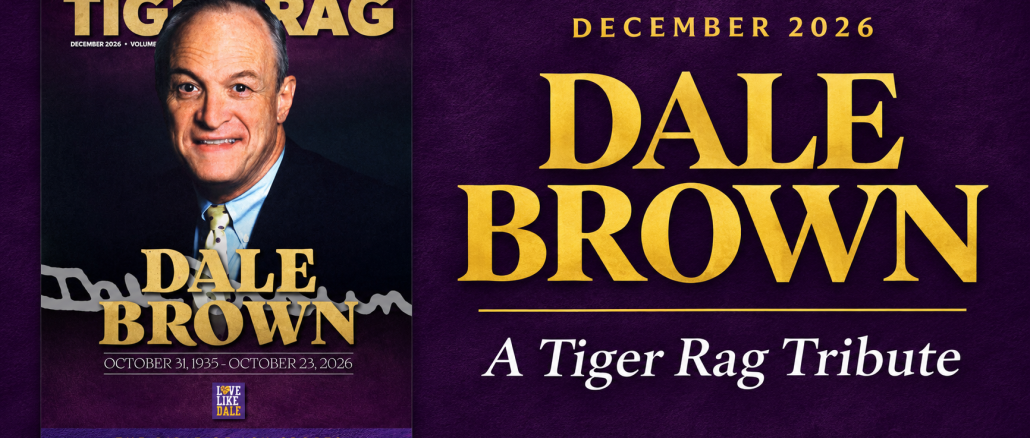
October 31, 1935 – October 23, 2026
Dale Brown’s life reached far beyond the basketball court. Tiger Rag’s December 2026 commemorative issue brings together the voices of his daughter, his players and the writers who knew him.
Read the complete tribute below, from Howard Carter’s story of the coach who kept calling to Robyn Brown Prudhomme’s invitation to carry her father’s example forward.
Dale Brown’s Enthusiasm And Effervescence Was Contagious
The first time I ever heard Dale Brown speak was on Saturday, Jan. 3, 1976.
It was before the LSU basketball team played at Auburn on regional television to open Southeastern Conference play. The Tigers were 7-1 in Brown’s fourth season.
He had not been doing well, having had a 10-16 season (6-12 SEC) the previous season and 12-14 and 6-12 in 1973-74 after his good first season in 1972-73 at 14-10 and 9-9.
Brown was being interviewed just before tip-off, and he was so positive and upbeat you would have thought his unranked team was No. 1 in the nation.
I was a freshman wrestler at Rummel High in Metairie at the time and was watching with my dad before a meet. My dad, Baker J. Guilbeau, and mom, Carmen LeBleu Guilbeau played prep basketball at Sunset High (near Opelousas) and Fenton High (near Lake Charles).
We had a goal on the roof overlooking the driveway. We did not have a purple-and-gold basketball net, so I guess Coach Brown or his assistants never made it to this part of Metairie. We watched Pistol Pete Maravich play on Saturdays like this quite a few times in his senior season at LSU in 1969-70.
Just being interviewed before the game, Brown got me so fired up and ready for my wrestling match … that I went out and got pinned.
But the point is, this guy’s energy and enthusiasm was just so contagious. He just couldn’t win.
But by the time I was a junior at Rummel in 1977-78 and had retired from wrestling at 1-9, Brown was somehow still the coach.
He nearly got fired after that 1975-76 season when he finished 12-14 and 5-13.
In researching this Dale Brown commemorative issue in your hands, I learned that Brown had actually asked then athletic director Carl Maddox if he was going to get fired after that 1975-76 season.
Maddox, who had hired him, said he was sticking with him … for now.
Brown knew he had to get better players fast. And he was recruiting one of the nation’s best forwards in Rudy Macklin of Shawnee High in Louisville. But so was Louisville coach Denny Crum, who had taken Louisville to the Final Four in 1972 and 1975.
I found out during the moving Celebration of Life ceremony at the Pete Maravich Assembly Center on Nov. 11 during Macklin’s eulogy that Macklin was watching that same LSU-Auburn game on Jan. 3, 1976, with his dad when he was a senior at Shawnee.
Macklin was considering LSU at the time as Brown had been recruiting him heavily. Brown’s pitch was he could go to any big time program like Louisville, but those would win whether he went or not.
“If you come to LSU, you’ll build something,” Brown said.
“Auburn won big,” Macklin said of LSU’s 102-86 victory that Saturday during the eulogy. “And I’m thinking, ‘This LSU team would be bad with God at center.’”
Well, just moments after that game, Brown found a pay phone in Auburn’s Memorial Coliseum and called Macklin.
“Now, you see why we need you,” he said.
Macklin signed with LSU for the 1976-77 season, and other elite players followed through the late 1970s, 1980s and early 1990s.
And Brown didn’t get fired.
He had his first winning season since his first year in 1976-77 with Macklin at 15-12 (8-10 SEC). They were better in 1977-78 at 18-9 and 12-6.
And by the time I was a high school senior in 1978-79, LSU was rolling to a 23-6 record and won the SEC for the first time since 1954 at 14-4. The Tigers also played in the NCAA Tournament for the first time since 1954.
And the strangest thing happened. My dad was great friends with a neighbor named Warren Doussan, and I with his son, Warren Jr. They were the most rabid LSU fans we had ever seen. We went to watch LSU football games at their house often.
But in 1978 and ‘79, for the first time, they were talking about LSU Basketball as much as football.
That was because of Dale Brown.
Tigers Close Out Dale Brown’s Reign At PMAC With Win
Reprinted from the March 3, 1997, issue of Tiger Rag Magazine.
He went out the way he’d lived for the last generation, railing against what he perceived as injustice, championing the oppressed, his stricken countenance brightening each time the calls went his way.
But with 51.1 seconds remaining in the game, holding a 66-62 lead against Arkansas, LSU coach Dale Brown stood next to senior forward Duane Spencer, who had just fouled out, with a look of tranquil resolve spreading across Brown’s face.
“We’re not losing this game,” Brown said, speaking the words into Spencer’s left ear.
He probably had said them before, hundreds of times, as he cajoled groups of overachievers to improbable victories, countless Davids slaying Goliaths as he led LSU basketball to peaks never before scaled. Peaks like two Final Fours, two Elite Eight finishes, four SEC regular season championships second only to Kentucky great Adolph Rupp, 13 NCAA Tournaments and 10 seasons of 20 or more wins.
In the four losing SEC seasons that ended his career, when Brown spoke these words, the result he demanded usually didn’t happen. This time, it did.
Brown offered a modest smile when the final horn blared with the Tigers on the long end of a 66-64 victory over Arkansas — Brown’s first over the Razorbacks since they joined the Southeastern Conference in the 1991-92 season after 11 straight losses. And it will keep Arkansas out of the NCAA Tournament.
“The victory was almost like it was planned,” the ever-spiritual Brown said.
Yes, the Dale Brown Farewell Tour made its final stop Saturday in the two-thirds full Pete Maravich Assembly Center. And the 8,910 in attendance showered the man they alternately revered and reviled with an outpouring of affection that left him visibly blinking back tears, but never losing his composure during a loving postgame ceremony at midcourt.
The requisite gifts were bestowed: a brown leather recliner from a local furniture store; a stunning crystal globe from the LSU athletic department, which Brown proudly hoisted and kissed; and proclamations and letters from President Bill Clinton, Vice President Al Gore and members of Congress and various state houses.
Countless hugs and kisses from officials and well-wishers, a fond embrace from LSU athletic director Joe Dean. It was Dean, a high-flying Converse Shoes executive and TV color analyst for SEC basketball who recommended Brown to then-LSU athletic director Carl Maddox back in 1972. And Maddox hired him. Brown whispered, “Thank you for your support. I love you for it,” to Dean, who has been LSU’s athletic director since 1987.
“Carl Maddox,” Brown said at the microphone, “I want to thank you for giving a no-name guy a chance. I went into coaching because I love it deeply. I wanted to make a difference.”
Brown pointed to two dozen or so former players and coaches on hand.
“You represented everything that was good,” he said, then waved to the crowd. “And thank you people for tolerating me and my sometimes stupid statements and actions. Finally, I am deeply humbled. I am appreciative and gratified. I love Louisiana. And I thank you from the bottom of my heart.”
As the ceremony ended, some of Brown’s former players, led by Collis Temple, unveiled a banner from the rafters that said, “Thanks Dale 25” for 25 seasons.
Brown seized the net and headed for a spot in the stands, behind the press tables, which Brown climbed over. He stopped an elderly man, embraced him, and placed the net around his neck. It was former LSU chancellor Cecil Taylor, who along with Dean and Maddox, was instrumental in his hiring.
“I wanted to win this game desperately,” Brown admitted after finishing his final season at 10-20 and 3-13 in the SEC. “It isn’t monumental as far as statistics, but it’s one of the most gratifying moments of my career.”
Dale Brown’s Daughter Robyn Brown Prudhomme Remembers Her Dad As The Happiest, Most Optimistic Person She Knew
Robyn Brown was 8 years old when her father, Dale Brown, left an assistant coaching job at Washington State to be LSU’s head basketball coach before the 1972-73 season. He and his wife, the former Vonnie Ness, and Robyn moved to the Westminster/Pine Park subdivision in Baton Rouge. Robyn graduated from LSU, where she met her husband Chris Prudhomme. They have three children – Christopher, Peyton and Cameron.
She sat down with Todd Horne and Glenn Guilbeau of Tiger Rag on Nov. 9 at her home in Baton Rouge to discuss the life and times of her dad.
Dale Duward Brown, born on Oct. 31, 1935, in Minot, North Dakota, passed away on Oct. 23, 2026, at age 90 at his home in Baton Rouge with his wife Vonnie of 67 years.
TIGER RAG: What are some of your memories from the final weeks and months with your dad?
ROBYN BROWN PRUDHOMME: I was just thinking of the funny things. Over the summer, we saw these men in his neighborhood installing fiber optic cable, and it was really hot. And he goes, “These work conditions are ridiculous.” So, he goes out there and gives them Gatorades and says, “I need to find out who your supervisor is.” And he went through the supervisor, and the next guy and then the next guy. “These are terrible work conditions,” he told them. The next day, they had umbrellas. He was so concerned about people all the time.
TR: How was he over the last days?
RBP: He was in good spirits. He could not believe he won that John Wooden Legends of Coaching Award (just three days before he died). He was so humbled by that. And he kept saying, “Can you go for me to accept the award?” Dad had not been leaving the house much because of his health. I told him I would go (to Los Angeles in April), and Dad was so happy.
TR: But he usually didn’t keep a lot of his awards and trophies?
RBP: He just didn’t want them. “You want that Final Four trophy? Take it.” So, for him to know about this latest one, he was so happy about that.
NOTE: The Legends of Coaching Award recognizes the lifetime achievement of coaches who exemplify Coach Wooden’s high standards of coaching success and personal achievement. The committee considers a coach’s character, success on the court, graduating rate of student athletes and his or her philosophy. Among the winners since the first — Dean Smith in 1999 — are Mike Krzyzewski, Pat Summitt, Denny Crum, Geno Auriemma, Billy Donovan, Tom Izzo, John Calipari, Mark Few and Dawn Staley.
RBP: He was so proud of that award, because that’s quite a company he’s in. He was so happy. John Wooden was his idol, and he became his father figure, too.
TR: What was it like being the only child of the man they called “Daddy Dale?”
RBP: That picture when I was a little girl sums up my dad and our relationship. We were kind of kindred spirits. I was very appreciative of all the experiences that my parents provided – all the travel. I went on a lot of the road trips during the season and vacations. How much fun they were. I mean there were some belly laughs on those road trips. Those were great times.
TR: What did you find so inspiring about your dad?
RBP: I don’t want to say he was my idol, but he was such a great example. Just watching him on a daily basis, he would just light up everybody’s day. He just had a presence about him. I always use the example of the grumpy checkout clerk we’d see. They’d be in a bad mood, and he would say, “I heard, only the most beautiful and most talented and intelligent people can work here? Is that true?” And they’d be like, “What?” And they would start smiling, and they’d start talking to each other. That was what he was really famous for. He was just an ordinary man who just loved extraordinarily well. That was who he was. He was resilient. He was an eternal optimist. He really was like that. That’s how he lived. He is the happiest person I know. Always in a good mood. He loved people. And that’s really how he was.
TR: Why do you think he was that way, considering he grew up poor? His father abandoned him and his mom and sisters two days before your dad was born.
RBP: I guess grace, I don’t know. He could’ve been bitter, considering his circumstances growing up. He had such a wonderful mother. I know that that’s what drove him as far as his social justice causes. Any time he saw an injustice, he felt compelled to speak. I guess everybody comes to a crossroads in their lives – if you’re going to be bitter, or you’re going to be better. And he chose better. He made a decision. He told me this. He was 9 years old. He was sitting on the fire escape in Minot. He said, “There were two things I want to do in my life. I want to travel the world, and I want to have a child. And I’m going to be the best father I can be.” And he was. I haven’t really cried much yet. I’m sorry.
The Coach Who Kept Calling
Howard Carter scored 1,942 points for LSU, but Dale Brown’s hold on him extended far beyond basketball. A Kentucky recruitment, teammate feuds, a police detention in France and an ultimatum on Acadian Thruway reveal the coach that Carter actually knew.
The calls kept coming.
Howard Carter did not answer the first ones. He had returned to Baton Rouge after a long professional career in Europe, and his life was coming apart. His years in the NBA and France had not separated him from drugs. Retirement had made the problem worse.
Carter’s mother told Dale Brown that her son was not doing well and that she had not heard from him. Brown began calling Carter himself. Carter did not have the number saved and kept letting the phone ring.
Finally, he picked up.
“Howard, where you at?” Brown demanded.
Carter asked why.
“Wherever you at, I’m coming right now,” Brown told him. “If you don’t come to my office, I’m coming out there and find you.”
Carter still did not go immediately. A day or two later, he walked into Brown’s office on Acadian Thruway. It was around 2004, more than 20 years after Carter had played his final game for LSU. Brown had no scholarship to hold over him, no playing time to threaten and no team rule to enforce.
He spoke to Carter as if none of that mattered.
“Howard, you need to get yourself together before your mother and father leave this earth,” Carter remembers Brown telling him.
The words did not cure Carter. They did not immediately make him sober. But they followed him out of the office.
“That stuck in my mind every time I had the urge,” Carter said.
On Nov. 10, 2026, Carter marked two milestones: his eighth wedding anniversary and 21 years of sobriety. The next morning, he attended Brown’s funeral Mass at St. George Catholic Church in Baton Rouge. In his homily, Father Jeff Bayhi asked the mourners to do what Brown’s mother had done for her son: “Plant seeds with people.” That evening, Carter returned to the Pete Maravich Assembly Center for Brown’s celebration of life on the court that bears the coach’s name.
Years after Carter got sober, Brown was still calling to tell him to finish his LSU degree. Brown had once demanded that Carter take the next shot. Decades later, he demanded that Carter take responsibility for the rest of his life.
Brown died Oct. 23 at 90. He won 448 games and four Southeastern Conference championships at LSU and took the Tigers to the Final Four in 1981 and 1986. Carter scored 1,942 points, fourth in LSU history behind Pete Maravich, Rudy Macklin and Tasmin Mitchell. He was a two-time second-team All-American and a two-time first-team All-SEC selection. In 1983, he went 15th in the NBA draft, the first of Brown’s players to go in the first round.
Carter remembers a recruiter who knew who made the decisions at home and a coach who could step between two furious players or make a game plan his assistants drew up sound like a sure thing. Brown could wear you out. Long after Carter played his last game for LSU, Brown was still calling his mother.
Brown’s daughter, Robyn Brown Prudhomme, recognized that same relentlessness from inside the family. “He was just an ordinary man who just loved extraordinarily well,” she said in a Tiger Rag interview.
The Player Brown Saw
By his senior year at Redemptorist High School in Baton Rouge, Carter was tired of being recruited. Joe Dean Jr., an assistant at Kentucky, had given him a real option.
Carter went to see Rick Huckabay, his coach and guidance counselor.
“Coach, I’m tired of this recruiting thing,” Carter remembers saying. “I’m going to commit to Kentucky.”
Huckabay asked whether he was sure, then told him they would get Dean on the telephone later. Carter returned to class without making the call.
“I was still confused,” he said. “I was just tired of the recruiting thing. So even though I said I was ready to commit to Kentucky, I probably wasn’t.”
Huckabay had another question. Would it change Carter’s mind if Huckabay went to LSU with him?
“It probably would,” Carter answered.
Brown hired Huckabay. Carter stayed home.
Carter’s father worked rotating shifts at a plant. His mother made many of the decisions at home, and she didn’t want him going to Kentucky.
“Coach Brown got close to my mother,” Carter said. “I guess his first meeting with our family, he saw that in my family my mother makes a lot of decisions.”
Brown and Carter’s mother kept talking for the rest of Brown’s life.
At LSU, Carter entered a lineup crowded with established personalities: Macklin, Ethan Martin, Greg Cook, DeWayne Scales and Jordy Hultberg. His opportunity came when Scales was suspended early in Carter’s freshman season. Carter moved into the lineup at forward. When Scales returned, Brown kept Carter with the first team, shifted him into the backcourt and made Hultberg the sixth man.
Carter thinks he made his case at Rupp Arena. In his first game at Kentucky, the freshman went up against senior guard Kyle Macy and, as he remembers it, scored LSU’s first four baskets.
“Rupp Arena, 23,000 fans—I guess I was numb to it,” he said. “I wasn’t intimidated.”
On the break, Carter would pull up at the foul line. That jumper became his signature. In the years before the 3-point line, he averaged 10.5 points as a freshman, then 16.0, 16.7 and 17.6.
“I wasn’t as good as people thought I was,” he said. “I just had the mind for it, and I worked hard.”
“He was always on me to try to take over more, to score more,” Carter said. “He would always tell me, ‘I need you to shoot the ball.’”
Carter had come out of a system that taught him to play for the team. At LSU he had to learn when the team needed him to take the shot.
“I’m the one that needs to shoot,” Carter said of the lesson Brown pressed into him. “I never considered myself a great shooter until I got to LSU and they started telling me to shoot.”
Even as a freshman among older stars, Carter knew where the ball would go late in a close game. If the Tigers needed someone at the foul line or needed one shot, Brown put the ball in his hands.
“He instilled confidence in me that I didn’t have,” Carter said. “I grew up a shy kid, and he helped me on that level, too—being more outgoing.”
During Carter’s senior season, Brown was bearing down on Steffond Johnson in a team meeting. Carter finally challenged the younger player himself.
“Howard, I need you to do more of that,” Carter remembers him saying.
Brown wanted Carter to speak up before the coach had to.
The Team Brown Had to Hold Together
DeWayne Scales, who was listed at 6-8, wanted the ball. When Ethan Martin ran the offense toward Rudy Macklin’s side of the floor, Carter remembers hearing about it from Scales.
“Stop going to Rudy’s side,” Carter remembers Scales yelling. “You always get bragging about Rudy’s side. Come to my side.”
Martin shouted back. Sometimes Brown had to step between them.
“It wasn’t Scales and Macklin,” Carter said. “It was Scales and Ethan. He felt like Ethan was going to Rudy’s side of the floor too much.”
Brown had asked Martin to lead all of them. That got easier after Scales left LSU.
Carter had seen Brown go nose to nose with Greg Cook, who was also listed at 6-8.
“Dale Brown ain’t backing down from nobody,” Carter said. “I saw him get in Greg Cook’s face. I saw him get in DeWayne Scales’ face. Those two dudes could battle.”
“That wasn’t just a show he was putting on for people,” he said. “That was the real dude.”
Robyn remembers that side of her father from a border crossing.
Vonnie Brown’s work in folk dance took the family behind the Iron Curtain to Czechoslovakia. They went into the mountains and visited villages where they couldn’t speak the language. On their way back from a folk festival, border officials took them into a gray room. The Browns had failed to check in with the police. There was a fine to pay.
Brown opened a dictionary, found the word “unfair” and pointed to it.
Vonnie and Robyn wanted him to pay so they could leave. Then the officials took him out of the room. Robyn sat beside her mother and wondered whether she would see her father again.
A man who spoke English eventually explained the violation. Brown paid, and the family was allowed to leave. Back home, he called the Czech and American embassies. Months later, he got the money back.
Robyn remembers the refund. She also remembers how badly she and her mother wanted to get out of that room.
After an LSU road loss, the team bus pulled into Broussard Hall with music blasting from Cook’s box. Brown told him to turn it down. Cook took too long.
“Coach Brown went off on him,” Carter said. Brown ordered Cook off the bus and told him to “take that loud-ass music with him.”
Cook got off. Macklin ran behind him, trying to calm him and uncertain whether Cook might quit the team.
“Come on, Cook,” Macklin pleaded.
Carter saw a different side of Brown in the huddle. The assistants did much of the work of figuring out what LSU would run.
“To be honest, he let the other coaches do that,” Carter said.
Huckabay, Ron Abernathy and other assistants handled much of the detailed tactical work. Carter said Huckabay developed what Carter remembers as the “diamond defense,” a hybrid that could look like a zone, man-to-man or diamond. The assistants installed it.
Then Brown sold it.
“They’d even print up the great game plan, but he was going to present it to you,” Carter said.
During timeouts, the coaches stepped away from the players to confer.
“Back then, we didn’t have 10 coaches,” Carter said. “We had four. The four coaches would go over to the side. We’d just sit there.”
When the coaches finished talking, Brown came back to the huddle with the plan.
“He had a good way of getting his point across,” Carter said. “He was good at getting a message there, getting you to buy into it.”
“One coach might present the same thing and you might be like, ‘All right, OK,’” Carter said. “But Dale Brown was convincing. He was going to make you believe what he said: This is going to work.”
That ability helped turn LSU basketball into an event. Carter arrived after Brown had already begun challenging Kentucky’s control of the SEC. By Carter’s sophomore season, LSU went 31-5, finished 17-1 in the conference and reached the 1981 Final Four.
Students waited outside the Assembly Center overnight. To Carter, a full building was just what LSU basketball looked like.
“That’s just what I was used to,” he said.
The Final Four ended differently. LSU led Indiana at halftime in Philadelphia before losing 67-49.
“We were whipping their butts the first half, and everything just fell apart,” Carter said.
“I think we went in overconfident,” he said. “I think we started taking bad shots.”
LSU had overwhelmed two NCAA tournament opponents in the regional in New Orleans. The Tigers expected to keep running. Indiana adjusted.
“Bobby Knight is one of the best coaches of all time,” Carter said. “I’m not going to say one of the best men of all time, but one of the best coaches of all time. You knew he was going to figure it out.”
Knight did. LSU did not recover.
The next two seasons were outliers as the Tigers had to settle for the NIT. Brown did not become gentler when the roster became less dominant.
“Coach Brown was Coach Brown,” Carter said. “He stayed on us.”
The Coach Who Stayed in Their Lives
Decades later, many of the same players still talk in a sprawling group text.
Prudhomme remembers the machinery behind the calls. “He had that big three-ring binder of addresses,” she said. “He’d go through the book. As soon as he got through with the book, he’d start over again.”
Carter rattled off the names: Tyrone Black, his former roommate; Macklin; Martin; Scales; Hultberg; Leonard Mitchell; Joe Costello; Brian Kistler; Johnny Jones; Ernie Brown; Temple family members and others. Even Verge Ausberry is included, Carter said, although “Verge never says anything.”
Martin’s participation follows one rule.
“If you’re not playing golf, he ain’t got nothing to talk about,” Carter said.
Years after their playing days, Carter drove Brown, Jim Engster and Macklin to New Orleans to support Jones, then the coach at Texas Southern, in a postseason game against the University of New Orleans. The conversation turned to Scales. Macklin had his number and called him.
Brown took the phone and disguised his voice as a woman from Scales’ past.
“DeWayne, you remember me?” Brown asked. “You don’t remember me? You left me.”
Scales began explaining himself to the mystery woman.
“But I’m married now,” he protested. “My wife is even here with us.”
The car erupted. Carter could not believe Scales failed to recognize Brown’s voice. The same coach who had once stood nose to nose with him was now pranking him across a telephone line.
Brown built relationships with opponents, too. One of them was Kentucky center Sam Bowie.
Carter believed Bowie fouled him on the final shot of LSU’s 73-71 loss at Kentucky in 1981. Years later, after Carter had returned from Europe and become sober, Brown called with an unexpected announcement.
“Howard, I gave Sam Bowie your number,” Brown said. “He’s going to call you.”
Bowie called.
“I fouled you on that shot,” Carter remembers him admitting.
Carter laughed. They spoke for only three or five minutes. Bowie told him that he had been talking with Brown on and off for years.
“I don’t know what connected them,” Carter said. “I don’t know how they got connected.”
Carter had carried that play around for decades. Brown had kept in touch with the man on the other end of it.
On an LSU team visit to the Louisiana State Penitentiary at Angola, the players were unexpectedly allowed onto death row.
Brown began trying to encourage the condemned men.
“They didn’t really respond,” Carter said. “They were looking at him like he was crazy or something.”
Brown kept talking. Carter can’t remember the words, only that Brown was trying to give the men a reason to hope.
“You’re on death row,” Carter said. “There’s really nothing left but Jesus Christ.”
“He tried to help people that had nothing to do with LSU basketball or nothing to do with basketball, period,” Carter said. “It was amazing how he cared for everybody.”
In the summer of 2026, a crew was laying fiber-optic cable through Brown’s Baton Rouge neighborhood. From the house, Brown could see the men working in the heat.
“This is ridiculous,” Prudhomme remembers him saying. “Those working conditions are ridiculous.”
Brown took Gatorade out to the crew and asked for their supervisor. He told the supervisor the conditions were terrible, then took the complaint to the next man up and the one after him.
The next day, the workers had umbrellas.
Prudhomme had tried to stop him. “Dad, you don’t have to do that,” she told him. By then his health was failing. “He was still concerned,” she said. “Even then, he gets things done.”
He did not experience concern as a feeling. He experienced it as an assignment.
After two NBA seasons, Carter rebuilt his playing career in France. His first French club won consecutive championships. He remained in Europe for roughly 13 years. His career recovered. His life did not.
In 1994, French police detained Carter for two days in a drug investigation. The news reached the wires before Carter knew his family had heard.
His mother finally reached him.
“She said, ‘Coach Brown called here and said you got arrested over there. Do we need to come over there? Does he need to see about getting us to come over there?’” Carter recalled.
Carter told her no. Brown had been prepared to help bring his family to France.
“I didn’t get caught with anything,” he said. “I can be honest—I was actually trying to purchase some drugs, and I got caught in the wrong spot.”
The incident forced him to leave the team he had played with for years.
“I feel comfortable talking about that stuff because I’ve been sober for 21 years now,” Carter said. “I’m just grateful for the life God has for me right now.”
His addiction became worse after he returned to Baton Rouge. Then came Brown’s calls, the threat to come find him and the meeting on Acadian Thruway.
Carter established his sobriety on Nov. 10, 2005. His father lived until 2016, long enough to see his son sober for a decade.
At his father’s funeral, Carter told the church why those 10 years mattered.
“I didn’t want him to leave here with me still being addicted, sick, whatever you want to call it,” Carter said.
Brown attended the funeral.
“Of course,” Carter said. “Of course.”
Brown had been talking with Carter’s mother every month or two.
“You got him to go back to school?” Brown would ask her. “Is he all right?”
If Brown called Carter and Carter did not answer, his mother’s phone would ring almost immediately.
“Two minutes later, my mama’s going to call,” Carter said. “Coach Brown looking for you.”
For years, a call from Brown could mean another question about the LSU degree Carter hadn’t finished. When Brown stopped asking about school, Carter knew how sick he must be.
“If he’s not calling me telling me to get back in school, something must be wrong,” he said.
Prudhomme said Brown’s insistence that Carter finish school was part of a much larger, mostly private pattern. “I can’t even begin to tell you,” she said. “He did so many things anonymously. The number of players that he sent back to school on his own nickel…”
When Carter’s mother’s house in North Baton Rouge flooded in 2016, Brown gave her money to replace the floors.
“Man, Dale Brown has done a lot,” Carter remembers his mother saying after Brown died.
Their final encounter came during the 2025-26 basketball season at a reception honoring LSU’s 1986 Final Four team. Carter greeted Brown when he arrived, then stepped away as others surrounded the coach. Later, Carter returned with his wife, who hugged Brown.
Brown complained that Carter’s wife had spoken to him but Carter had not.
“Coach, I was one of the first ones to speak to you when you first walked in,” Carter answered.
Brown’s calls often came after 11 p.m. He’d make a point, move on to something else and then make the same point as if he were telling Carter for the first time. That was when Carter started to notice Brown’s memory slipping.
Prudhomme said Johnny Jones told her Brown had a ritual at the end of those conversations. “He would never hang up the phone until he told his players he loved them,” she said. “He would say, ‘I love you.’”
Asked what he would say if he could have one more private conversation with the coach, Carter began with two words.
“Just thank you.”
“Thank you for helping me see things that I didn’t see when I played under you,” Carter said. “I didn’t realize until later in life.”
He would thank Brown for lessons he had dismissed as a teenager and young adult. He would tell him he regretted not graduating. He would tell him he wished he had learned earlier what Brown had tried to teach.
Most of all, Carter said, he would tell Brown that he wished there were more people like him.
“People who cared about everybody,” Carter said. “No matter if you’re on death row, if you’re homeless.”
Brown’s voice had filled arenas. When the urge came back, Carter heard what Brown had told him in that office on Acadian Thruway. First, he had to pick up the phone.
Dale Brown Was A Lover And A Fighter In Every Sense Of Both Words
Celebration Of Life At PMAC Was As Entertaining And Thrilling As Some Of His Greatest Wins
Dale Brown truly was “Billy Graham in sneakers,” as the great Peter Finney of the Times-Picayune once wrote.
He was also a true humanitarian for the Everyman. After Hurricane Katrina in 2005, when Brown noticed stranded people or families, he actually rented cars and gave them to these storm victims. Sometimes, he heard back from them and got his money back. Sometimes he didn’t.
When he was coaching LSU basketball from 1972-97, players often said you never knew who was going to be on the team bus or at practice or at the games.
“He picked up strays,” LSU guard/center Ricky Blanton said at The Celebration of Life for Dale Duward Brown on Nov. 11 at the Pete Maravich Assembly Center. That was a place Brown so often packed and filled with life like a sold-out performance on Broadway.
That’s how it was on this night. Stirring, emotional, inspiring and fun – like the program he ran.
Brown died at age 90 on Oct. 23 at his home in Baton Rouge with his wife of 67 years, Vonnie Brown, and his daughter Robyn Brown Prudhomme.
“Every day, somebody new would be at practice,” said Blanton, a hero in LSU’s improbable run to the Final Four in 1986. “Or there’d be somebody new on the plane, or in the shoot-around, the pre-game meal, the bus. He taught us how to treat people. All we had to do was look and watch him.”
A Helping Hand
Brown signed the dirt-poor Jose Vargas, a 6-9 center from La Romana in the Dominican Republic, before the 1984-85 season. Vargas developed into a dominant player and was a second-round pick of the NBA Dallas Mavericks in 1988 before playing 18 years overseas.
“Dale Brown never met his father, but he knew what a father was,” Vargas said.
Brown helped the downtrodden because he was that and then some in Minot, North Dakota. He was raised by his mother, a saint of a woman named Agnes Marie Hennessy Brown, along with older sisters Lorraine and Eleanor. His father, Charles Brown, skipped town two days before Dale was born on Oct. 31, 1935, into scary conditions in a tiny apartment and on welfare. He would be ostracized for much of his young life.
“But he never used that upbringing as an excuse to fail,” said John Brady, the man who had the difficult task of replacing Brown in 1997. “He used that upbringing as a reason to succeed. And boy did he.”
Wherever somebody’s fightin’ for a place to stand Or a decent job or a helpin’ hand. Wherever somebody’s strugglin’ to be free, Look in their eyes ma you’ll see me.
From Bruce Springsteen’s “Ghost of Tom Joad,” that’s how Brown lived. Coaching college basketball was his profession, and at times he loved it. But very often, it was more of a platform. He gave and gave to those less fortunate.
“Never forget to do something for someone who needs a helping hand, he always said. Everybody gets a second chance,” said LSU forward Bernard Woodside.
“My mother turned him down,” Woodside said. “She didn’t want me going to ‘the racist South,’ as she said. ‘And that Coach Brown guy thinks he’s a preacher,’ she said. But she was wrong. I wanted to transfer, and I’m so glad I did. He was such a great man. He had a heart for people. Coach Brown treated his players like men, and we played like men.”
A Coach Who Never Backed Down
But do not forget that this “Billy Graham in Sneakers” was for much of his life a street fightin’ man.
“I tell you what, I would’ve hated to fight Dale Brown or get into an altercation with him,” LSU guard Howard Carter said.
“Dale Brown ain’t backin’ down from nobody,” Carter said. “I’m talking about nobody. I saw him get in Greg Cook’s face.”
Cook was a genuine bad ass center for the Tigers from Newark, New Jersey, who was listed as 6-8 and 225 pounds. He played even larger, particularly while intimidating Kentucky’s 7-foot-1 Sam Bowie.
“Yeah, the Cookie Man,” Carter said. “Coach Brown didn’t care. I saw him get in DeWayne Scales’ face, too.”
That included the late Indiana coach Bobby Knight. Where most coaches were too fearful to confront Knight, Brown stood up to him and criticized his bullying and abusive ways.
“We should wrestle naked in a ring until only one of us is left alive,” Brown famously said at the height of their feud after LSU’s loss to Indiana in the 1987 NCAA Regional final.
“Didn’t back down to no one,” Carter said. “That was his mentality. That was him.”
Standing Up For His Players
Vargas found that out one night at the Popeye’s on Highland Road.
“I was robbed by about four or five guys,” he said at the ceremony. “They took my money, my chains, a bracelet, and earring.”
Vargas told no one, but Brown noticed something was off with him at practice. As soon as Vargas explained, Brown sprang into action.
“He had a bat, and I had a bat,” Vargas said simply.
And off they went to the home off Highland Road. They didn’t have to use the bats, but the show of force got Vargas’ valuables and his money back, along with an apology.
“That’s Dale Brown,” Vargas said. “And Dale Brown was the first man who said to me, ‘Jose, I love you.’ That is difficult to say, but he said it every phone call. Dale Brown changed my life. He taught us how to fight for ourselves.”
Shaquille O’Neal noticed that fight as well during the infamous O’Neal-Carlus Groves altercation at the SEC Tournament.
“I saw him run off the bench, and I was like, ‘Damn, I’m in trouble,’” O’Neal said. “And then I see him go toward Carlus Groves. And he hit Carlus with a two piece. And I was like, ‘Yeah, coach. This guy’s a fighter.’”
“That’s just the type of guy he was,” O’Neal said. “He was a sacrificer. He was a fighter. He was a lover. He cared for everyone.”
Taking On The NCAA
Brown fought the NCAA for decades, famously calling the organization “Gestapo Bastards” in the 1980s and repeatedly saying the NCAA “legislated against human dignity.”
The NCAA beat him and his program first toward the end of his career for his recruitment of Baton Rouge star Lester Earl, who received cash from an LSU booster to play for the Tigers. LSU landed on probation for three years.
But in the end, Brown beat the NCAA as it began compensating players in 2015 with cash stipends for basic necessities – something Brown campaigned for since the 1980s. Then in 2021, much larger payments to players began via Name, Image & Likeness.
David Didion, the NCAA’s enforcement director during Brown’s time at LSU, estimated that “500,000 student-athletes per year in all 1,100 NCAA colleges and universities in this country are benefiting today, because of those rule changes pushed by Dale Brown.”
The Road Through Kentucky
Brown was also a dreamer. He constantly talked of overtaking kingpin Kentucky, which had won 27 SEC regular season titles and four national championships before Brown took over at LSU in 1972.
That’s the Rolling Stones’ “Street Fightin’ Man.” And Brown beat Kentucky, 95-84, in his second season. From Feb. 11, 1978, through Jan. 19, 1981, LSU was 6-2 against Kentucky – one of the best runs against the Wildcats by any SEC school in history.
Brown also handed the Wildcats their worst loss at Rupp Arena in history – 76-41 on Jan. 18, 1987. He delivered one of the biggest upsets of Kentucky in NCAA Tournament history when the No. 11 seed Tigers knocked off No. 1 seed Kentucky, 59-57, in the NCAA Regional final in Atlanta.
“Beating Kentucky meant so much to him,” Bo Bahnsen said. “That was one of his main goals when he got here.”
Brown spoke of winning the SEC regular season title and did it in 1979 after LSU hadn’t done that since 1954. He won three more, and at the time he retired, only Kentucky’s Adolph Rupp had won more league crowns than Brown’s four.
He spoke of the Final Four, and he got LSU there in 1981 and again in 1986 and damn near did it again in 1987.
“He taught us how to dream,” Blanton said. “The belief he instilled in all of us was just unbelievable.”
A Change Agent at LSU
Brown was a pioneer in race relations.
“When I think about all that going on in the world now, Coach Brown was way ahead of his time when it came to diversity,” Blanton said.
Brown didn’t integrate LSU basketball, but he was the first to start five black players at LSU in the 1970s.
“When we were 17, 18, 19 years old, we thought he was crazy,” Collis Temple said. “But he was a special cat. He was a real change agent.”
The Calls That Kept Coming
“We came here 50 years ago,” Ed LeBlanc said. “And he never let up on us. I’m going to miss those calls every year on my birthday.”
“Dale Brown was my John Wooden,” former Brown player and assistant coach Johnny Jones said.
“I ended my last call with Coach Brown with ‘I love you.’ And I used to never end a phone call like that,” Jones said. “I used to never hug people. And I’ve been hugging people and telling them I love them ever since.”
O’Neal summed up the evening.
“As I look at all these players, he created men,” Shaq said. “He will be missed, but he’s inside all of us. He will definitely be inside of me until I see him on the other side.”
“I was working, and I was saying to myself, ‘I’m going to call him the next day,’” O’Neal said. “And he passed away. And now my Daddy Dale is gone, and I forgot to tell him I love him.”
When LSU Hired Dale Brown In 1972, Joe Dean Offered Advice
“You’ve Got To Sweep The Floor And Raise The Flag” … And That’s What He Did … Then He Won Big
When LSU athletic director Carl Maddox was looking for a new head men’s basketball coach in the spring of 1972 to replace Press Maravich, father of LSU legend Pistol Pete Maravich, Dale Brown was not first on the list.
Maddox wanted Kentucky assistant Gale Catlett. But Catlett opted for the head coaching job at Cincinnati instead.
Maddox also offered the job to USC coach Bob Boyd. Boyd turned it down, but he recommended a young assistant coach from Washington State.
That was the 36-year-old Dale Duward Brown.
“We are confident that coach Brown brings to this assignment the personality, character, industry and coaching ability, which will build a strong basketball program at LSU,” Maddox said on March 23, 1972.
“This opportunity is one that my family and I welcome,” Brown said. “We are delighted to be associated with an institution of LSU’s prestige and national reputation. I certainly hope that we can keep our native sons in the state, playing basketball at LSU.”
Former LSU basketball player Joe Dean had also recommended Brown to Maddox.
“But Dale, if you get this job, you’re going to have to sweep the floor and raise the flag,” Dean said.
“And that’s what he did,” Brown’s daughter Robyn Brown Prudhomme said.
Robyn remembers her dad and assistants hanging up purple and gold basketball nets around their neighborhood and all around the state.
“I can’t tell you how many people have told me, ‘I remember when your dad came to my house and gave me a purple and gold basketball net,’” Robyn said.
And Brown won immediately. In his first regular-season game on Dec. 5, 1972, his Tigers defeated No. 11 Memphis State, 94-81.
But the next four years would be difficult before an influx of premium recruits.
By the 1978-79 season, everything started clicking. The Tigers roared to three straight NCAA Tournaments from 1979-81, culminating in the Final Four in 1981.
“It would be hard going to dinner with him because so many people would stop us,” Robyn said. “He always made time for people. It took us two hours to get out of a restaurant.”
Brown possibly could’ve left LSU for other college or NBA jobs, but he never fell out of love with Louisiana and never moved from Baton Rouge.
“He had such a special love for people from Louisiana,” Robyn said.
Behind The Scenes With Dale Brown
Former Baton Rouge State-Times/Advocate Columnist Sam King And Daddy Dale Were Buddies
My many meetings in 25 years with Dale Brown were only beginning in the spring of 1972 when the new basketball coach picked me up to go to Converse Shoes executive Joe Dean’s basketball camp in Summit, Mississippi.
We snaked our way up Louisiana Highway 16, dodging speeding gravel trucks as I held my breath. Somehow, we escaped Livingston Parish without a load of sand or gravel on top of Brown’s Volkswagen Bug.
I was silently hoping he could coach better than he drives.
Boy, could he, and did he ever.
We made it to the camp, where Brown gave a motivational speech. And I was so motivated, I was ready to put my sneakers on and start shooting.
Over that spring and summer, Brown traversed the state, putting purple and gold nets on any basketball goal he would see while giving out “I Love LSU Basketball” T-shirts.
After his opening season of 14-10 and 9-9 in the SEC in 1972-73, Brown had three straight losing seasons.
But after signing Rudy Macklin, Jordy Hultberg and Greg Cook in 1976, the Tigers began to take off.
Brown improved to 15-12 and 8-10 in the SEC in 1976-77. In 1977-78, he rose to 18-9 and 12-6 with a stunning overtime win over No. 1 Kentucky.
LSU won its first SEC regular-season title since 1954 in 1979 and reached its first NCAA Tournament since that same year.
Brown directed LSU’s greatest season ever in 1980-81 at 31-5 as the Tigers won the SEC and reached LSU’s first Final Four since 1953.
Brown went to 13 NCAA Tournaments from 1979 through 1993, including a school-record 10 straight from 1984-93.
Brown was at his best at NCAA Tournament press conferences. This was especially true in Atlanta at the NCAA Southeast Regional in 1986.
LSU had suffered suspensions, injuries and a chicken pox epidemic that season, yet kept winning. Brown decided he would go without sleep until the Tigers won the regional.
About midnight before the regional title game against Kentucky, I walked to his hotel room to check on him.
“Come on, we’re going to take a walk,” he said.
We entered a towering building, heard a loud click and discovered the door had locked behind us.
We walked for an hour trying to find a way out. Then out of the darkness came a voice: “Coach Brown?”
We were saved by a janitor from Abbeville who recognized Brown.
Later, I had a fish head delivered to Dale’s room with a note:
“You got a head, now stay ahead.”
And LSU beat Kentucky, 59-57, to reach the Final Four in Dallas.
Dale and the times spent with him will not be forgotten.
There Was Never A Final Four Team Quite Like Dale Brown’s 1986 Tigers
They Crossed The Chicken Pox Highway And Made History By Never Giving Up
Reprinted from April 5, 2026, Tiger Rag.
One thing about LSU basketball legendary coach Dale Brown – his players still remember today what he preached four decades ago.
“None of us ever quit, because this guy taught us to never quit in life,” Jose Vargas said.
“Every day, get up and fight. Every day,” Vargas said. “Coach Brown, thank you so much for teaching me how to fight for life.”
That happened even when Brown told him, “Jose, don’t shoot!”
“The first time that ball came to me after the timeout, I shot it,” Vargas said. “And the worst part was, it was terrible.”
He missed a 10-foot jumper with seven seconds remaining.
“But you know what? I’m still shooting the ball,” Vargas said. “That’s what’s important.”
That was the Tigers’ fourth straight loss amid a chicken pox epidemic that left Brown with barely enough players.
But they didn’t quit. LSU recovered and finished the regular season at 22-11 for a No. 11 NCAA Tournament seed.
The Tigers knocked off No. 6 Purdue in two overtimes and No. 3 Memphis State on a buzzer jumper by Anthony Wilson.
LSU beat No. 2 Georgia Tech to advance to No. 1 Kentucky.
The Tigers had lost to Kentucky three times that season. But LSU pulled out a 59-57 win and became the only No. 11 seed in NCAA Tournament history to beat No. 1, No. 2 and No. 3 seeds to reach a Final Four.
“After losing to Kentucky three times, they just kept fighting and finally beat them,” Bo Bahnsen said.
Brown helped take the net down with his teeth in one of his finest hours.
LSU’s fairy tale ended against Louisville at the Final Four in Dallas.
“If anybody would like to draw a picture of what love is, what coaching is, what a team is – how about the love and compassion that you’ve shown tonight,” Brown said at the team’s reunion.
“Thank you for coming. It was the highlight of my life,” Brown said.
“Coach told us, ‘If you make it here, you will make it through life,’” Vargas said. “And that’s why each one of us 40 years later, we’re still here making it in life.”
Dale Brown: NCAA Reformer And True National Hero
The Man Who Called The NCAA “Gestapo Bastards” Was Proven Right Via Name, Image & Likeness Dawning In 2021
Anyone who works tirelessly over three decades to the benefit of 500,000 student-athletes per year is, by definition, a national hero.
This describes the late LSU basketball coach Dale Brown and what he accomplished in his 35-year campaign to reform the NCAA rule book.
Brown was the undisputed leader of the 20th-century movement to change or eliminate many of the heavy-handed rules used by the NCAA to govern student-athletes.
Brown even made the cover of Sports Illustrated on Nov. 18, 1985, as the chief troublemaker challenging the rule book of the once-invincible NCAA.
Brown was deeply motivated by the unshakable belief in the inherent value and dignity of every human being.
“All people — regardless of their station in life — have a God-given right to their human dignity and should be treated with respect,” Brown said.
“The NCAA legislates against human dignity,” Brown said, “and practices monumental hypocrisy.”
He sent out some 6,000 letters between 1983 and 1986 to people he felt could influence the NCAA rule makers.
Nearly three dozen of the 43 rules he targeted were eventually changed. Among the examples of what previously constituted an NCAA violation:
- A coach paying for a player suffering from a toothache to visit a dentist.
- A coach giving a player a ride home during a storm.
- A coach buying a ticket for a player to visit a dying parent.
- A coach buying food for a player when the school cafeteria was closed.
Brown argued that athletes should be given a stipend for basic necessities. In 2015, the NCAA passed full cost-of-attendance legislation that provided student-athletes with stipends.
David Didion, the NCAA’s enforcement director during Brown’s time, estimated that 500,000 student-athletes per year benefit from the rule changes Brown pushed.
Bahnsen compared Brown’s proposed rule changes to the rules the NCAA changed over a 30-year period. His conclusion: 34 of “Brown’s 43” were changed or completely discarded.
Brown’s thirst for justice can be traced to his childhood of poverty in Minot, North Dakota, when his father left the family two days before his birth.
As his wife Vonnie put it:
“When he sees an injustice, he just goes berserk!”
Mahmoud Abdul-Rauf, Formerly Chris Jackson, Credits Dale Brown For His Conversion To Islam And Name Change
At LSU, he was Chris Jackson – the closest player to Pistol Pete Maravich in LSU history.
The 6-foot-1, 165-pound dynamo from Gulfport, Mississippi, took over college basketball for two glorious seasons in 1988-89 and 1989-90 as coach Dale Brown had his “Showtime.”
Jackson averaged 30.2 points a game as a freshman and 27.8 as a sophomore.
That despite battling Tourette syndrome since his poverty-stricken childhood. Basketball became his salvation.
Jackson had the best freshman season in NCAA basketball history as he set records for points, scoring average and points in a game.
In 1991, Jackson converted to Islam and changed his name to Mahmoud Abdul-Rauf in 1993.
“You can blame him for this,” Abdul-Rauf said with a laugh as he spoke at Brown’s Celebration of Life.
“Coach Brown gave me a book – the Autobiography of Malcolm X – when I was here,” he said. “And I began to read. And the man’s life just fascinated me.”
“Coach Brown was loving. He was a humanitarian. He was a defender,” he said. “But also he was resilient. He can go straight to the jugular vein when dealing with issues.”
Abdul-Rauf had to pause amid tears.
“The greatest impact I’ll always be grateful for from him was this,” he said. “Coach Brown used to always be reading something. He’d give me something he was reading. ‘Tell me what you think about this.’ He’d make you think.”
During interviews at LSU, Jackson would try hard not to say anything.
“I’d be soft pedaling, trying to be politically correct,” he said. “And he literally shouts, ‘Hey, tell ‘em what you really feel!’”
“All of these things he did created this person who ended up getting into some good trouble by taking positions that I’m still taking today. He was the catalyst.”
Brown didn’t have to work too much with Jackson’s basketball game. As he did with many of his players, he coached the person.
“He’s going to be missed,” Abdul-Rauf said. “If we can be half the humanitarian that he was, this will be a great place.”
We Should All Practice What He Showed
Robyn Brown Prudhomme shared this message to her father on what would have been his 91st birthday.
Most news stories will recount his countless basketball accomplishments, but his greatest victories were never measured by trophies or banners. His true success was found in shaping young men of character, championing the underdog, and standing beside those who had been treated unjustly.
His favorite saying was simple:
“God doesn’t make any junk.”
Born on Oct. 31, 1935, he was abandoned by his father and raised by his mother, Agnes, a woman with only an eighth-grade education. Those experiences could have left him bitter. Instead, they instilled in him a lifelong determination to defend the overlooked and vulnerable.
My father accomplished extraordinary things, yet I believe his greatest legacy was found in the ordinary moments of everyday life—in the kindness he extended, the dignity he recognized in others, and the love he so freely gave.
He treated everyone with the same dignity and respect, whether speaking with a president or a janitor. He didn’t see titles, professions, or social status.
He saw people.
He learned their names, listened to their stories, and remembered their struggles long after others had forgotten them.
In a world that often measures people by their influence, status, or what they can offer us, my father saw every encounter as an opportunity to extend compassion.
He understood something we too often forget. People carry burdens we cannot see.
The coworker across the office.
The waiter serving our table.
The grumpy checkout clerk.
The stranger we pass every day.
We have no idea what battles they may be fighting.
Looking back, I realize that witnessing his kindness in these ordinary moments shaped my faith as profoundly as his extraordinary accomplishments. He taught me that discipleship is not reserved for grand gestures. More often, it is lived quietly through the choices we make in how we treat one another.
Above all, he was an extraordinary father and grandfather whose love and generosity of spirit reached far beyond our family. It was no accident that so many affectionately called him “Daddy Dale.”
Through his example, I came to understand that God’s love is not merely something we speak about, but something we are called to live.
He gave me my first glimpse of God’s love.
For that, I will be forever grateful.
The greatest way I can honor him is to carry forward his example—to love as he loved, to serve as he served, and to see others as he saw them.
Somewhere today, a discouraged stranger, a lonely neighbor, or a hurting friend may be searching for hope or simply needing to know they matter.
My father’s life reminds me that we may never know how deeply our smallest gestures touch another person’s life.
The question is not whether our lives will influence others.
They will.
The question is:
What image of God will they see in us?
If there is one legacy of my father’s I hope we carry forward, it is to choose compassion over indifference, kindness over judgment, and love over division.
And perhaps the most meaningful way to honor him is also the simplest:
Love like Dale.
What Dale Brown Did for My PawPaw
When I walked into my grandfather’s hospital room, Dale Brown was already there. I had left him at basketball practice, gone back to the Tiger Rag office to file my story and then headed to Our Lady of the Lake. LSU’s basketball coach had gotten there before me, and my PawPaw was so happy.
It was February 1991. The players were shooting free throws in the Pete Maravich Assembly Center, and I was sitting in the stands watching. Brown was nearby, talking with his assistants. There was another SEC game coming, and I was there to cover his team, but my mind was at the hospital.
My grandfather, R.G. Larkin, had been there about a week. He was ill, wasn’t doing well and had become depressed. Brown must have noticed something in my expression because he looked over and asked how I was doing.
I told him I was OK, just thinking about my PawPaw. He asked if my grandfather was OK, and I could tell he wanted to know. We talked for a while. Brown asked my grandfather’s name and which hospital he was in. I told him, then steered the conversation back to basketball.
After practice, I drove to our office off Perkins Road and filed my story. I had asked Brown for nothing beyond the few minutes we spent talking in the stands. By the time I reached the hospital room, he was visiting with PawPaw.
My grandfather died on September 3, 1991. But he died a man who was no longer depressed, who felt seen and dignified. Brown’s visit changed his outlook for the rest of his life.
That memory came back Friday with the news that Brown had died at 90. His teams gave LSU fans seasons they still talk about, players they still love and nights in the Assembly Center they will never forget. But when I think of Dale Brown, I see my grandfather.
I returned to Louisiana and Tiger Rag in August 2022 after 28 years away. After that, it wasn’t uncommon for my phone to ring sometime after 11 p.m. Always after 11. It would be Coach Brown, and he would just want to talk.
In March 2023, I told author Trent Angers about my grandfather. Angers forwarded the story to Brown, who emailed me at 1:32 AM the next morning.
“Todd, it pleases me that I brought some comfort to your grandfather,” he wrote. “Thanks for sharing this with Trent. Blessings to you.”
I wrote back that morning and tried to explain what he had done. His kindness had made my grandfather’s life better. It had also changed mine. I called it “love demonstrated,” because that was what I had witnessed.
More than three decades after that hospital visit, Brown was still asking about him.
His final response began, “God put us all on this earth to help one another.”
Now I think about those late phone calls and the way he always began.
“I didn’t wake you, did I, Todd?”
Yes, Coach, you woke me. Really awoke me. But I wasn’t asleep yet.
Dale Brown Left The World A Better Place
Dale Brown arrived in 1972 like a midwestern twister and Baton Rouge, Louisiana, and college basketball haven’t been the same since.
It wasn’t that he initiated damage. It’s like the old joke goes; he figuratively did millions of dollars in improvements.
That’s why with his death on October 23rd, eight days prior to his 91st birthday, we all here have a duty to reflect on someone who left the world a better place than he found it.
People who challenge the status quo run into roadblocks. Dale ran over and around them even before he started winning on a regular basis.
The first obstacle was LSU football, which dominated the local sports interest. A born talker, he used that skill to recruit top-level classes and had LSU in the Final Four in his 10th season.
His speaking skill often got more credit than his coaching ability, which was unfair. He knew basketball and knew how to get his players to perform. By the time he retired, he was the second-winningest coach in SEC history with 448 victories.
You don’t just talk your way to that place.
Dale talked in concepts. He talked about change and emotions. He exuded kindness, enthusiasm and hope.
Dale always had time, too, and often went above and beyond expectations.
When I was working in the LSU sports information office in 1979, I asked if he might say hello to a developmentally disabled teenage friend who was a huge LSU sports fan.
Dale welcomed my friend into his office and put him in a friendly embrace as he left.
Generous to a fault, Dale would always lend a hand to raise money for charities and other noble causes.
Even some of the most cynical people in my profession realized Dale wasn’t all bluster. He had a gift for remembering names years later.
I’ll admit to seeking his counsel when I was going through a rough time in my life. He listened as if I were family and never tried to tell me what to do.
Dale got to LSU just in time. He showed basketball could create excitement in a football town and succeed beyond its wildest dreams.
He became a world traveler and extended his recruiting reach to foreign players. But he didn’t limit himself to people who could help him win basketball games.
I ran into Dale at a local bicycle shop one day after he’d retired. With him was a Russian girl he’d met overseas who was attending LSU. She didn’t have a car, so Dale bought her a bike.
The anecdotes could go on forever.
Dale did many things, great and small, because he truly cared about people.
And you didn’t just meet Dale Brown. He sucked you in like a midwestern tornado.
Dale Brown: An American Original
The earthly realm was completed for Dale Brown on Oct. 23. The man, who traveled to 95 countries, was reared in poverty during the Great Depression. This peripatetic force of nature was always on the run, yet his foundations were the places he called home, North Dakota and Louisiana.
Daddy Dale started his life on Halloween of 1935 in one of the world’s coldest places. His birthplace of Minot, N.D., is 50 miles from the Canadian border.
Brown logged his first 29 years in the remote prairie town where his father deserted his family two days before Agnes delivered her son.
Coach Brown revealed that he didn’t sleep in a bed until he was 18. His youth was logged in a one-room residence above a barroom.
Brown rose above the humblest of beginnings to walk with kings and presidents. Basketball provided the platform for him to pursue an insatiable quest for learning about a world beyond dribbles and dunks.
He became the foremost advocate for reform of college basketball. His epic battle with the NCAA resulted in major changes to better the lives of athletes.
Before Brown left North Dakota for a coaching job in California, he was a stellar athlete in multiple sports at Minot State University. He met Vonnie Ness and married her on Jan. 17, 1959.
A rarely discussed part of Brown’s life was his stint in the U.S. Army. His infantry unit was stationed at Fort Riley, Kansas.
The son later scheduled a meeting with the father who had deserted the family. When he arrived, Charles Brown asked, “Which one of you is my son?”
The visit was unsatisfying for a young man seeking clarity about why his dad deserted his family.
Brown never retreated from his responsibilities or roots. He lived the last 54 years of his life in Baton Rouge with his wife of 67 years. He drove the same car for the last 25 years and coached at the same school for a quarter-century.
Brown’s foundation was his career at LSU, where he coached 160 players, 114 of whom earned a college degree.
He turned down overtures from other programs and told this writer in 1983, “I will never leave Baton Rouge.”
Brown retired in 1997 as the second-winningest coach in SEC history. He directed teams to a pair of Final Four appearances and four SEC titles. Yet his greatest achievements were contributions away from the court.
At his celebration of life at the PMAC, players spanning his tenure paid homage to a man who had not coached a game in nearly 30 years.
Brown assembled files on the lives of each man he coached. They would receive a birthday greeting from their mentor every year.
Forty hours before his death, we talked. Brown wept about news that he would receive the John Wooden Award for his excellence in coaching and humanitarian efforts.
At the close, he mentioned his mother Agnes and reminded me that my mother had died exactly 27 years earlier. I said Agnes was waiting for him on the other side.
“I know, Jim,” he answered. “I love you.”
I told the coach I loved him as we hung up. The last words of 48 years of stirring conversations with a legend who became my friend.
Dale Duward Brown taught us how to live for nine decades. And showed us how to die in his final year. As his rock-strong body was faltering, the abundant love inspired by his mother never wavered.
Be the first to comment