
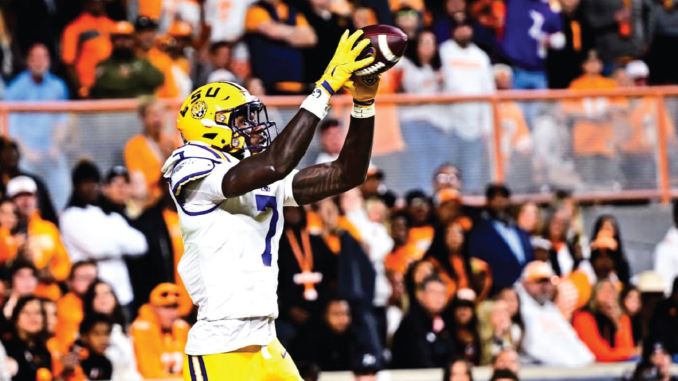
The golf balls came late. By then, LSU had thrown away almost everything else.
Somewhere in Neyland Stadium, Tennessee fans had saved up a five-year-old joke for Lane Kiffin. They threw golf balls onto the field, as they had when he returned in 2021 with Ole Miss. This time he stood on the other sideline with LSU, and there was no winning score for him to take home. The game was stopped while the field was cleared. I wish the football had been as interesting as the interruption.
I picked LSU to beat No. 9 Tennessee on the road if the Tigers showed up. I was hardly the only one betting on what LSU might be. The Tigers, unranked in the AP poll, went to Neyland favored by 1½ points. According to ESPN Research, only once before since 1978 had an unranked team been favored on the road against an AP top-10 opponent. That team, USC, won at No. 10 Arizona in 2014. The line saw LSU’s talent through its four losses. I watched the Tigers come apart one flag at a time. They still reached the fourth quarter tied, which says something about their defense and quite a bit more about what their offense wasted.
LSU’s first possession supplied the evening in miniature. Dilin Jones ripped off 34 yards on the Tigers’ second offensive snap. Then center Braelin Moore snapped the ball while Leavitt was looking to the sideline. It struck the quarterback in the chest and bounced to Tennessee. A promising drive did not even make it to its first flag.
Ty Benefield stripped Faizon Brandon and brought the ball back to the Tennessee 18. LSU took a delay of game and a false start and kicked a 44-yard field goal. Davhon Keys picked off Brandon on the next Tennessee possession. This time LSU got all the way to the 2. A false start and a sack sent Scott Starzyk back out. Two takeaways. Two trips inside the 20. Six points.
LSU still led 6–3 when Dilin Jones fumbled and Arion Carter recovered at the LSU 7. Tennessee had first-and-goal. It ran three times and got five yards. On fourth down, George MacIntyre threw incomplete for DaSaahn Brame. The defense walked off with the lead intact and handed the offense the ball at its own 2. All LSU had to do was get out of there.
Two false starts later, Grant Chadwick shanked a 29-yard punt. Tennessee got the ball back at the LSU 34. Benefield, who already had eight tackles, a sack and that takeaway, was ejected for targeting on the drive. Kiffin questioned how a hit on a receiver so low could show intent to target him. He called Benefield one of his best defenders and said the ejection forced LSU into personnel it would not ordinarily use against a spread offense. A pass interference flag put the ball back at the 2. The same quarterback threw to the same tight end from the same yard line. This time Brame caught it. Twelve seconds before halftime, Tennessee led 10–6.
That was Tennessee’s only touchdown through three quarters. Its two field-goal drives had started at the LSU 48 and the LSU 39. Even with Benefield gone, it held the Vols to three when they got inside the 5 in the third quarter.
Then Qua Moss muffed a punt and PJ Woodland recovered at the Tennessee 9. Sam Leavitt found Trey’Dez Green on the next snap. Thirteen all. Tennessee’s touchdown had grown out of Jones’s fumble and the field position LSU never got back. LSU’s had taken one play after a muff. Through three quarters, neither team had scored on a possession that began in its own territory.
And LSU had the ball to start the fourth quarter. The Tigers could take the lead on the road against No. 9 Tennessee. They went backward and punted. Asked afterward about Tennessee’s two quarterbacks, Kiffin brushed aside the premise. “Our issue was our offense,” he said, against the Vols’ defense. There was no reason to look across the field for the problem.
At Kentucky, Kiffin punted when LSU needed a yard to close out the game. Kentucky tied it and won in overtime. LSU led Alabama 13–10 late in the third quarter and lost by 18. It led Texas into the final seconds and lost by one. I wrote after Kentucky that this team couldn’t close a deal. In Knoxville, the defense had already saved the lead from first-and-goal at the 7. Special teams had handed the offense the ball at the 9, and Leavitt and Green had tied it. LSU still needed somebody to go win the damn game. Kiffin said the Tigers had to “learn how to finish better and coach better.” He was describing a season. I was watching it happen again.
Keys dropped Brandon for a three-yard loss back to the LSU 37. After the play, Tylen Singleton struck DeSean Bishop in the head. I watched Kiffin shake his head as the flag gave Tennessee a first down at the 22. Brandon ran 18 yards for the lead. For the first time all day, a team had started a scoring drive on its own side of the field.
On LSU’s next possession, a Tennessee defender knocked the ball from Leavitt’s hand as he began to pass. The Vols recovered. Brandon went left for 55 yards and the last touchdown in a 27–13 Tennessee win. He had 112 rushing yards on 12 carries; two of those carries settled the game in the fourth quarter. The defense that had kept the score close finally split open. The offense answered neither score.
Jackson Harris tried to play hurt and could not stay in. Winston Watkins was unavailable. They are LSU’s two most productive receivers, and their absence against Tennessee’s defense hurt. Leavitt got up after hit after hit. “I thought Sam played really hard,” Kiffin said. He also rejected the broader charge that the Tigers had quit: “I don’t think it’s an effort issue.” He allowed that one late long run might not have shown LSU at its best. Then came the sentence that fit the offense from the first quarter on: “We just don’t execute very well.”
I believe him about the fight I saw. I also know what I saw on the scoreboard. LSU gained 162 yards in the second half, 159 of them passing. It rushed for three net yards. In the fourth quarter of a tied game, with a lead there to be taken, it rushed seven times for minus-one yard. Sixty-five passing yards brought the quarter’s total to 64 and its point total to zero. The final 265 yards were 65 fewer than LSU managed at Ole Miss, its previous low this season, and 205 below its 11-game average of 470. It had gained 457 against Alabama, even in a loss, and 366 against Texas. In Knoxville it did not drive the field for a touchdown once. Its only trip to the end zone began nine yards away, courtesy of a muffed punt.
Tennessee’s defense deserves its due. It also deserves an honest account of what it did: the official book credits the Vols with eight sacks, seven of Leavitt and one of Jones, for 46 lost yards. That is more sacks than LSU allowed against Alabama and Texas combined. The line could not keep Tennessee out, the running game could not make the Vols hesitate, and Harris and Watkins could not give Leavitt the receiving corps he had come to rely on. Leavitt kept getting up. Kiffin was right to praise his fight. Fight is not a completed pass, though, and it does not erase the quarter in which the offense needed a score and came away with minus-one yard on the ground.
Sixteen penalties for 98 yards. Its most in a game in more than 30 seasons. Eleven came before halftime; Kace Kieschnick counted 11 of the 16 against LSU’s offense. The count sounds almost comic until you remember where the flags landed. They moved a first-quarter gift backward. They helped turn another chance at the 2 into three points. They preceded Tennessee’s touchdown just before halftime. Singleton’s foul gave back a stop in the fourth quarter of a tied game. Four of Tennessee’s five scoring possessions began on LSU’s side of the field. After a while you could watch the flag and know where the ball was going before the referee turned on his microphone.
Kiffin kept the clap cadence instead of opening with a silent count, Kieschnick reported. His offenses had used it in Neyland before. Kiffin said LSU practiced with speakers right behind the players, but Tennessee found another level of noise: “Plus, some players have louder claps.” There is a funny line buried in there. There is also a $91 million coach admitting that his offense could not reliably start a play. The crowd earned its volume. LSU supplied the confusion.
Now set that afternoon beside what LSU spent to build this team. Kiffin’s seven-year deal guarantees $91 million. Blake Baker makes $3 million a year; Charlie Weis Jr. makes $2.5 million. LSU paid for offensive genius and got minus-one rushing yard in the fourth quarter. Tiger Rag reported the nation’s No. 1 portal class. Athletic director Verge Ausberry discussed roughly $40 million committed to the roster. LSU also owes Brian Kelly $54 million for the privilege of replacing him. Leavitt’s reported number is roughly $4.5 million this season. That’s a report, not a contract I’ve seen. But LSU has seen the quarterback it bought. If he wants anything close to that price to return next year, he may soon be looking for work elsewhere. I would offer him a much lower number to remain a Tiger. He has played hard; he has not played like that kind of scratch. An eight-sack afternoon is not one man’s bill, but the quarterback on a team this expensive cannot be exempt from the accounting.
Those obligations come due on different schedules. I know how a ledger works. I also know LSU has never committed anything close to this much money to a football season. By far the most expensive team in school history is 6–5, 3–5 in the SEC, with three straight losses and five league defeats in Kiffin’s debut. Only Gaynell Tinsley, in 1948, had lost five SEC games in his first year coaching LSU. This is not a verdict on the next six years. It is a verdict on the year LSU bought.
Money for nothing. The phrase is too hard on Benefield and the other men who kept getting up in Knoxville. LSU beat ranked Texas A&M and Mississippi State; those wins happened. But those are not enough to make this season look like anything but a historically expensive disappointment. LSU bought coaches, players and a new beginning. It has spent November watching the same ending.
The fans finally threw their golf balls. “I don’t know that I’ve ever credited a crowd before,” Kiffin said. “They did a great job changing the game today, truly.” He was right about the noise. He had also said he would revisit LSU’s cadence after the snap and communication problems. But the fans did not commit 16 LSU penalties. They did not waste the first two takeaways. When the fourth quarter began, the game was tied and LSU had the ball. The crowd had to wait for the Tigers to give that away, too.
The golf balls were the best part of LSU’s night. At least somebody in Neyland knew exactly where to throw.

Be the first to comment