
Tiger Rag Column
LSU’s Defense Showed Up Late. Trinidad Chambliss Beat It Anyway.
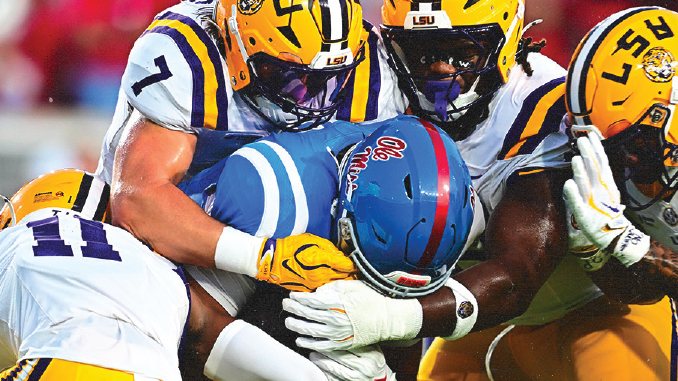
LSU allowed Trinidad Chambliss to own the first half, found itself defensively after halftime and erased a 17-point deficit. Then the Ole Miss quarterback answered the defense the Tigers should have brought with them to Oxford.
LSU’s defense sucked in the first half. There is no reason to dress that sentence in analytics, soften it with the quality of the opponent or hide it beneath the emotion surrounding Lane Kiffin’s return to Oxford.
Trinidad Chambliss completed all eight of his third-down throws while passing for 248 yards and two touchdowns before halftime. Ole Miss led 289-117 in total offense, 248-51 in passing yards, 106-28 in yards after the catch and 15-7 in first downs. A defense that arrived leading the Football Bowl Subdivision with a 53-percent pressure rate could not make Chambliss uncomfortable, could not tackle the people catching his passes and could not get off the field when it created the down designed to do exactly that.
Princewill Umanmielen recorded a sack, but one isolated victory did not amount to pressure. LSU even forced Ole Miss into third-and-12 at the Tigers’ 21, then watched Chambliss throw a touchdown pass to Traylon Ray. The Tigers kept reaching the down that should have ended possessions. Chambliss kept turning it into the down that extended them.
The most damaging possession came after LSU finally appeared to stop the game from getting away. Dilin Jones scored with 1:57 remaining in the half, cutting Ole Miss’ lead to 17-7, and LSU would receive the second-half kickoff. Ole Miss had no timeouts. It drove 75 yards in 1:52 anyway, with Chambliss finding Deuce Alexander for a 20-yard touchdown with five seconds left.
That was not an emotional hangover. It was bad defense. LSU went to halftime trailing 24-7 because Chambliss had been allowed to make the hardest down in football look routine.
Then LSU’s defense showed up, and the difference was immediate and measurable. Ole Miss gained 289 yards before halftime and 137 after it. Chambliss passed for 248 yards in the first half and 115 in the second. The Rebels did not score in the third quarter, and LSU turned defensive disruption into the possession that began its comeback.
Ty Benefield hurried Chambliss on third-and-6, and Ja’Keem Jackson intercepted the throw and returned it to the Ole Miss 33. Six plays later, Sam Leavitt scored on a four-yard keeper. What LSU had advertised for two weeks finally appeared: pressure that did not merely decorate the stat sheet, but changed possession, field position and the score.
Kiffin understood how close the game came to continuing in the humiliating direction established by the first half. Afterward, he said he was glad LSU “battled back” and described Ole Miss during the Tigers’ third-quarter and early fourth-quarter surge as “kind of out on the ropes.”
“Kind of out on the ropes.”
Lane Kiffin on LSU’s comeback
That description was accurate. LSU reduced the deficit to 24-21 when Leavitt converted third-and-11 with a 23-yard pass to Trey’Dez Green and third-and-13 with a 26-yard touchdown pass to Winston Watkins Jr. On Ole Miss’ next possession, replay overturned a completion that would have moved the Rebels into LSU territory. Benefield then sacked Chambliss for a 20-yard loss and forced a punt.
The LSU defense that had been absent for two quarters had taken control of the game. The Tigers forced consecutive empty possessions, changed the field and gave Kiffin’s offense enough chances to erase every point of the 17-point halftime deficit.
LSU tied the game 24-24 early in the fourth quarter, but the way it did so mattered. The Tigers reached the Ole Miss 3 before Jones lost two yards on a third-down direct snap. Kiffin settled for Scott Starzyk’s 23-yard field goal instead of a touchdown that would have given LSU its first lead. “I was going to go for it, and we lost the yard,” Kiffin said. “So now I went back to three, and then we kicked.”
The decision completed the comeback without completing the takeover. LSU had transformed a 24-7 game into a tie, and its defense had reduced Ole Miss to 48 yards on its first three possessions of the second half. The stadium had changed. The pressure had changed. The game had reached the precise psychological point the prediction in this space anticipated—only much later and by a path no one would have chosen.
If Ole Miss had been powered only by grievance, this was where it should have cracked. The 17-point lead was gone. LSU’s pressure had reached Chambliss. The crowd that spent the day cursing Kiffin could feel the revenge fantasy slipping toward the familiar dread of an LSU finish.
Chambliss defied the collapse. Ole Miss took possession at its 25 with 11:21 remaining and traveled 75 yards in 13 plays. Chambliss completed a 22-yard pass to Horatio Fields to cross midfield. On fourth-and-1 at the LSU 40, J.T. Lindsey took a direct snap and gained two yards—the same concept LSU had called at the Ole Miss 3, with the opposite result.
The symmetry was merciless. LSU’s direct snap lost two yards and produced a field goal. Ole Miss’ direct snap gained two yards and preserved the possession that won the game.
An Ole Miss holding penalty pushed the Rebels behind schedule, but Chambliss answered with a 14-yard completion to Alexander. After LSU hurried him into an incompletion, Ole Miss called timeout with 6:20 remaining. Six seconds of game time later, Chambliss kept the ball, ran untouched around the left side and scored from 14 yards.
This was the defense LSU should have brought into the first quarter. It had already intercepted Chambliss, sacked him for 20 yards, held Ole Miss scoreless throughout the third and helped erase a 17-point deficit. Chambliss beat that defense too.
Kiffin had warned during the week that Chambliss could destroy correct calls as easily as bad ones. After the game, he called them “Houdini plays.” “You scheme them up, and then he just makes plays,” Kiffin said, again calling Chambliss the most dynamic player in college football.
“You scheme them up, and then he just makes plays.”
Lane Kiffin on Trinidad Chambliss
Kiffin also said Chambliss became more dangerous after running back Kewan Lacy left the game because every snap then ran through the quarterback. That was what LSU confronted on the decisive drive: not merely a quarterback escaping pressure, but a quarterback accepting complete control of the game after LSU had finally found the defensive structure expected from the opening kick.
“We’re going to have to be aggressive,” Kiffin said. LSU might hold Ole Miss at times, he added, “but it won’t be that long.” It lasted long enough for LSU to tie the game. It did not last long enough for LSU to win it.
The Tigers compounded Chambliss’ touchdown with the kind of indiscipline that makes a comeback feel less complete in retrospect. LSU jumped offsides twice before Ole Miss’ two-point conversion. Malik Blocton moved the ball from the 3 to the 1. Shone Washington moved it half the remaining distance. Lindsey crossed the goal line, turning a six-point deficit into eight.
LSU had already lost a timeout on the decisive possession because of a late defensive substitution. Now two more pre-snap mistakes altered what the offense needed to do and how little room it had to do it. The defense had finally shown up, then lost its composure at the finish.
The offense was not an innocent bystander. Pete Golding’s defense harassed Leavitt without repeatedly exposing its coverage. Ole Miss once rushed only three on third-and-13 and still forced him off schedule. Leavitt played much of the night without a settled pocket, but the protection problems do not erase his missed throws to open receivers.
He overthrew an open Eugene Wilson III near the goal line in the first half. On LSU’s final possession, Zach Grace came open in the end zone on third down and Leavitt missed him. Jaylon Braxton intercepted the fourth-down pass at the goal line with 58 seconds remaining.
The final drive also consumed too much time. LSU took possession with 6:08 left, one timeout and an eight-point deficit. It did not reach the Ole Miss 10 until a pass-interference penalty with 1:55 remaining. A false start by Grace then moved the Tigers from the 5 back to the 10 before Leavitt’s final two incompletions.
LSU lost this game in three distinct pieces. Its defense buried the team in the first half. Its offense and its quarterback spent too much of the night fighting protection and their own missed opportunities. Then, after both units had done enough to create a tied game, LSU lost a timeout, jumped offsides twice and false-started five yards from the touchdown it needed.
Kiffin did not pretend the return had been emotionally ordinary. Six years in Oxford had contained what he called life-changing experiences and people who helped him through hard times. He expected to enter the stadium in competitive mode and embrace the hostility. The night reached him differently. “Sometimes you can’t predict your emotions,” Kiffin said. “I’m a human too.”
“Sometimes you can’t predict your emotions. I’m a human too.”
Lane Kiffin after returning to Oxford
That admission explains Kiffin’s night better than any villain costume assigned to him before kickoff. He could dislike losing, credit Ole Miss for deserving to win and still acknowledge that part of him felt glad for former players and coaches. The return was more complicated for him than the crowd’s anger allowed. The football was simpler.
The prediction in this space was LSU 47, Ole Miss 21. It was wrong about the winner, wrong about the margin and wrong about the direction of the game’s early separation. More important, it was built on two assumptions the game destroyed: that LSU’s defense would establish itself before Chambliss established the game, and that Ole Miss would begin losing by fractions if LSU erased the lead.
LSU’s defense did not arrive until the second half. Ole Miss did not fracture when the lead disappeared. Chambliss answered the best defensive stretch LSU produced all night with the game’s defining possession.
The original analysis correctly identified Golding’s pressure advantage, LSU’s protection vulnerability, Green’s ability to change coverage and the possibility that emotion could turn against the home team. It missed the result because it assumed LSU would impose those truths first. Ole Miss did.
Chambliss completed 33 of 48 passes for 363 yards and two touchdowns. He dominated before LSU’s defense appeared, endured after it did and scored the winning touchdown with his legs when LSU had every reason to believe the game had finally become its own.
LSU’s defense was terrible, then it was forceful, then it was not good enough on the possession that decided the game. Chambliss was himself throughout. That was the difference.
Be the first to comment