
Todd Horne Column
Maybe It Was Perfect for LSU. Ole Miss Will Decide.
LSU buried Louisiana Tech beneath 528 yards and a suffocating defense. Four turnovers, five sacks and 101 penalty yards turned the mismatch into the warning Lane Kiffin wanted before returning to Oxford.
Baton Rouge — Louisiana Tech gained no yards in the first half Saturday night. Not one. The Bulldogs made no first downs, ran only 20 plays and needed LSU to carry the football the final 100 yards to the end zone for them.
Still, with a half of football gone, No. 8 LSU led 10–7. The Tigers had gained 278 yards, run 50 plays and made 14 first downs, yet one more LSU mistake could have sent a heavy underdog into the locker room with the lead.
LSU Moved the Ball for Both Teams
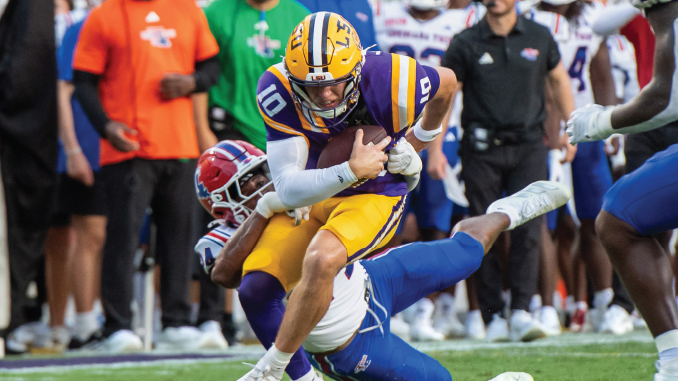
Louisiana Tech’s offense could not move the football, so LSU’s offense moved it for both teams. Eugene Wilson III lost a fumble, and Sam Leavitt threw interceptions on the Tigers’ next three possessions.
The first interception came on second and 8 from the LSU 38, when Kam Franklin picked off Leavitt at the Louisiana Tech 40. The next one punished LSU far more severely. The Tigers had driven 74 yards in 19 plays, consuming 9 minutes, 6 seconds, when Leavitt tried to hit Jackson Harris at the goal line from the Tech 6.
Harris’ route appeared too shallow, Leavitt’s throw sailed over him and Jordan McRae caught it at the goal line. Left tackle Jordan Seaton and Leavitt chased McRae the length of the field, both diving at his legs and both missing before McRae completed the Louisiana Tech-record 100-yard return.
A possession that should have ended with LSU leading 17–0 instead ended at 10–7. The Tigers answered by driving to the Louisiana Tech 14, but Leavitt tried to force a third-and-8 throw to Wilson near the goal line. Taeden Rogers broke up the pass, Zheric Hill intercepted it at the 5 and LSU’s fourth consecutive turnover ended the half.
“The crosser, I think I tried to force that one a little bit,” Leavitt said. “If I am going to put it on him, I need to see it a little better.”
LSU had dominated almost every conventional measurement and squandered almost every advantage. Its four first-half turnovers were the Tigers’ most since they committed four against New Mexico State in 2014. That LSU team eventually won 63–7. This one carried a three-point lead into halftime despite owning every yard gained from scrimmage.
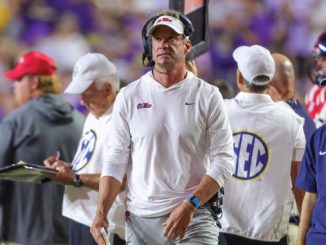
Kiffin did not sound grateful while it was happening. By the time LSU had finished a 45–14 victory, he could see some use in the ugliness.
“Maybe it was perfect for us, that we needed something like that. If we played good on offense, it was 70–7 or something, we don’t have their attention. I think it’s what we needed.”
Lane Kiffin
Perfect is not the word anyone in Tiger Stadium would have selected during the second quarter. Useful may be closer, because the absurdity of that halftime score stripped away any temptation to confuse yardage with control.
One week after LSU dismantled Clemson 51–10, Kiffin no longer has to manufacture reasons for his players to listen. The Louisiana Tech film will make the argument for him before LSU travels to Oxford for its first SEC game and his return to Ole Miss.
LSU eventually scored 35 second-half points and won 45–14. The path exposed nearly everything that can make the Tigers dangerous this season—and nearly everything that can get them beaten next week.
Leavitt completed 25 of 38 passes for a career-high 344 yards and one touchdown. He also ran for three scores. He accounted for every touchdown produced by LSU’s starting offense, but one of his three interceptions supplied Louisiana Tech’s only points until the Bulldogs scored against LSU’s backups with 8:08 remaining.
Leavitt had been decisive against Clemson. Against Louisiana Tech, his competitiveness began working against him. One mistake followed him into the next possession because he appeared determined to correct everything with his next throw.
“He’s very competitive, and you can see that in some plays, trying too much there because we’re not doing well. A week before, he did a good job of not doing that. You’ve got to not be frustrated in that.”
Lane Kiffin on Sam Leavitt
Kiffin reminded Leavitt at halftime of Matt Corral’s six-interception game against Arkansas during Kiffin’s Ole Miss tenure. Corral kept playing that afternoon, and Ole Miss kept giving him the chance to recover. Kiffin’s message to Leavitt was patience, not redemption on demand.
“We’ve got to be patient, and we’ve got to win the game regardless of what that looks like,” Kiffin said.
The Answer After Halftime
Leavitt followed the instruction. He completed 8 of 11 passes for 110 yards and a touchdown after halftime without throwing another interception. He ran for two more scores as LSU turned its 10–7 lead into a 38–7 advantage before the backups finished the game.
Last week, Kiffin’s halftime speech against Clemson had been animated and profane. This one was different because LSU did not require emotion. It required restraint.
“It was a lot calmer,” Kiffin said. “It was a lot more just about the execution on the offense and finishing things—and taking care of the football too.”
LSU did not need to discover another offense after halftime. It needed to stop destroying the one that was already producing yards, then find a way to run against a defense committed to flooding the middle.
Dilin Jones supplied the first answer on LSU’s opening snap of the third quarter, bursting for 46 yards through the front that had held him to 2 yards on 11 first-half carries. The run led to Scott Starzyk’s 25-yard field goal and a 13–7 lead, but the offense still had not reached the end zone since the first quarter.
That changed on LSU’s next possession. Facing second and 18, Leavitt found Trey’Dez Green for 23 yards to rescue the drive. He finished it with a 9-yard touchdown run, then threw the two-point conversion to Malachi Thomas for a 21–7 lead.
Green became LSU’s reliable answer whenever the offense fell behind schedule. The preseason All-SEC tight end caught six passes for a game-high 104 yards and a touchdown, repeatedly using his size and reach to turn difficult downs into manageable ones.
The defense handed LSU another short field when DJ Pickett intercepted Louisiana Tech quarterback Blake Baker and returned it 32 yards to the Bulldogs’ 11. The offense stalled again, however, and Starzyk’s third field goal made it 24–7.
Then the separation arrived. Leavitt rolled away from pressure and launched a 53-yard pass to Wilson, who laid out for the catch. Leavitt followed Seaton and Jones into the end zone from 5 yards, then later found Green for a 10-yard touchdown after Deuce Geralds forced another Louisiana Tech fumble.
The Tigers finished with 528 yards, 26 first downs and 85 offensive plays. Added to the 644 yards gained against Clemson, LSU has produced 1,172 yards—the most total offense through the first two games of a season in school history.
Its problem Saturday was converting production into points before a turnover, sack, penalty or missed assignment ended the possession. LSU reached the red zone 10 times; two trips ended with interceptions and three more with field goals. The Tigers also committed 10 penalties for 101 yards.
“This was an offensive production issue about how we finished drives and taking care of the ball,” Kiffin said. “The yards are still up there—528 yards. But we’ve got to finish the drives and do a better job in the red zone.”
The rushing numbers reveal another problem LSU cannot take to Oxford. The Tigers gained 147 yards on 44 attempts, an average of 3.3 yards. College statistics charge sacks against team rushing totals, but the production from LSU’s running backs was not much more reassuring.
Dilin Jones led LSU with 66 yards on 18 carries. One run gained 46 yards. His other 17 produced 20.
Louisiana Tech crowded the interior, sent run blitzes and waited for LSU to make its calls before revealing the pressure. Kiffin adjusted after halftime by snapping the ball faster instead of allowing the offense to continue searching for the perfect play.
The adjustment helped. It did not change his assessment of the offensive line.
“Not real good. Five sacks and negative plays.”
Lane Kiffin on LSU’s offensive line
Louisiana Tech sold out to stop LSU’s direct running game. Kiffin acknowledged that a defense playing so aggressively will produce some zero- and one-yard gains before leaving itself vulnerable to an explosive run.
That explains the 46-yard gain. It does not make the other 17 Jones carries for 20 yards disappear.
A week after LSU rushed for 309 yards and physically overwhelmed Clemson, its offensive line could not consistently move Louisiana Tech. The Tigers worked around the Bulldogs’ pressure. They did not whip it, and five sacks will command attention with Ole Miss defensive tackle Will Echoles waiting in Oxford.
“Inability to run the ball,” Kiffin said when asked about LSU’s red-zone problems. “They did a really good job—a lot of pressures down there—and then we didn’t execute on assignments. The turnovers certainly didn’t help, but the inability to run the ball on direct runs, something that the week before was really good for us. As you saw later, I had to start going around them with things because everything was up in the middle.”
The Defense Travels
LSU’s defense required no detour. Louisiana Tech entered Tiger Stadium one week after scoring 80 points against Northwestern State, an FCS opponent. Against LSU’s first unit, the Bulldogs could barely begin a possession before Blake Baker’s defense dismantled it.
Louisiana Tech finished with 140 yards, eight first downs and 2.5 yards per play. The Bulldogs rushed 31 times and ended the game with minus-3 yards. Their offense did not score until 8:08 remained, after LSU had taken a 38–7 lead and begun playing its backups.
For nearly 52 minutes, Louisiana Tech’s only touchdown belonged to its defense. The last LSU opponent to finish with negative rushing yardage was BYU, which had minus-5 yards on 14 attempts in 2017.
“I thought our defense was lights out again. We ended up with negative yards rushing, even with the twos. But the first team was really lights out. It was almost like you felt like they were going to get turnovers on every possession.”
Lane Kiffin
The performance followed LSU’s demolition of Clemson, which managed 145 total yards and 40 rushing yards. Through two games, defensive coordinator Blake Baker’s unit has allowed 285 total yards and 37 net rushing yards.
The Tigers produced seven sacks and 11 tackles for loss against Louisiana Tech. Princewill Umanmielen supplied three sacks and four tackles for loss by himself, giving the Ole Miss transfer five sacks through two games. That already exceeds the four sacks Harold Perkins Jr. recorded while leading LSU during the entire 2025 season.
Geralds added a sack and forced a fumble. Pickett supplied the interception that LSU turned into a field goal. Tamarcus Cooley and Jhase Thomas recovered fumbles as a defense that spent the night receiving little complementary help created three takeaways of its own.
LSU’s first two opponents have combined to average 18.5 rushing yards a game. Clemson could not run against the Tigers. Louisiana Tech finished three yards behind where it started.
That defense will travel well. LSU must determine whether its discipline, pass protection and quarterback judgment can travel with it.
Ole Miss Will Decide
No. 9 Ole Miss handled Charlotte 41–9 Saturday night in Oxford. While LSU entered halftime leading Louisiana Tech by three, the Rebels led Charlotte 27–0 after scoring on five first-half possessions.
Starting quarterback Trinidad Chambliss completed 23 of 26 passes for 225 yards and two touchdowns without an interception. Kewan Lacy rushed 13 times for 87 yards and two touchdowns. Ole Miss averaged 5.3 yards per rush and finished with 420 yards.
The Rebels were not dominant defensively. Charlotte gained 322 yards, rushed for 143 and possessed the ball for 37 minutes, 14 seconds. Ole Miss converted only one of four third downs and did not score during the third quarter.
LSU played the superior defense Saturday. Ole Miss received the steadier quarterback performance and ran the ball far more efficiently.
That is where next week begins—not with Kiffin’s reception in Oxford, the hostility surrounding his return or the endless examination of why he left. The football question is whether LSU can force Ole Miss to play against Baker’s defense without first giving the Rebels points, field position and extra possessions.
“You get ready to go on the road in the SEC versus a really good team that has played really well for years at that place. This was good because I guess it’s harder to get their attention after last week. I’m glad it happened.”
Lane Kiffin
Ole Miss has scored 41 points in each of its first two games. LSU has scored 51 and 45. Both teams are 2–0. Only one will enter Vaught-Hemingway Stadium with a defense that has allowed fewer than 300 yards all season. Only one will arrive after its starting quarterback threw three interceptions in a half.
Clemson showed how good LSU can be when its parts operate together. Louisiana Tech showed how quickly the Tigers can become their own most effective opponent.
Kiffin called the experience perfect because LSU won by 31 and left angry. It becomes perfect only if the lesson survives the trip to Oxford, where Ole Miss will not give LSU an entire half to learn it again.

Be the first to comment