
Sometimes, winds of change blow in unexpected directions.
Predicting the next football coach at LSU is as unsure as annual forecasts from the National Hurricane Center. Recent coaching storms reveal the Ole War Skule has pivoted from a model of elevating assistants or head coaches at lesser powers to a chase for the best available coach in America.
When Paul Dietzel left for West Point in January of 1962, the LSU job was considered by many astute analysts to be the best in the country. Rather than scout the nation for heavyweight prospects, LSU Athletic Director Jim Corbett promoted Dietzel assistant Charles McClendon. It would have been considered ungentlemanly or too costly to pursue Bear Bryant or Woody Hayes or John McKay.
Mac logged 18 mostly successful seasons, but when he was nudged out in 1979, LSU leaders provided a glimpse of the fall of 2025. Board member Charles Cusimano was dispatched to Fayetteville on a mission to coax Lou Holtz of Arkansas this way, but the trip was futile.
Dietzel then offered the plum to Florida State’s Bobby Bowden, who said no after his undefeated Seminoles beat LSU at Tiger Stadium on Oct. 27 by a narrow 24-19 score.
Dietzel turned his focus to 34-year-old Bo Rein, who perished in a plane crash 42 days after he was seduced from a comfortable perch at North Carolina State. There, he captured a conference title in his fourth season. Rein was hired on Nov. 20 ,1979, exactly 46 years before Lane Kiffin became LSU’s coach. The successor to Rein at NC State was Monte Kiffin, who took the job at Raleigh when his son was five years old.
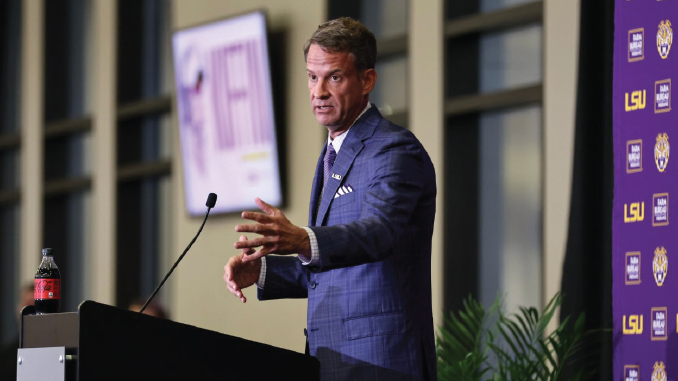
Lane Kiffin was the preferred candidate from day one for LSU Athletic Director Verge Ausberry. Four years ago, Scott Woodward’s top prospect was not Brian Kelly. It was Lincoln Riley, who opted to migrate from Oklahoma to USC rather than move to LSU.
When Nick Saban was snared from Michigan State in 1999, AD Joe Dean tried to attract Miami’s Butch Davis to Death Valley. Davis bolted for the NFL and the Cleveland Browns a year later and posted a 24-35 record in four seasons. His disastrous decision was a warning Saban did not heed when he defected to the Miami Dolphins after five years in Baton Rouge.
AD Skip Bertman settled for Les Miles, the 51-year-old coach of Oklahoma State. Miles sported a pedestrian 28-21 worksheet in four years at Stillwater. He was not in the same league with Kiffin 21 years later as a coveted target to steer the Tiger ship.
The most successful coach LSU has lured from another school was hired in 1923. A century ago, the LSU coach was Mike Donahue, who had directed Auburn to three national championships. Unlike 1958, Auburn legitimately claimed titles in 1910, 1913 and 1914. Donahue bolted the Plains in 1923 after guiding Auburn to a 99-25-5 record in 15 seasons.
Michael Joseph Donahue was born in County Kerry, Ireland in 1876. He came to Yale as a quarterback and graduated in 1903. Donahue was inducted in the inaugural class of the College Football Hall of Fame in 1951, but he was a disappointment as LSU coach.
The Tigers posted a modest 23-19-3 record in five years under Donahue, and he left his post in 1927, one year before Huey Long’s election as Louisiana governor.
Coaching the Tigers has always been a treacherous profession in terms of long-term viability. But golden parachutes have turned firing squads into retirement planners. Brian Kelly and Ed Orgeron were paid more than $70-million to live the rest of their years in oblivion and in luxury. At LSU, IRA is an acronym for getting rich as “I Run Away.”
Any suggestion of pressure being intense for contemporary LSU football coaches is laughable. Charlie Mac felt pressure when he had one year remaining on a $100,000 dollar contract. Orgeron, Kelly and Kiffin have no pressure. They get their millions no matter what happens on the field.
Eight of the last ten permanent coaches before Kiffin have been fired while three have won national championships. Based on those numbers, there is a 62.5 percent greater chance of being canned than winning it all at LSU. Orgeron was nailed two years after winning the 2019 crown while Miles was axed nine years removed from his 2007 conquest.
Kiffin stands to win many games and receive record compensation, but both he and the LSU brass are restless souls. In the NIL world, it is possible to win everything with an entirely new team. And that is exactly what is expected of LK. If LSU drops it opener to Clemson, Kiffin will have the shortest honeymoon since Jerry Stovall replaced Rein.
Stovall took command in 1980 and faced Bowden and Florida State in his debut at Tiger Stadium, losing 16-0. The gifted writer Dave Kindred witnessed commotion after the game as punks were pounding their fists into the windows of Stovall’s office at Death Valley.
Kindred said one “fan” shouted, “Hey why don’t you put your jockstraps on next game? You buncha pussies.” Stovall rebounded two years later to deliver a historic win at home. A 55-21 thumping of Florida State on a foggy night with oranges cascading from the stands came with a bid to the Orange Bowl and National Coach of the Year honors. Fourteen months later, the LSU hero and Heisman runner-up had a career change. He went to work at a bank.
Considering the peripatetic past of Kiffin, it is likely there is at least one more stop in his nomadic existence. He has not experienced a decade without a move in his 51 years.
Mike Donahue served as head coach at Springhill for one season after leaving LSU. He returned to Baton Rouge where he died in 1960 at 84.
Dietzel also died in Baton Rouge at 88 in 2013. Tall Paul resurfaced after being forced out as athletic director in 1982.
Former USC Coach John Robinson died at 89 in Louisiana’s Capital last year. Three national champion football coaches have expired in TigerTown, but it is doubtful Baton Rouge will adopt a slogan as “The Place Where Champions Come to Die.”
The expectation from this corner is that Kiffin has a 50-50 chance of joining LSU predecessors Dietzel, Saban, Miles, Orgeron and Edgar Wingard (1908) as NCAA champions. It will be fascinating to follow the trajectory of this man of mystery, wealth and fame.
Board member Jerry McKernan called LSU “Twilight Zone in The Bayou” 45 years ago. Not much has changed.


Be the first to comment