
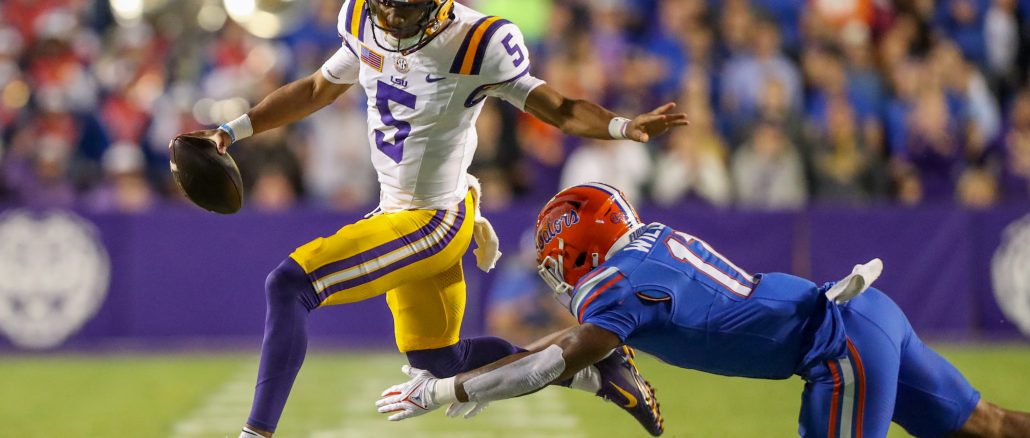
Jayden Daniels Has NIL Rights. He Doesn’t Own LSU’s No. 5
LSU’s Own Bylaws Say No. 5 And No. 9 Can Be Worn Again. If Brian Kelly Had Promised DJ Pickett Joe Burrow’s Number, Lane Kiffin Should Have Honored That Promise, Too.
Jayden Daniels has a legitimate argument that LSU cannot commercially use his name, image and likeness forever without his permission.
He does not have a legitimate claim to ownership of No. 5.
Those are separate issues, and almost everything about this increasingly strange dispute becomes clearer once they are treated that way.
LSU’s own bylaws say No. 5 remains available to another football player. So does Joe Burrow’s No. 9. In fact, there is only one football number at LSU that cannot be issued again: Billy Cannon’s No. 20.
That is why Lane Kiffin was right to give DJ Pickett the number LSU had promised him during recruiting.
And if Brian Kelly’s staff had promised Pickett No. 9 instead of No. 5, Kiffin should have given him that one, too.
That may offend LSU fans who understandably regard Burrow’s 2019 season as sacred ground. It does not change LSU’s written policy.
Kiffin inherited a commitment LSU made to a current player. He investigated what Pickett and his family had been told and concluded LSU should keep its word.
“When a kid is promised something to come to a school, he should wear it,” Kiffin said. “We should honor what he was told.”
That is the governing principle here.
Not which former quarterback was greater.
Not which Heisman winner is more popular.
Not which number means more to LSU fans.
What did LSU promise the player it was recruiting, and does LSU intend to honor its promises after the coach who made them is gone?
If Pickett had grown up wearing No. 9, if Kelly’s staff had promised him No. 9 and if that promise had helped LSU sign him, Kiffin would have been facing the same decision he faced with No. 5.
I believe he would have given Pickett Burrow’s number.
Under LSU’s bylaws, he could have.
And under Kiffin’s own reasoning, he should have.
That is where LSU’s 2007 jersey-retirement policy matters.
Effective Jan. 1, 2007, LSU changed what it means to retire a jersey. From that point forward, retiring an athlete’s jersey no longer meant removing the number permanently from circulation. A future LSU athlete can wear a number associated with a retired jersey, subject to the head coach’s discretion.
LSU grandfathered five numbers that had already been permanently retired under the old system.
Pete Maravich’s No. 23 in men’s basketball.
Bob Pettit’s No. 50 in men’s basketball.
Shaquille O’Neal’s No. 33 in men’s basketball.
Skip Bertman’s No. 15 in baseball.
And Billy Cannon’s No. 20 in football.
Those five numbers may never again be worn in their respective LSU sports.
That is why Cannon’s 20 is different.
It is not because LSU has a present-day rule saying a Heisman Trophy winner owns his number forever. Cannon’s number had already been permanently removed from circulation decades before LSU rewrote its policy, and LSU preserved that retirement when the new rules took effect.
Every football jersey retired since then works differently.
Tommy Casanova’s No. 37 jersey is retired, but another LSU player can wear 37.
Jerry Stovall’s No. 21 jersey is retired, but another LSU player can wear 21.
Charles Alexander’s No. 4 jersey is retired, but another LSU player can wear 4.
Bert Jones’ No. 7 jersey will be retired this season, but 7 remains available.
The same policy would apply if LSU retires Burrow’s jersey.
It would apply if LSU eventually retires Daniels’ jersey.
Their jerseys could be permanently honored without their numbers becoming permanently unavailable.
Burrow’s No. 9 does not become Cannon’s No. 20.
Daniels’ No. 5 does not become Cannon’s No. 20.
That makes Brian Kelly’s explanation for withholding No. 5 particularly revealing.
Kelly said he knew Pickett had been promised the number during recruiting but did not issue it because LSU also had been protecting Burrow’s No. 9.
“We didn’t want to issue No. 9, so you can’t treat one differently from the other,” Kelly said.
Kelly was trying to create consistency between Burrow and Daniels.
Fair enough.
But LSU’s consistency problem was created by an unwritten practice, not by its bylaws.
No. 9 has not been worn since Burrow left LSU after the 2019 national championship, and Burrow has said he was told the number would not be issued again.
That may have been an institutional promise LSU intends to honor.
But it is not LSU’s retired-number policy.
The written policy treats 9 and 5 the same way.
Both are available.
That does not mean Burrow and Daniels have identical résumés. They do not.
Burrow’s case as the greatest quarterback in LSU history remains exceptionally strong.
He went 25-3 as LSU’s starter. He threw for 8,565 yards and 76 touchdowns in two seasons. In 2019, he completed 76.3 percent of his passes for 5,671 yards and 60 touchdowns, produced 6,039 yards of total offense and accounted for 65 touchdowns.
LSU went 15-0, won the SEC championship and won the national championship.
And Burrow did it against one of the toughest schedules in the country.
LSU’s 2019 schedule ranked sixth nationally in strength of schedule. The Tigers played seven teams ranked in the AP Top 10 at the time and beat all seven. Over Burrow’s two LSU seasons, he led the Tigers to 11 victories over Top-10 opponents.
Daniels did not have that team résumé.
But anyone using LSU’s 19-7 record with Daniels to dismiss how great he was individually is ignoring what happened around him.
Daniels finished his two LSU seasons with 6,725 passing yards, 2,019 rushing yards and 8,744 yards of total offense. He accounted for 79 touchdowns.
In 2023, he completed 72.2 percent of his passes for 3,812 yards, 40 touchdowns and four interceptions. He rushed for another 1,134 yards and 10 touchdowns.
His 208.0 passer-efficiency rating was an FBS record.
His 412.2 yards of total offense per game were actually more than Burrow’s 402.6 in 2019.
And Daniels operated with far less help from LSU’s defense.
The 2019 defense behind Burrow allowed 21.9 points and 343.5 yards per game.
The 2023 defense behind Daniels allowed 28.0 points and 416.6 yards per game.
Daniels’ three losses that season came against Florida State, Ole Miss and Alabama.
LSU allowed 45, 55 and 42 points.
Against Ole Miss, Daniels produced 513 yards of total offense and accounted for five touchdowns.
LSU scored 49 points.
It still lost.
That research matters because this should not become a cheap argument that Burrow deserves protection while Daniels does not because Burrow was somehow vastly more worthy.
Burrow had the greater season because of what he accomplished against elite opponents and because LSU finished 15-0 with a national championship.
Daniels nevertheless produced one of the greatest individual seasons an LSU quarterback has ever had.
Both deserve to be honored.
Neither owns a football number under LSU’s present rules.
Daniels’ stronger argument involves something else entirely: his NIL.
According to ESPN’s reporting on the cease-and-desist letter sent to LSU, Daniels’ agreement allowed the school to use his NIL for 180 days after his final college game. Daniels last played for LSU on Nov. 25, 2023, putting the expiration of that reported contractual period on May 23, 2024.
I have not seen Daniels’ executed agreement, so that provision has to be understood as reported from the cease-and-desist letter.
But if LSU’s contractual license expired, Daniels is entitled to insist that LSU respect the limits of whatever rights it retained.
If LSU wants to use Daniels in a new commercial advertisement, build new merchandise around his identity, use him to solicit money or suggest that he currently endorses a commercial venture, LSU needs legal authority to do it.
That is a legitimate issue.
It does not follow that LSU must remove Daniels from its own history.
Louisiana’s right-of-publicity law protects commercial rights in a person’s identity but also contains broad protections for sports accounts, historical and biographical works, news, photographs and audiovisual material.
There is an obvious difference between LSU documenting that Jayden Daniels won the Heisman Trophy and LSU selling something by trading commercially on Jayden Daniels.
The expiration of an NIL license does not turn LSU history into Daniels’ private property.
And it certainly does not turn the number 5 on DJ Pickett’s jersey into Jayden Daniels’ name, image or likeness.
No. 5 is not Daniels’ NIL when Pickett wears it.
It is a football number LSU promised to Pickett.
That promise should have been honored.
The same would be true if the number were 9.
LSU should certainly decide whether it intends to keep whatever promise was made to Burrow about No. 9. It also should understand why Daniels would look at No. 9 remaining unused and ask why No. 5 received different treatment.
That is a fair question.
But the solution is not to pretend LSU’s bylaws say something they do not.
If LSU wants Heisman winners’ numbers permanently removed from circulation, change the policy.
If LSU wants national championship quarterbacks treated differently, write that policy.
If LSU wants 9 and 5 protected forever, say so.
But under the rules LSU actually adopted almost 20 years ago, both numbers remain available.
Only one LSU football number is truly untouchable.
Billy Cannon’s No. 20.
Everything else comes down to the promises LSU chooses to make — and whether LSU intends to keep them.
Be the first to comment