
By TODD HORNE, EXECUTIVE EDITOR
Brian Kelly is on television now, and in a strange way, that may be the cleanest image of how his LSU story ended.
Not bitter.
Not dramatic.
Not surprising.
Just displaced.
Kelly was fired on Oct. 26, 2025, one day after LSU’s embarrassing 49-25 loss to Texas A&M in Tiger Stadium. It was a midseason dismissal, not a quiet separation. LSU did not wait for the calendar to soften the blow. It acted when the moment made the decision unavoidable.
Kelly finished 34-14 at LSU, a good record almost anywhere else and an insufficient one in Baton Rouge. He came to LSU with one of college football’s longest resumes. He had built Notre Dame into a playoff program. He believed in structure, culture and long-term program building.
None of that was fake.
It was not enough anymore.
Now Kelly has moved into television commentary work, appearing on CBS Sports programming to break down football prospects and discuss the NFL Draft. Major coaches often find that kind of soft landing after high-profile exits. They sit under studio lights, talk ball and remind everyone they are still connected to the sport.
But with Kelly, there is another layer.
There is the contract.
LSU’s obligation to Kelly has been reported at roughly $54 million after his without-cause termination. That money did not disappear because he stopped coaching. But Kelly’s contract also contains mitigation and offset language, and that language matters.
The relevant wording is not vague. Under Kelly’s LSU contract, LSU’s liquidated damages obligation is reduced by compensation Kelly earns, receives or is entitled to receive for football-related employment, including coaching, administration or media.
Media.
That one word changes the conversation.
Kelly going on television is not merely an image play. It is not just a former coach staying visible. It is exactly the kind of football-related work the contract language appears to contemplate.
That does not mean CBS Sports Network is paying Kelly enough to meaningfully dent a $54 million buyout. It may not. Television appearances can range from modest guest fees to more formal analyst agreements. The amount matters contractually, but it does not matter to the larger point.
LSU should not pay one dollar more than the contract requires.
Kelly should receive every dollar the contract protects.
Both things can be true.
This is not a moral argument. It is a contract argument.
If Kelly is being compensated for football media work, LSU has every reason to document it, review it and apply any required offset against its remaining obligation. That is not petty. That is responsible contract management. LSU negotiated the language. Kelly agreed to it. Now both sides have to live inside it.
And that is where the larger LSU football story comes back into focus.
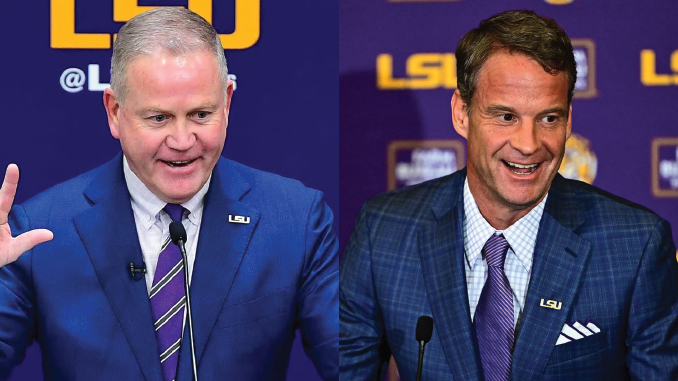
Kelly’s television pivot lands almost too perfectly as a symbol. He is analyzing the game from a distance while LSU has moved into a different era with Lane Kiffin.
Kelly represented structure, stability and traditional program building.
Kiffin represents speed, volatility, acquisition and market response.
LSU did not merely change coaches.
LSU changed operating systems.
College football changed underneath Kelly. The transfer portal became roster free agency. NIL became payroll by another name. Revenue sharing arrived. Retention became as important as recruiting. A coach no longer has three or four years to stack classes and develop toward a window.
At LSU, the window is now.
Always.
That is why Kiffin fits the moment in a way Kelly never fully did.
Kiffin is faster and more adaptable. He understands that modern college football rewards aggression more than patience. LSU’s roster investment and pursuit of elite transfer talent were not side notes to the coaching change. They were the point of it.
LSU hired Kiffin because the school understood the sport was no longer built to wait.
That does not guarantee Kiffin will win a national championship. Spending big money does not guarantee anything. A loaded roster can still fracture. A transfer-heavy team can still miss. A coach who understands the new economy still has to win Saturdays.
But LSU’s choice was clear.
It wanted a coach built for the market as it exists, not the one college football pretends to be.
Kelly on television sharpens the contrast.
One coach is explaining the game.
The other is trying to bend it.
One is being paid by LSU to go away, with outside football-media compensation potentially reducing the bill. The other is being backed by LSU to attack the new economy as aggressively as possible.
That is the new reality of LSU football.
It is colder. Faster. More expensive. Less sentimental.
Brian Kelly did not fail because he forgot how to coach. He failed because LSU decided it could no longer afford a coach misaligned with the moment.
Now he is on television, still talking football, still connected to the sport, still tied financially to LSU through a contract that anticipated this very kind of next step.
That is the final irony.
Kelly moved on.
LSU moved on.
But the contract followed him into the studio.
LSU did not just move on from a coach.
It moved on from an era.

Be the first to comment