

Every development district needs a center of gravity.
For the Bayou Fountain Economic Development District, that gravity isn’t LSU or any of the sports-tourism advocates pushing the project.
It’s the Duplantier family’s land.
And if that land remains off-limits, BFEDD isn’t an economic engine.
It’s a hollow map.
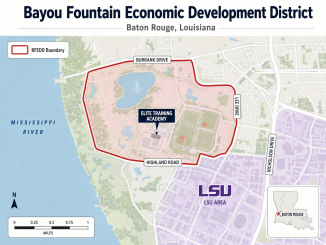
According to Steve Legendre, who speaks for the Duplantiers, the family owns roughly 57 percent of the district. Even more striking: Legendre says less than 2 percent of BFEDD can be built upon without touching Duplantier property.
One number speaks to ownership.
The other speaks to viability.
If both are correct, BFEDD isn’t merely facing political pushback or procedural snags. It’s confronting an existential land-use crisis.
The Duplantiers say they never gave meaningful consent to include their property, and they have made clear they will not sell to any of the proponents — Elite Training Academy, 820 Development Group or related parties.
That refusal doesn’t just complicate a negotiation. It calls into question the very premise of the district.
What exactly is BFEDD developing if the crucial acreage at its core isn’t for sale?
Yet the district’s tax machinery is already humming.
On July 1, the City-Parish Revenue Division notified businesses of new BFEDD reporting requirements. Meanwhile, the Cooperative Endeavor Agreement that governs how those revenues will be used remains deferred until Aug. 26.
City-Parish officials have identified nearly 800 responsive emails related to Tiger Rag’s public-records request, but those records have not yet been produced.
This fractured timeline amounts to a governance failure.
You can defend each step — creating the district, publishing tax notices, deferring the finance agreement — in isolation.
But taken together, they erode public confidence.
First you draw the boundary around majority landowners who say they never consented. Then you delay the agreement that would explain how money is spent. Then you send out tax notices and wait for the public to trust the process.
That’s a heavy lift.
BFEDD isn’t a tidy parcel on the outskirts of the parish that can be shuffled aside. It sits in the Burbank-Lee-Highland corridor, one of Baton Rouge’s most important development frontiers and within LSU’s sprawling economic orbit.
The operators behind Elite Training Academy and 820 Development Group are LSU-adjacent. Yet the district is framed as an independent venture, leaving LSU’s name to hover in the background without formal accountability.
Louisiana’s constitution bars taking property merely for economic development. Officials insist no expropriation suit is planned — and they’re right to say so.
But public-finance districts wield influence long before anyone files in court.
A tax district can reshape the bargaining environment, apply pressure and signal public priorities. It can chill negotiations without a single legal condemnation.
So dismissing the Duplantier family’s concerns as paranoia misses the point.
The land is the truth beneath all the rhetorical flourishes about sidewalks, lighting and youth sports.
If Duplantier property is unavailable, BFEDD may lose access, infrastructure feasibility, developable acreage and its basic economic rationale.
Everything else is paperwork.
Proponents of the district should meet the objection head-on.
Show a viable plan that excludes Duplantier land.
Present an alternate site.
Detail the infrastructure strategy and the truly developable acreage.
Explain why the boundary should remain fixed if the owners never consent and will not sell.
If such a plan exists, publish it.
If it doesn’t, say so.
Because the question before Metro Council members in August is no longer just whether to approve a Cooperative Endeavor Agreement.
It’s whether BFEDD can exist as promised at all.
If 57 percent of the district is held by one family — and less than 2 percent of the land is developable without them — then BFEDD isn’t merely delayed.
It’s structurally blocked.
And that is a crisis of land use, not a PR problem.
Until City-Parish officials and BFEDD advocates prove otherwise, that remains the reality beneath every tax notice and every draft agreement.


Be the first to comment