
By TODD HORNE, EXECUTIVE EDITOR
The City-Parish Revenue Division has notified businesses inside the Bayou Fountain Economic Development District that new sales-tax reporting requirements took effect July 1, even though the Metro Council has deferred until Aug. 26 the Cooperative Endeavor Agreement that would govern how district revenue is remitted, rebated and used.
A notice sent by the City of Baton Rouge-Parish of East Baton Rouge Department of Finance-Revenue Division informs businesses that the East Baton Rouge Parish sales and use tax report now includes two new reporting columns for BFEDD collections.
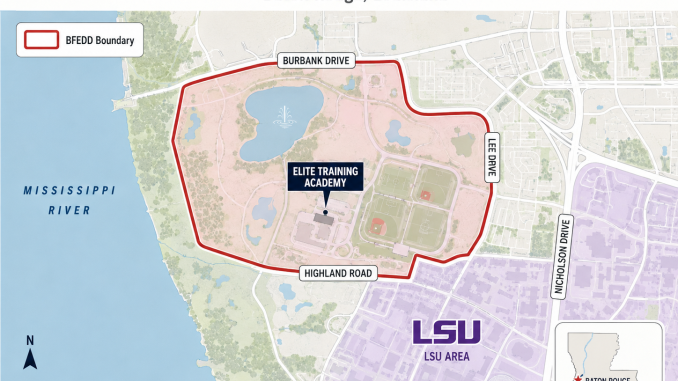
Column S applies to the portion of BFEDD inside Baton Rouge city limits, under domicile code 2717. Column T applies to the portion of BFEDD in unincorporated East Baton Rouge Parish, under domicile code 2718.
The columns do not stack on top of each other. A business reports sales in the applicable column based on where it is located — either the city portion of BFEDD or the unincorporated parish portion. The notice states that each column carries a total local sales and use tax rate of 7.5%.
“All sales made within the Bayou Fountain EDD should be reported in these columns as applicable,” the notice says.
The City-Parish notice confirms that tax reporting machinery for BFEDD is now active, despite unresolved questions about the district’s proposed public-finance structure, the status of the deferred CEA and objections from the Duplantier family, which says it owns a majority of the land inside the district.
The Metro Council created BFEDD on April 22. The district was designed to support economic development near Burbank Drive, Lee Drive and the LSU area, including sports-tourism projects connected to Elite Training Academy.
The BFEDD board later moved to levy additional district taxes. Public notices previously stated the district intended to levy a 2% sales and use tax and a 2% hotel occupancy tax inside its boundaries.
The Metro Council was scheduled to vote June 24 on a Cooperative Endeavor Agreement between the City-Parish and BFEDD. That agreement would establish how certain tax revenues, rebates and pledged increments would be handled between the City-Parish and the district.
Instead, the Council deferred the item until Aug. 26.
The deferral followed objections from members of the Duplantier family, who have said they own approximately 57% of the land inside BFEDD and were not meaningfully notified before the district was created. The family has also said its property is not for sale to Elite.
Steve Legendre, speaking for the Duplantier family, said the family believes less than 2% of the land inside the district can be developed without affecting Duplantier-owned property. He said the family has no intention of selling its land to Elite.
That claim, if confirmed by maps and parcel records, would raise a central question about BFEDD’s viability: whether the district can accomplish its proposed development goals without the land its primary landowners say is unavailable.
The tax notice sent to businesses does not resolve where collected BFEDD revenue will be held while the CEA remains deferred. It also does not state whether any tax proceeds can be remitted to BFEDD, spent, pledged, rebated or reimbursed before the CEA is approved.
Those questions are now central to the public debate surrounding BFEDD.
The City-Parish has confirmed separately that an email search related to Tiger Rag’s public-records request on BFEDD returned nearly 800 responsive emails. Those records have not yet been produced. The City-Parish has said production is expected July 9.
Tiger Rag has requested records related to BFEDD’s formation, communications involving City-Parish officials, the district’s boundaries, the Duplantier property, Elite Training Academy, Greg Stringfellow, Carlos Spaht, 820 Development Group, Elite Landowning Company and the proposed CEA.
Greg Stringfellow is the head of Elite Training Academy and president of 820 Development Group, LLC, which the Duplantier family identified in its May 26 objection letter as one of the entities involved in BFEDD. Stringfellow has also publicly spoken as a representative of the district.
Tiger Rag has requested clarification on Stringfellow’s formal role with BFEDD, the identities of BFEDD board members, who appointed them and whether any BFEDD tax proceeds could directly or indirectly benefit Elite, 820 Development Group or related entities.
The public question is no longer only whether the Metro Council will approve the CEA in August.
The tax reporting requirements are now active.
The CEA remains deferred.
The public records remain pending.
And the landowners at the center of the district say they never consented to inclusion and will not sell the land that district backers have described as central to future sports-tourism development.
Tiger Rag is requesting clarification from City-Parish officials on where BFEDD tax collections will be deposited while the CEA remains deferred, whether any funds can be remitted or spent before the CEA is approved, and what happens to collections if the Council later amends the district boundary or rejects the agreement.



Be the first to comment