
Todd Horne Column
Ole Miss Was The Warning. Marcel Reed Is The Test For LSU’s Defense
The Tigers are not yet the transformed defense they appeared to be through two games. Now they face the mobile quarterback who has dismantled Blake Baker’s unit twice—and they must do it without Dashawn Spears.
Lane Kiffin’s Monday review of LSU’s 32-24 loss at Ole Miss indirectly supported the central conclusion of my postgame column, but the point is no longer what happened Saturday night. LSU has a more urgent problem coming through the front door.
The Tigers’ defense is not yet as improved as LSU believed it was after overwhelming Clemson and Louisiana Tech. Three games into the season, that is the most consequential truth to emerge from Oxford.
LSU allowed Clemson 145 yards, including 40 rushing, in a 51-10 destruction that made the reconstruction appear nearly complete. Louisiana Tech produced no offense at all before halftime a week later. LSU arrived at Ole Miss with the nation’s highest pressure rate, two weeks of overwhelming evidence and every reason to believe defensive coordinator Blake Baker finally possessed the personnel required to play his defense without compromise.
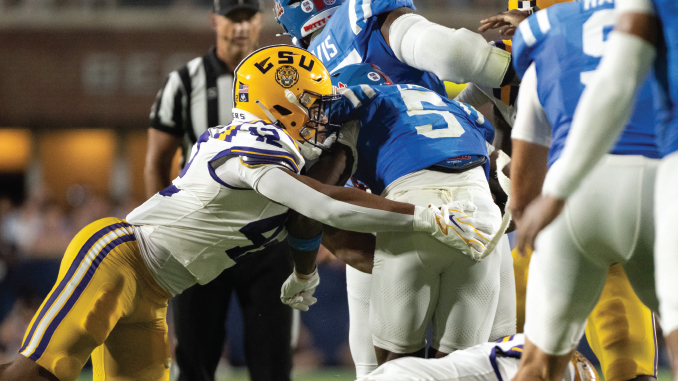
Trinidad Chambliss punctured that belief in two quarters. Ole Miss gained 289 yards before halftime. Chambliss completed all eight of his third-down passes, threw for 248 yards and repeatedly turned LSU’s pressure into empty pursuit. LSU could not make him uncomfortable, could not tackle consistently after the catch and could not leave the field on the down designed to end possessions.
The second-half recovery was real. LSU pressured Chambliss, intercepted him, sacked him for a 20-yard loss and held Ole Miss scoreless in the third quarter while the Tigers erased a 17-point deficit. Kiffin’s film review explained the movement from a conservative opening plan toward greater aggression, confirming that LSU did not merely execute the same approach better after halftime. It changed how it defended the quarterback.
The danger now is allowing that recovery to obscure what preceded it. LSU found a better answer after Chambliss had established the game, then watched him drive Ole Miss 75 yards for the winning touchdown after the score reached 24-24. The defense improved within the night. It did not prove that the larger problem had been solved.
Texas A&M quarterback Marcel Reed arrives next with two years of evidence against Baker that LSU cannot explain away. In 2024, Reed entered the LSU game during the third quarter with Texas A&M trailing 17-7 and its offense stalled. He carried nine times for 62 yards and three touchdowns, completed both of his passes for 70 yards and transformed the game into a 38-23 Texas A&M victory.
Reed returned as the starter in Tiger Stadium last season and was even more destructive. He rushed 13 times for 108 yards and two touchdowns, including a 41-yard scoring run, while passing for 202 yards and two more scores in a 49-25 victory. LSU intercepted him twice and still allowed him to produce 310 yards of total offense and four touchdowns.
Across those two games, Reed has rushed for 170 yards and five touchdowns against Baker’s LSU defenses. Texas A&M has won by a combined 39 points. Those were not two versions of the same game, either: Reed changed the first one from the bench and controlled the second one from the opening drive.
He enters this meeting with legitimate weaknesses. Reed is not an established high-level passer, and Kentucky forced him to show why Saturday. He completed 26 of 49 passes for 236 yards, threw two interceptions and failed on several throws that were available as the Wildcats upset Texas A&M 31-21 in College Station.
Reed had also been unusually quiet as a runner through the Aggies’ first two games, gaining 37 yards on 14 attempts. Kentucky did not contain him that way. Reed ran for 80 yards and a touchdown, raising his season total to 117 yards on 24 carries. Even during one of his poorer passing performances, his legs remained the part of the offense the defense could not remove.
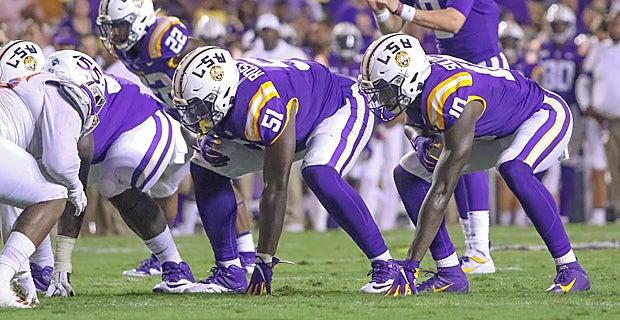
That combination presents LSU with a more complicated problem than simply assigning a defender to spy on the quarterback. Baker must pressure Reed without creating the escape lanes Reed has used to punish LSU twice. The edge rushers must compress the pocket without running beyond him. The interior rush must remain coordinated. Linebackers must distinguish the running back from the quarterback quickly enough to avoid losing either, and the secondary must hold its coverage when Reed extends the play.
LSU cannot retreat into the soft structure Chambliss dismantled. It also cannot chase Reed recklessly and abandon the escape lanes he has exploited twice.
The correct approach lives between those failures: controlled aggression, disciplined lanes, secure tackling and a willingness to force Reed to prove he can sustain drives with his arm.
LSU must construct that answer without Dashawn Spears. Spears tore the anterior cruciate ligament in his knee against Ole Miss and will miss the remainder of the season. His absence would damage LSU against any opponent. It becomes especially important against Texas A&M because the STAR position exists inside the conflict Reed creates.
The STAR must cover the slot, fit the run, tackle in space, understand option responsibility and react when the quarterback turns a pass concept into a scramble. Spears had emerged as one of LSU’s most dependable defenders in that hybrid role. When he left Saturday, Tamarcus Cooley moved to STAR and Jhase Thomas replaced Cooley at safety, meaning LSU did not make one substitution. It changed two positions within the structure of its secondary.
Texas A&M will test both changes. Motion, option looks and Reed’s ability to hold the ball long enough to distort run fits can force the STAR to make several decisions within the same play. One false step can open the edge. One lost assignment can leave a receiver uncovered behind the defender reacting to Reed.
LSU still owns the personnel advantage in enough places to control this game. Texas A&M is also 2-1, just lost at home to an unranked opponent and has not developed Reed into a passer who should frighten an elite defense. Kentucky pressured him, challenged his accuracy and forced him into two interceptions. LSU should be capable of doing the same, but “should” is no longer sufficient evidence.
Clemson and Louisiana Tech allowed LSU to play from ahead, unleash its pressure and confirm what it already believed about itself. Ole Miss forced the defense to adjust after its original approach failed. Texas A&M now asks whether the adjustment can become a plan rather than a halftime repair.
Reed does not have to become Chambliss as a passer to threaten LSU. He only has to remain the Marcel Reed who has already beaten Baker’s defenses with his legs in consecutive seasons. LSU knows exactly what is coming, which removes surprise as an explanation if it happens again.
The question Saturday is not whether LSU’s defense improved during the Ole Miss game. It did. The question is whether it has improved enough since the previous two meetings with Reed to prevent history from becoming scheme.
LSU believed the first two games had supplied the answer. Ole Miss proved the examination had barely begun.
Be the first to comment