
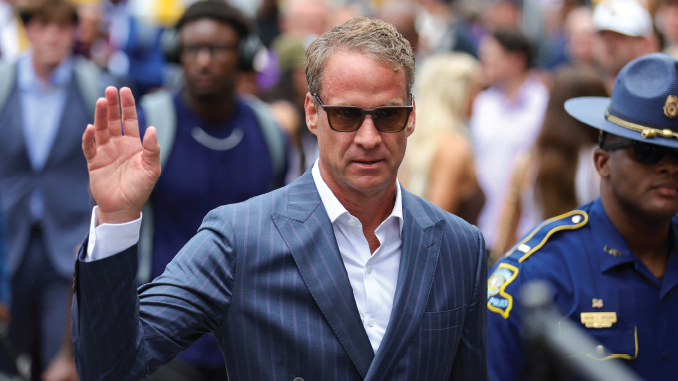
Todd Horne Column
The SEC’s Audacity: Accusing LSU of Lacking Institutional Control
The SEC decided Lane Kiffin orchestrated a national crisis he did not create—and treated LSU’s failure to stop him as institutional collapse.
The SEC is angry at Lane Kiffin. It has mistaken that anger for evidence.
Then it turned its resentment toward one coach into an accusation that LSU lacks institutional control.
That is the real story now emerging from the conference’s federal lawsuit, the threat to LSU’s membership and the anonymous SEC officials lobbying for Kiffin to be suspended even after LSU left the disputed players off its roster.
The SEC appears to have reached an emotional conclusion: Kiffin orchestrated the eligibility crisis, LSU failed to control him, and that failure proves LSU lacks institutional control.
Every part of that conclusion is either unproven, historically hypocritical or demonstrably wrong.
Kiffin did not create the eligibility crisis. It began in Colorado, spread into more than 60 lawsuits and now involves approximately 450 athletes nationwide. Most have no connection to Kiffin, LSU, Louisiana or former NFL training camps.
LSU did not bring the Louisiana case. The athletes did. LSU did not ask Judge William Jorden for a preliminary injunction. The judge protected LSU at the end of the hearing so the SEC could not punish the university if it rostered the athletes his order protected.
And LSU ultimately did not roster Dae’Quan Wright or Zxavian Harris.
The conference remained angry anyway.
A USA TODAY report published Wednesday stripped away much of the institutional language. An anonymous senior SEC football administrator said LSU had “lost control and harmed” its reputation, then made the desired punishment personal: “I hope they’ll suspend Lane. If not, he won’t feel it and won’t care.” Another conference official complained that Kiffin “loves the attention.”
Kiffin’s swagger did not create the crisis, but it gave angry conference officials a face on which to hang it.
Paul Finebaum says “no one” outside Louisiana likes Lane Kiffin, amid SEC eligibility battle.
— wdsu (@wdsu) September 9, 2026
That is not a finding. It is not a standard. It is not an adjudicative process.
It is irritation with Lane Kiffin dressed in the language of institutional governance.
Eleven current SEC universities have been found and penalized by the NCAA for lack of institutional control. Together they account for 19 final NCAA findings. Seven received at least one while competing in the SEC. Four others were admitted to the conference with those findings already in their histories.
None was expelled.
LSU is not one of the 11.
Yet the SEC declared in an amended federal complaint that LSU’s conduct “confirm[s] the lack of institutional control over the athletics program at LSU that is required by Article 6 of the SEC Constitution.”
That sentence is not incidental legal phrasing. It is the conference converting its theory about Kiffin into an institutional verdict against LSU.
Commissioner Greg Sankey then disclosed that, at the informal direction of the other 15 presidents and chancellors, he called a Special Meeting at which they could consider terminating LSU’s membership—whether LSU abandoned its effort to roster two former NFL players or not.
Tiger Rag confirmed Wednesday that no expulsion vote is expected Thursday. That is not proof that the SEC has withdrawn the accusation, permanently abandoned expulsion or ended the federal case. It means only that the immediate vote came off the agenda.
But the vote is not the lead. The accusation is—and the anger underneath it.
The SEC borrowed the NCAA’s gravest institutional label, pronounced that LSU’s conduct confirmed it and brandished the ultimate punishment before defining the offense, establishing an adjudicative process or holding anything resembling a trial.
The SEC decided Kiffin started the fire. Then it accused LSU of institutional failure for not extinguishing it.
The fire started in Colorado
The chronology matters because it dismantles the emotional premise beneath the SEC’s case.
After the NCAA adopted its new five-seasons-in-five-years eligibility model in June, athletes from the 2022 high-school class challenged the transition rule that excluded them. The pivotal national action began in Colorado. From there, litigation spread across the country.
The NCAA’s figures place approximately 450 athletes in the litigation and roughly 300 under at least temporary relief. They are spread across dozens of schools, multiple sports and more than 60 cases. Only a small fraction had signed NFL contracts before seeking another college season.
The SEC’s own complaint acknowledges the sequence. It says the NCAA adopted the new model. It says members of the 2022 class then began filing lawsuits across the country. Only after that does the complaint allege that LSU saw an opportunity and began pursuing players coming out of NFL camps.
Lane Kiffin did not start the fire. LSU became the place where the SEC decided to fight it.
The conference makes a narrower and serious allegation. It says LSU and Kiffin conducted an “orchestrated campaign” to contact professional players or their representatives, encourage litigation and bring successful plaintiffs back to LSU.
But the public evidence offered for that allegation remains remarkably thin. The complaint relies principally on an anonymously sourced CBS Sports report and public statements Kiffin made on Aug. 24, Aug. 25 and Aug. 31.
The Louisiana athletes filed their case on Aug. 19.
Kiffin’s words prove LSU wanted the players. They may prove LSU intended to take advantage of a legal opening if one survived. They do not prove LSU selected the venue, hired the lawyers, controlled the plaintiffs or initiated the lawsuit that had already been filed.
The complaint publicly identifies no LSU email or text directing litigation, no sworn declaration from a player or agent, no financial arrangement with counsel and no firsthand witness saying Kiffin ordered anyone to sue.
Discovery may produce such evidence. If it exists, the SEC should present it.
What the conference may not honestly do is collapse two different propositions into one. Recruiting athletes who are already litigating is not the same thing as creating their litigation. Participating in one corner of a nationwide controversy is not the same thing as orchestrating the whole crisis.
LSU did not ask the court to protect it
The SEC’s emotional narrative also obscures LSU’s actual procedural role.
The athletes went to the 19th Judicial District Court. They asked for relief. LSU was not the plaintiff seeking another season for them.
After a nine-hour hearing, Judge Jorden granted the preliminary injunction. At the last minute, he also barred the SEC from punishing LSU, its coaches or its administrators if the university rostered athletes protected by his order.
LSU did not ask the court to manufacture that shield. Jorden supplied it because protecting the athletes would mean little if the SEC remained free to impose a half-season coaching suspension, seize half of a sport’s operating budget or otherwise punish the school for honoring the injunction.
The SEC then recast the protection LSU had not requested as part of a confrontation LSU supposedly engineered.
It filed its separate federal action in Alabama. It named LSU, Athletic Director Verge Ausberry and Kiffin as defendants. It later amended the complaint, accused LSU of lacking institutional control and invoked the possibility of expelling a founding member.
Then LSU filled its final two roster positions with Aidan Anding and Gabriel Reliford. Wright and Harris cannot be added this season. The immediate conduct the SEC said it feared became impossible.
Still, according to USA TODAY, conference officials continued discussing a Kiffin suspension, institutional sanctions and a potentially massive fine.
Why punish Kiffin after LSU closed the roster?
One anonymous administrator supplied the answer: Otherwise, Kiffin would not “feel it.”
There it is.
This is punishment as emotional instruction. The conference wants Kiffin to feel its authority, and it blames LSU for allowing him to challenge it.
That may explain the anger. It does not establish lack of institutional control.
What “lack of institutional control” means
“Lack of institutional control” is not a colorful way to say a university angered its commissioner. It is not a synonym for disobedience, embarrassment or aggressive lawyering.
In NCAA enforcement, it is a formal institutional violation. It means a university failed fundamentally to establish, communicate, monitor and enforce compliance throughout its athletics operation. It is more serious than a finding that a school failed to monitor a particular coach, program or part of the department.
The NCAA does not simply announce that conclusion in a lawsuit. Its enforcement staff investigates. The university receives specific allegations and answers them. An adjudicative body determines what the evidence proves. The institution may appeal.
The proper terms are “found,” “determined” or “sustained,” not “convicted,” because this is not a criminal proceeding.
By any of those formulations, LSU has never been found to lack institutional control.
The NCAA tried.
Its enforcement staff included the accusation in the football and men’s basketball case resolved in 2023. The Independent Accountability Resolution Panel sustained multiple violations and found that LSU failed to monitor its football program. It imposed recruiting restrictions, ordered 37 football victories vacated and placed LSU on three additional years of probation.
But the panel did not sustain lack of institutional control.
That is not a technicality. It is the difference between an allegation and a judgment.
The SEC nevertheless claims the authority to supply the judgment the NCAA declined to make. But confirmed by whom? Under what standard? After what hearing?
The SEC has no public history of adjudicating a lack-of-institutional-control case against one of its members. It has published no body of precedent defining the violation. It has identified no evidentiary standard separating failure to monitor from institutional collapse. It has shown no familiar path through notice, response, hearing, judgment and appeal.
It has an allegation in a complaint, a declaration from Sankey and a threat of expulsion.
That is not an adjudicative system. It is power pretending to be one.
LSU’s record is ugly. That is not the same finding.
None of this requires pretending LSU has been a model institution. It has not.
- 2011–12 — An NCAA major-infractions case involving football recruiting violations put LSU on probation.
- 2012–17 — Booster John Paul Funes provided approximately $180,000 in impermissible benefits to the family of a football player, using money embezzled from a hospital foundation.
- 2013 — LSU’s investigation of football coach Les Miles was intentionally stored outside the university’s normal records system. Then-athletic director Joe Alleva recommended firing Miles. LSU kept him.
- 2017–19 — Basketball coach Will Wade was caught on an FBI wiretap discussing a “strong-ass offer.” LSU suspended Wade in 2019 after he refused to meet with university and NCAA officials, then reinstated him five weeks later.
- 2020 — LSU’s mishandling of sexual-misconduct allegations was exposed. Odell Beckham Jr. handed cash to LSU players after the national championship game. LSU later self-imposed scholarship reductions, recruiting restrictions and a bowl ban while the NCAA investigation continued.
- 2021 — An independent review found systemic Title IX failures. Verge Ausberry was suspended for 30 days without pay.
- 2022 — LSU fired Wade after receiving an NCAA Notice of Allegations containing multiple Level I charges. In a separate case, the NCAA found that the football program committed recruiting violations during the COVID-19 dead period and imposed another year of probation.
- 2023 — The larger football and basketball case was resolved. LSU received more punishment, including three additional years of probation beginning when the previous probation ended on Sept. 21, 2023.
- 2024 — LSU paid $1.9 million to settle Title IX claims without admitting liability.
- 2026 — LSU rehired Wade. The athletic director announcing the decision was Ausberry. LSU pursued international professional basketball players, an NBA draft pick and players with other professional experience. It explored outside capital connected to future SEC media revenue. Its football program pushed to add players who had signed NFL contracts and gone through NFL camps.
Different coaches. Different scandals. The same institution—and, in some cases, the same people.
That history invites scrutiny. It justifies skepticism. It may support an argument that LSU’s leaders have repeatedly tolerated risk, hidden from hard decisions or treated rules as obstacles to be maneuvered around.
What it does not do is permit the SEC to skip the part where it defines and proves the charge.
LSU’s NCAA probation expires Sept. 21. The SEC scheduled its Special Meeting for Sept. 10—eleven days before that expiration.
Being on probation does not establish lack of institutional control. Neither does a long list of institutional failures, no matter how embarrassing, when the body that actually adjudicated the allegation declined to sustain it.
The SEC does not get to transform accumulation into adjudication merely by using a loaded phrase in federal court.
The SEC’s grievance is emotional. Its weapon is institutional.
The USA TODAY report makes the psychology of the conference’s response unusually visible.
Senior football officials are not quoted discussing an evidentiary standard for institutional control. They are quoted discussing Kiffin’s personality, his appetite for attention and whether a suspension would make him care. One reportedly hopes the SEC will remove him from LSU’s Sept. 19 game at Ole Miss. The Big Ten’s 2023 suspension of Michigan coach Jim Harbaugh is being offered as a model.
That comparison exposes the problem. The Harbaugh matter involved allegations of a prohibited scouting operation affecting competition. This matter began with a national legal revolt against an NCAA eligibility transition rule. The athletes went to court and won protection. LSU explored whether two of them could play, then left both off its roster.
The common element is not the conduct. It is that conference officials want a coach publicly disciplined.
Louisiana Attorney General Liz Murrill identified the real struggle when I asked her during an interview carried by Tiger Rag Radio why the SEC was pressing so hard.
“I think this is about power and the fact that their power and their rules have been challenged, and they don’t like it. It’s that simple.”
Louisiana Attorney General Liz Murrill
Asked about the SEC’s federal lawsuit, Murrill called it “legal gamesmanship” and said, “I think it’s garbage.”
“It’s not about Lane Kiffin,” Murrill also said. “It’s about these individuals who want to play.”
What changed was not Lane Kiffin’s personality. What changed was that a court restrained the SEC’s power to punish one of its members—and the conference experienced judicial review as institutional rebellion.
The SEC is entitled to defend its rules. LSU is not entitled to ignore them merely because it dislikes them. Recruiting Wright and Harris was aggressive. Encouraging litigation, if the SEC eventually proves that occurred, would raise legitimate questions about LSU’s judgment and its obligations to the conference.
But the SEC has skipped from suspicion to condemnation. It believes Kiffin turned a nationwide legal crisis into a personal campaign against conference authority. It believes LSU either approved the campaign or failed to stop him. It then attached “lack of institutional control” to that belief before publicly proving the orchestration allegation or adjudicating the institutional charge.
This stopped being about two roster positions when LSU filled them and the SEC kept discussing punishment.
It became about making Lane Kiffin—and LSU—feel the power they had challenged.
This is what happens when a commissioner begins treating disagreement as disloyalty, litigation as rebellion and his authority as sovereignty.
The 11 SEC schools the NCAA found lacked institutional control
This is the history that exposes the SEC’s hypocrisy.
It is not a list of schools accused by the SEC. The conference has never publicly adjudicated such a case against one of its members.
These are the 11 current SEC universities that the NCAA found and penalized for lack of institutional control. Together, they account for 19 final NCAA findings. Seven received at least one while they belonged to the SEC. Four others carried such findings in their records when the SEC later admitted them.
None was expelled.
Alabama — 1995
Improper bank loans and inadequate university handling of the underlying records. The NCAA imposed probation and other penalties; portions of the decision were later modified on appeal. Alabama remained in the SEC.
Auburn — 1993
The Eric Ramsey case involved cash and unsecured loans to players, extra benefits and unethical conduct. The NCAA imposed probation, scholarship reductions, a postseason ban and television penalties. Auburn remained in the SEC.
Florida — 1985
The Charley Pell-era football case involved widespread violations concerning recruiting, improper benefits, outside funds, practices and complimentary tickets. The NCAA penalized Florida. Florida remained in the SEC.
Kentucky — 1976, 1989 and 2002
The cases involved recruiting violations, improper benefits, outside funds, cash provided to a prospect, academic fraud, falsified records and deficient fiscal control. The NCAA penalized Kentucky each time. Kentucky remained in the SEC after all three findings.
Mississippi State — 1975 and 1996
The cases involved recruiting inducements, extra benefits, transportation, recruiting entertainment and unethical conduct. The NCAA penalized Mississippi State. Mississippi State remained in the SEC.
Missouri — 1979 and 1990
The cases included improper recruiting, extra benefits, financial-aid violations and unethical conduct. Both findings occurred while Missouri belonged to the Big Eight. The SEC admitted Missouri in 2012.
Oklahoma — 1960 and 1988
The cases involved improper financial aid, recruiting inducements, benefits, transportation, outside funds and unethical conduct. Both findings preceded Oklahoma’s SEC membership. The SEC admitted Oklahoma in 2024.
Ole Miss — 1994 and 2017
The cases involved booster recruiting, inducements, extra benefits and unethical conduct. The 2017 decision described an unconstrained football culture. The NCAA penalized Ole Miss. Ole Miss remained in the SEC.
South Carolina — 1991 and 2005
The first finding came shortly before South Carolina joined the SEC. The second involved impermissible tutoring, extra benefits, unethical conduct and failure to monitor. The NCAA penalized South Carolina. South Carolina remained in the SEC.
Texas — 1987
The case involved improper entertainment, financial aid, lodging, transportation, extra benefits, complimentary tickets and recruiting violations. The finding occurred while Texas belonged to the Southwest Conference. The SEC admitted Texas in 2024.
Texas A&M — 1988 and 1994
The cases involved improper employment, benefits, recruiting violations and a booster jobs program that paid athletes for work they did not perform. The NCAA classified Texas A&M as a repeat violator. Both findings occurred in the Southwest Conference. The SEC admitted Texas A&M in 2012.
When Alabama, Auburn, Florida, Kentucky, Mississippi State, Ole Miss and South Carolina received at least one such finding while belonging to the SEC, they stayed.
When Missouri, Oklahoma, Texas and Texas A&M sought admission with such findings in their histories, the SEC welcomed them.
LSU, which has never received the finding, was threatened with expulsion on the strength of an unadjudicated SEC allegation.
That is the hypocrisy in one sentence.
The expulsion vote receded. The accusation did not.
The SEC can argue that Article 6 of its constitution gives the presidents and chancellors authority to decide whether a member maintains institutional control. Conference membership is contractual, it can argue, so the SEC need not duplicate the NCAA’s enforcement process.
Fine.
Then what process does it use?
What is the definition? What evidence is required? Who decides what has been proved? How does LSU answer? What separates failure to monitor from lack of institutional control? What precedent guides the decision? Why would this LSU dispute warrant expulsion when actual NCAA findings against other members did not?
The SEC has answered none of those questions publicly.
Instead, it borrowed the NCAA’s most damaging institutional label while discarding the procedures that give the label meaning. Then it attached the possibility of expulsion—not after a hearing or judgment, but while its publicly identified evidence of Kiffin’s alleged orchestration remained principally an anonymously sourced news report and Kiffin comments made after the Louisiana case was filed.
By Wednesday, Tiger Rag had confirmed that no expulsion vote was expected at Thursday’s meeting. A subsequent USA TODAY report said conference officials no longer appeared to be seriously considering removal after LSU closed its roster.
Neither report establishes that the SEC has withdrawn the accusation, permanently renounced expulsion or dismissed its federal case. More important, neither can erase that the conference brandished the threat.
It worked. Wright and Harris won an injunction but will not play for LSU. The roster closed. President Wade Rousse sent Sankey a letter pointing to LSU’s decision. The SEC obtained the immediate practical outcome it wanted without first proving that Kiffin orchestrated the litigation.
Yet conference officials still wanted punishment. Not because the players remained on the roster. Not because LSU had defied the final deadline. Because, in the words supplied anonymously to USA TODAY, Kiffin otherwise might not “feel it.”
That is not strong governance.
It is wounded authority looking for someone to hurt.
Lane Kiffin did not create the crisis. It began in Colorado, spread into more than 60 cases and reached approximately 450 athletes before LSU became the SEC’s chosen battleground.
If the conference believes LSU helped engineer the narrower NFL-player litigation, it should prove it. If it believes LSU lacks institutional control, it should define the offense, adjudicate it and explain why LSU deserves a threat never used against members with 19 actual NCAA findings.
Until then, this is not institutional control. It is institutional anger—and institutional power.

Be the first to comment