
The Eligibility Intelligence Report
What happened, what ten Tiger Rag columns established and what comes next in the LSU–SEC fight
I learned first-hand over the weekend that a lot of people are counting on Tiger Rag to make this eligibility fight understandable. They are not asking us to tell them whom to cheer for. They are asking more basic and more important questions: Which court order exists? What does it do? Who is bound by it? What did LSU decide? What can the SEC do next? And what would actually change the legal position this week?
That reliance creates a responsibility. This story has moved through NCAA legislation, SEC policy, a sanctions package, two court systems, a nine-hour hearing, an injunction, a federal lawsuit, a Clemson contract warning and an LSU roster decision. Each development has produced rhetoric faster than it has produced clarity. So this report puts the events back in order, audits what our ten columns established as the dispute unfolded and identifies the few events that can materially change the picture this week.
That is the present tense of this case.
What actually happened
The origin of the fight was not Lane Kiffin, Greg Sankey or LSU. It was a transition problem created when college athletics changed its eligibility architecture after athletes had already made decisions under the old one. Members of the 2022 class completed four seasons and were told their college eligibility was exhausted. Some, including Wright and Harris, pursued professional football because college football had closed its door. The NCAA later created a path to a fifth season but excluded players who had exhausted their eligibility in 2025–26.
That chronology matters because it separates this group from athletes who knowingly chose professional football over an available college season. Wright and Harris did not possess that choice when they signed NFL contracts. Their fifth-season possibility appeared later through a rule change and then through court orders. One may still believe former NFL exposure creates a competitive advantage. It plainly can. But the legal and equitable question is whether a contract signed after college eligibility had ended should retroactively extinguish an opportunity that did not exist when the contract was signed.
As courts began granting temporary relief, LSU pursued players who became potentially available. Kiffin moved quickly and aggressively, but he did not create the fifth-year policy, the exclusion, the lawsuits or the resulting market. The SEC then established a separate barrier for athletes who crossed specified professional thresholds and attached extraordinary institutional penalties to its rule. Those penalties included a half-season suspension for a head coach, a fine equal to 50 percent of a sport’s annual operating budget, the loss of voting rights and additional commissioner authority. LSU abstained from the vote.
The sanctions were the enforcement mechanism. An athlete could win relief from an NCAA rule and still have no usable remedy if his university feared crushing conference punishment for putting him on the field. Once Wright, Harris and other plaintiffs challenged that mechanism, the case necessarily expanded from NCAA eligibility into the limits of conference power.
Judge Jorden first restrained the SEC temporarily and, after a nine-hour hearing, issued a preliminary injunction. Claims against the conference had been narrowed to seven plaintiffs with direct SEC connections, including Wright and Harris. The court preserved the covered athletes’ fifth-season opportunity while the underlying litigation continues and restrained the NCAA and SEC from blocking or punishing its use. Judge Jorden did not abolish eligibility limits, decide the entire case permanently or erase the SEC’s general authority to govern its members. He decided that the plaintiffs had shown enough at this stage to receive protection before the season—and their opportunity—disappeared.
The SEC complied with the order while contesting it. That was not surrender. A party can obey a court and challenge its ruling at the same time. The conference announced an appeal and filed a federal complaint against LSU and its officials in Alabama, asserting a First Amendment right of expressive association. The complaint asks a federal court to protect the SEC’s ability to disassociate itself from conduct it says conflicts with the conference’s identity and purpose.
But a complaint is a request for judicial action, not judicial action itself. As of this report, the public docket reflected no federal restraining order against LSU. Likewise, an appeal does not automatically stop a Louisiana preliminary injunction. Louisiana Code of Civil Procedure Article 3612 permits an immediate appeal but says the injunction is not suspended during that appeal unless a court orders a suspension.
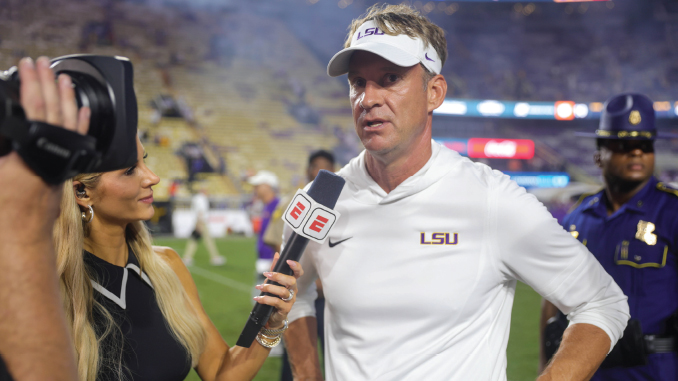
LSU then made the most consequential non-judicial decision of opening weekend. The university submitted a 103-player roster and omitted Wright and Harris. Both remained enrolled, and LSU retained two open spots, but neither could practice until formally added to the 105. LSU therefore preserved the ability to use Judge Jorden’s protection later while declining to use it against Clemson. Kiffin said he believed the players had the right to participate but chose what he called the “big picture of LSU” amid continuing uncertainty.
Clemson had supplied some of that uncertainty by warning LSU that using former professionals could breach the schools’ game contract, even while saying it would play and would not seek damages. LSU did not use the players and won 51–10. The Clemson threat is now moot as to that game, but its function deserves to be remembered: after a court neutralized NCAA and SEC sanctions, a private opponent attempted to create another deterrent.
What the ten columns did
The value of the ten-column series is not that every development could be predicted. Courts, litigants and universities always retain choices. Its value is that the columns identified the structure of the dispute early enough for readers to understand each choice when it arrived.
1. It established the reliance problem
“These Players Didn’t Leave College. College Left Them.” began with the most important human and legal fact: the Class of 2022 athletes acted after college athletics told them they were finished. The column separated a prospective rule—one that tells athletes today what choices will cost them tomorrow—from a retroactive consequence imposed on decisions already made. Wright and Harris later testified that they would not have signed professional contracts had a fifth college season been available. Their chronology became central to the claim of irreparable harm.
2. It located the real authority question
“Authority” argued that SEC organizational power is real but is not legal supremacy. Voluntary associations can make rules, discipline members and protect a common product. They still operate inside a larger legal system. The point was not that every SEC eligibility rule is an antitrust violation or that a judge automatically outranks every private rule in every setting. The point was that authority becomes meaningful when it survives a properly presented legal challenge. Within days, Sankey was testifying in Baton Rouge and the conference’s enforcement power was before a judge.
3. It forced the phrase “former professional” to become an actual rule
“Define Pro” showed why the label was rhetorically powerful and analytically incomplete. Monte Harrison could spend a decade in professional baseball, play 50 Major League games and later play SEC football at Arkansas. Cole Hutson could attend two NFL rookie minicamps without signing a contract and remain eligible at Texas. Harris could sign with New Orleans, suffer an injury and be released before a preseason game, yet be barred at LSU. Wright could sign, move through two clubs and play in the preseason, with the same result. The actual dividing lines were not simply professional versus amateur; they were contract, roster, league, sport and timing. Those distinctions became vulnerabilities under oath.
4. It explained why compliance was not capitulation
“The SEC Will Comply. Now We Find Out Where Its Authority Ends.” rejected the easy storyline that Kiffin had won and Sankey had backed down. The SEC’s compliance showed respect for a binding order, not agreement with it. The next phase would be litigation over the source and limit of conference authority. That is what followed: continued opposition in Louisiana, a stated appeal and a federal case in Alabama.
5. It explained eligibility by jurisdiction
“What’s Really Going On in the College Football Eligibility Fights” described the collapse of the old, clean hierarchy in which the NCAA made a rule, conferences followed it and schools obeyed. Athletes in different states were receiving different answers from different courts. LSU soccer players Jazmin Ferguson and Jocelyn Ollivierre were able to participate after a court order and conference compliance, demonstrating that judicial authority—not the NCAA handbook alone—controlled their status that afternoon. Louisiana did not create the national disorder; it made that disorder impossible to ignore.
6. It identified the institutional crisis beyond the roster
“How LSU Navigates Court Eligibility Rulings Will Be Bigger Than Football” examined reported possibilities such as probation, championship exclusion, a school boycott, federal litigation and even expulsion. It treated the last of those as dramatic but less likely than a judicial second front. The deeper issue was self-governance: could the SEC preserve uniform rules when a member institution was protected by a state-court order? The conference answered three days later by suing LSU in federal court.
7. It read LSU’s abstention accurately
“The SEC’s Authority Has Reached the Courthouse. Now It Must Defend It.” explained that LSU President Wade Rousse’s abstention from the sanctions vote was neither rebellion nor consent. It placed LSU outside the conference consensus without pretending the university had left the conference structure. That distinction became more consequential when the SEC named LSU, its Board of Supervisors, Rousse, Athletics Director Verge Ausberry and Kiffin in the federal complaint.
8. It clarified what Louisiana Attorney General Liz Murrill asked the court to decide
“Liz Murrill Tells the Court Why It Must Define SEC Authority” did not claim that Murrill had demanded automatic eligibility or an immediate contempt finding. Her argument was narrower and stronger: if conference sanctions could frighten LSU out of using court-ordered protection, the athletes’ relief would become meaningless. Judge Jorden’s later description of the SEC penalties as a “big gun” aimed at LSU captured the same practical problem.
9. It brought readers inside the hearing without oversimplifying it
“The Rabbit Got the Gun — And Nobody Could Define a Pro” synthesized a nine-hour proceeding in which the professional-status rule and the power beneath it were tested in public. Sankey testified for more than three hours and deserves credit for appearing and defending the conference’s position. The hearing nevertheless exposed how difficult it was to explain why certain professional experiences disqualified athletes while comparable or greater experiences in other settings did not. Judge Jorden granted preliminary protection but declined to find contempt, preserving the distinction between a vulnerable policy and a proven violation of the earlier order.
10. It identified Clemson’s warning as a substitute deterrent
“Clemson Threatens LSU For Obeying Court” explained that Clemson had picked up the practical leverage after the court took the SEC’s penalties off the table. The warning did not stop the game, create damages or produce a later claim because LSU withheld the players. But it revealed how institutional pressure can migrate. When one enforcement route closes, another interested party may attempt to recreate the same result through contract, scheduling or association power.
Taken together, the columns moved readers through five layers of the same story: reliance, definition, sanctions, jurisdiction and institutional power. They also imposed discipline on our own language. “Former professional” needed a definition. “Compliance” did not mean agreement. An SEC rule was not the same thing as a court order. A preliminary injunction was not a final judgment. And a federal complaint was not federal relief.
What Judge Jorden’s order did—and what LSU did
This is the area where precise wording matters most. The strongest accurate description is that Judge Jorden’s order removed every NCAA and SEC barrier before him and was intended to make Wright’s and Harris’ fifth-season opportunity real. LSU chose not to use that protection for the opener.
The order should not be described as a final resolution of the athletes’ eligibility or a permanent elimination of conference governance. Nor should its practical force be minimized. A one-season athlete can lose the entire value of his claim while lawyers litigate for months. Preliminary relief exists to keep that loss from occurring before a final decision. If the NCAA and SEC cannot declare the athletes ineligible or punish LSU for using them, the immediate purpose is to make roster participation possible.
Whether the signed judgment literally commands LSU to add Wright and Harris is a different question from whether the order was designed to allow their addition. LSU was not the target of the restraints at issue in the same way the NCAA and SEC were. Saying that the order “mandated LSU” risks turning purpose into an affirmative command and creating a contempt question the court did not decide. Saying LSU merely followed an unchanged status quo is equally incomplete. The university had court-created protection available, held two roster positions open and declined to activate it.
That decision may have been cautious, strategic or both. It does not erase the injunction. It means the legal victory did not become playing time against Clemson.
What to expect this week
The principal story is likely to be a paper war before it becomes another roster story. Because Monday is Labor Day, meaningful public docket movement is more likely beginning Tuesday.
First, expect an appeal or supervisory request from the SEC, the NCAA or both. The filing matters because it begins appellate review, but it does not by itself change the operative order. A stay request is more consequential. A signed order granting or denying that request is the event that can alter the immediate position.
Second, watch Alabama for an emergency motion rather than another round of statements. The SEC’s expressive-association claim raises a significant issue: whether a conference can be forced to remain associated with member conduct it says changes the nature of its competition. LSU is likely to answer with threshold arguments about jurisdiction, standing, ripeness, sovereign immunity and the problems created by parallel litigation. None of those positions becomes controlling because it appears in a pleading. The federal judge must act.
The SEC also faces a practical urgency question. LSU did not use Wright or Harris against Clemson, which weakens any claim that immediate federal intervention is necessary to stop conduct already occurring. The two open roster positions cut the other way because LSU can still add the players. That tension could shape whether the conference seeks emergency relief now or proceeds on a more deliberate schedule.
Third, LSU is more likely to wait through at least the early part of the week than to make an immediate move for Louisiana Tech. The 51–10 victory reduced the competitive need to force the issue. The more important signal will be an addition early enough for Wright or Harris to practice and acclimate for a later opponent. A change from 103 players to 104 or 105 will tell us more than another general statement.
Fourth, Friday’s hearings in Texas and Indiana could change the national context. The Texas Hudson litigation involves 41 plaintiffs and unusually strong professional-status facts. An athlete-friendly preliminary ruling there would make it harder to dismiss Louisiana as an isolated home-state result. Indiana’s proceeding follows temporary relief restoring eligibility for Stephen Daley, Kellan Wyatt and other Class of 2022 players. Kentucky has already supplied another important marker by refusing the NCAA’s emergency attempt to re-ineligibilize Alex Afari. The cases do not bind one another, but each contributes to the pressure for a coherent national answer.
Fifth, dramatic internal SEC punishment appears less likely this week than continued litigation. LSU did not play Wright or Harris against Clemson, and the conference has already selected the federal courts as its institutional response. Probation, championship exclusion, a boycott or an expulsion process would add legal risk without solving conduct that has not yet occurred.
The reporting standard from here
Tiger Rag will treat five items as separate events: a notice of appeal, a request for a stay, an order granting or denying a stay, an emergency filing in Alabama and an actual federal order. They are not interchangeable. We will also distinguish a player’s enrollment from his addition to the 105, his ability to practice and his clearance to play. Those are separate facts with separate consequences.
We will continue to recognize the SEC’s legitimate competitive concern. Professional experience can benefit a player, and a conference has a serious interest in preserving a credible college product. That position does not answer whether the SEC’s chosen line is coherent, whether it may be applied retroactively or whether institutional sanctions may nullify individual judicial relief. Those are the questions now before courts.
The ten columns did not turn a complicated dispute into a simple one. They did something more useful: they identified which complications control. The NCAA created the transition problem. The SEC attempted to restore a boundary. Its sanctions made the boundary enforceable against schools. The athletes followed that enforcement mechanism into court. Judge Jorden protected their opportunity. The SEC opened an appellate path and a federal front. LSU preserved two roster spots and paused.
This week will tell us whether that pause is merely tactical, whether an appellate court suspends the Louisiana protection and whether another federal judge enters the fight. Until one of those things happens, the public record—not the volume of the rhetoric—must control the report.

Be the first to comment