
MONDAY MORNING QUARTERBACK
Three Things LSU Proved While Demolishing Clemson
Lane Kiffin offered the funniest—and possibly most revealing—assessment of LSU’s 51-10 destruction of Clemson during his postgame interview with ESPN’s Holly Rowe.
“Our scout team scored more than they did against us.”
That line will travel because it is vintage Kiffin: funny, cutting and delivered as casually as a weather report. It also supplies the necessary warning before we draw sweeping conclusions from LSU’s opener.
Clemson might be bad.
Its offense was not merely ineffective Saturday night. It was dysfunctional. Clemson finished with 145 total yards, eight first downs and one successful conversion in 13 third-down attempts. LSU ran 47 plays in Clemson territory. Clemson ran only six on LSU’s side of the field.
Maybe we will look back in November and realize LSU dismantled the reputation of Clemson football more than an actual contender.
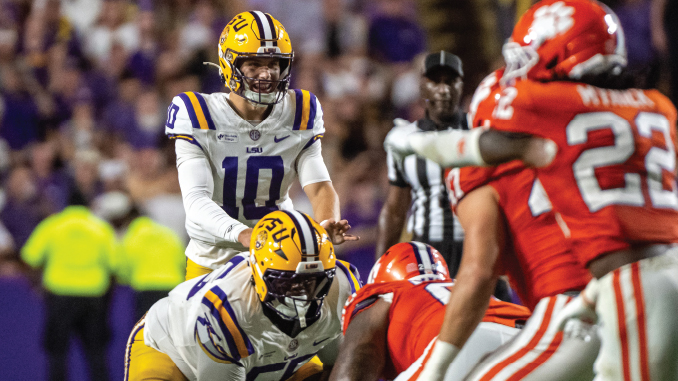
But I’m not dismissing what happened inside Tiger Stadium. Bad opponent or not, LSU did things that translate. The Tigers did not win with special-teams luck or a handful of explosive plays disguising an otherwise ordinary performance. They controlled 60 minutes of football, set a school record with 38 first downs and outgained Clemson 644-145.
Most importantly, LSU physically overwhelmed Clemson.
Here are my three biggest takeaways from Kiffin’s first game.
1. LSU can run the football
Not theoretically. Not occasionally. Not only when Kiffin catches a defense in the wrong personnel grouping.
LSU can line up and run it.
The Tigers rushed 58 times for 309 yards. Sam Leavitt and Dilin Jones each finished with 113. LSU collected 20 rushing first downs and converted 11 of 16 third-down opportunities. Clemson knew where the football was going for much of the second half and still could not stop it.
That changes the possibilities for this team.
Kiffin’s reputation was built on offensive invention, tempo and his ability to manipulate defenses through formation and play design. But his best offenses have never been passing exhibitions. They run the football relentlessly once the defense has been stretched and forced to declare itself.
Saturday night, LSU did not require much deception. The Tigers reached Clemson’s edges, created running lanes inside and repeatedly moved the chains without asking Leavitt to make a heroic throw.
That gives LSU something it has too often lacked in recent seasons: an offense capable of winning without living dangerously.
Leavitt threw an interception and completed only 16 of 28 passes. It did not matter. He avoided sacks, rushed for two touchdowns and helped LSU possess the ball for more than 36 minutes.
When the passing game becomes sharper—and it will—defenses will have to choose how they want Kiffin to beat them.
2. LSU’s offensive line is good
This was one of the largest questions surrounding the most expensive and dramatically reconstructed roster in LSU history.
It may no longer be a question.
LSU did not allow a sack. Its runners were not spending the night dodging defenders in the backfield. The Tigers consistently created movement at the point of attack and gave Jones room to reach the second level. Leavitt had clean escape lanes when he pulled the ball and punished Clemson for losing contain.
Clemson coach Dabo Swinney said afterward that his defense could not set the edge. He was right. But that was not merely Clemson failing to execute. LSU’s linemen and tight ends were displacing defenders, sealing pursuit and making Clemson’s linebackers hesitate.
There will be much harder tests. Texas A&M will bring a different collection of bodies into Tiger Stadium. Alabama and Texas will have NFL players across their defensive fronts. Road games at Ole Miss, Auburn, Tennessee and Arkansas will test communication in ways Clemson never managed to do.
Still, 309 rushing yards are 309 rushing yards. Thirty-eight first downs are 38 first downs. Zero sacks are zero sacks.
An offensive line cannot fake that degree of control for an entire game.
3. LSU’s defense—particularly its defensive front—may be for real
This is the takeaway that drives my confidence higher than the other two.
We knew Kiffin would eventually produce offense. LSU spent heavily enough to accumulate playmakers, and Leavitt already had proved he could direct a playoff team.
The defense was the variable.
On Saturday night, LSU’s defensive front did not simply beat Clemson. It manhandled Clemson.
The Tigers held Clemson to 40 rushing yards on 26 attempts. They produced four sacks and 11 tackles for loss. Clemson’s quarterbacks rarely had time to let a play develop, and its running backs encountered penetration before they could establish any rhythm.
Clemson gained one first down during the first half. One.
Kiffin was correct that Clemson looked dysfunctional. But LSU caused much of that dysfunction. The defensive line compressed the pocket, destroyed timing and continually forced Clemson into third-and-long. Once Clemson fell behind the chains, there was no reliable play available to recover.
That is what good SEC defenses do.
It remains possible that Clemson will spend the rest of the season proving it had no business being considered a serious test. But good teams are supposed to expose bad teams. Championship-level teams are supposed to make them look helpless.
LSU made Clemson look helpless.
One game does not establish that LSU will finish 11-1, reach Atlanta or receive a first-round playoff bye. It does establish that all three are legitimate possibilities.
LSU can run the football. Its offensive line appears capable of controlling people. Its defensive front can wreck a game before it begins.
Those conclusions matter more than the final score—and the final score was 51-10.
Be the first to comment