
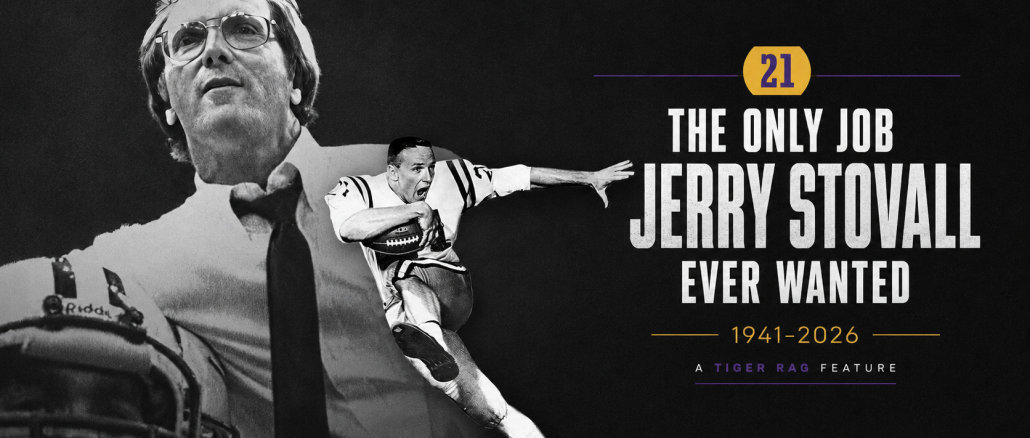
A Tiger Rag Special
The Only Job Jerry Stovall Ever Wanted
Jerry Stovall arrived at LSU as the final scholarship in a class of 52. Twenty-one years later, the university turned to him after Bo Rein disappeared over the Atlantic. Four years after that, LSU fired him. None of it changed what the university meant to him.
The Louisiana Sports Hall of Fame preserved the contrast in its account of Jerry Stovall’s career. When LSU hired Stovall as its head football coach in January 1980, the family’s home filled with well-wishers and the telephone rang throughout the night.
When LSU fired him four years later, no one came. The telephone rang twice.
The distance between those two days contains much of Jerry Stovall’s LSU story. He received the only job he ever wanted because another man had died. He lost it 11 months after completing one of the finest coaching seasons in school history. LSU celebrated him, wounded him and eventually placed his name above the field in Tiger Stadium.
Stovall died Monday in Baton Rouge at 85. His LSU life lasted 67 years, beginning when the university found one more scholarship for a player who was not certain he belonged and ending with Stovall recognized as one of the most accomplished and respected figures in the history of the athletic department.
“They gave out 52 scholarships that year,” Stovall once said, “and I was number 52.”
He came to LSU from West Monroe in 1959, one year after the Tigers won the national championship and during the season Billy Cannon won the Heisman Trophy. LSU’s freshman class was filled with players who had attracted more attention. Paul Dietzel called Stovall “that skinny little runt from West Monroe.”
For a while, Stovall believed he had made a mistake. He packed his belongings and called his father to tell him he was coming home. William Stovall did not argue. He said he would find his son a job. Jerry Stovall considered the kind of job his father might find, unpacked his belongings and stayed.
More than 50 years later, while discussing leadership in a 2011 interview, Stovall described the approach to life that had kept him at LSU.
“It’s not okay just to sit down and let life go by,” he said. “You have to be active. You have to prioritize what you’re going to do, but you have to really know what to stand for and who you stand beside.”
Dietzel soon discovered that the last player in the recruiting class could perform almost every assignment LSU gave him. In Stovall’s first varsity game against Texas A&M in 1960, he carried the ball, returned punts and kickoffs, played defense and punted 11 times. When an Aggie returner appeared headed for a touchdown, Stovall ran him down.
By the end of that season, he had led LSU in rushing, intercepted three passes and averaged more than 42 yards per punt. The player who had nearly gone home was becoming “Mr. Everything.”
The nickname was accurate. Stovall played halfback and defensive back. He caught passes, punted, returned kicks and blocked. LSU did not build its offense around giving him the football 25 times a game because the Tigers needed him everywhere else. Charles McClendon later called him “the most complete football player I’ve ever seen.”
In 1961, LSU lost its opener at Rice and then won 10 consecutive games. The defining play came against No. 2 Ole Miss in Tiger Stadium. LSU trailed 7-3 late in the first half when Stovall broke a 57-yard run to the Rebels’ 23-yard line. The drive ended with the decisive touchdown in a 10-7 victory.
LSU shared the Southeastern Conference championship, defeated Colorado in the Orange Bowl and finished fourth nationally. Stovall rushed for 405 yards on only 65 carries while continuing to punt and play defense.
Dietzel left for Army after the season, and McClendon became LSU’s head coach. Stovall’s senior year moved him into the Heisman Trophy race.
At Georgia Tech, he took the second-half kickoff at the LSU 2-yard line and ran 98 yards for a touchdown in a 10-7 victory. Stovall refused to claim much credit.
“Nobody touched me,” he said. “The blocking was perfect. All I had to do was run.”
Against Florida, Stovall rushed, caught passes, blocked and played defense as LSU won 23-0. McClendon said Stovall’s blocking and defensive play were the most vicious he had seen from one of his backs that season.
In his final two games against Ole Miss, Stovall rushed for 190 yards on 13 carries, although the Rebels handed LSU its only loss of the 1962 season.
Oregon State quarterback Terry Baker won the Heisman Trophy with 707 points. Stovall finished second with 618. He carried the South in the voting, but Baker drew support from both coasts and won by 89 points.
Stovall still had one college game remaining. LSU faced unbeaten and fourth-ranked Texas in the Cotton Bowl. The Longhorns held him to 36 rushing yards, so he contributed somewhere else. Stovall intercepted Texas’ final offensive pass to preserve LSU’s 13-0 victory.
His LSU career ended the same way it had unfolded: with Stovall performing whatever job the Tigers needed at that moment.
LSU’s original season sheets credit him with 1,071 rushing yards and 462 receiving yards. He intercepted seven passes, punted 165 times and handled extensive return duties. The numbers show the range of his work without fully explaining it. Stovall played in an era before specialization separated those responsibilities among several players.
He also remembered something beyond the games. Stovall and Judy married in February 1962 after his junior season and lived in married-student housing during his senior year.
“I probably enjoyed that one year more than any I have ever had in athletics,” he later said.
Judy had known him before LSU did. They were West Monroe high school sweethearts and later raised two children, Jay and Jodi.
The St. Louis Cardinals selected Stovall with the second overall pick of the 1963 NFL Draft. The New York Jets chose him third in the competing AFL draft. He signed with St. Louis and became primarily a safety, playing beside Hall of Famer Larry Wilson.
Stovall remained in the NFL for nine seasons, played 97 games, intercepted 18 passes and returned two for touchdowns. He also punted when the Cardinals needed him. He made the Pro Bowl in 1966, 1967 and 1969.
Near the end of his playing career, Stovall called Dietzel, who was coaching South Carolina. NFL salaries did not allow most players of that era to stop working permanently in their early thirties, and Stovall had a family to support. Dietzel gave him his first college coaching job.
Stovall returned to LSU in 1974 to coach McClendon’s running backs. He told Coach Mac that he had not come back merely to learn more football. He wanted to make at least one young player feel the way McClendon had once made him feel before a game.
Charles Alexander became one of those players. Stovall continued recruiting Alexander after repeated rejection and built the relationship that eventually brought him to LSU. Alexander became the first Tiger to rush for more than 4,000 career yards and later joined Stovall in the College Football Hall of Fame.
Stovall’s coaching philosophy was not complicated. He believed instruction began with the example established by the person in charge.
“Before you can lead, you have to know what your principles are,” he said in 2011, “and you can’t lead somebody where you haven’t been.”
Stovall left McClendon’s staff before the 1979 season to direct LSU’s Varsity Club, a predecessor of the Tiger Athletic Foundation. He wanted to become a head coach, but his interest was specific. LSU was the only head-coaching job he wanted.
By then, the university had already decided McClendon would not continue. McClendon had not resigned when Dietzel returned to LSU as athletic director before the 1978 season. Coach Mac worked both the 1978 and 1979 seasons under Dietzel, who had been brought back to find LSU’s next football coach.
Dietzel permitted McClendon to remain for 1979 because McClendon was serving as president of the American Football Coaches Association. The additional season changed the timing, not the decision. Dietzel forced McClendon out.
LSU hired North Carolina State coach Bo Rein on Nov. 30, 1979, before McClendon coached his final LSU game in the Tangerine Bowl. Rein was 34 and regarded as one of the rising coaches in college football. He assembled a staff, began recruiting and prepared to move his family to Baton Rouge.
On Jan. 10, 1980, Rein boarded a private plane in Shreveport for the return flight to Baton Rouge. Assistant coach Greg Williams later said Rein had spent that evening speaking with his parents, his daughters and his wife before leaving.
“Bo talked to everybody he loved before he died,” Williams recalled.
The plane veered far off course and continued over the Atlantic Ocean. The widely accepted explanation is that a loss of cabin pressure caused Rein and pilot Louis Benscotter to lose consciousness, although investigators never established an official cause. The aircraft disappeared into the ocean, and no wreckage was recovered.
Rein had been LSU’s head coach for 42 days. He never coached a game. LSU no longer needed someone merely capable of replacing McClendon. It needed someone who understood the university, could hold Rein’s staff together and would accept the job immediately.
In the aftermath of Rein’s death, Dietzel considered returning to coaching himself. Paul Manasseh, LSU’s longtime SID, later recalled walking into Dietzel’s office and finding the athletic director watching film as he contemplated taking over the team. Manasseh objected immediately. “You can’t do this!” he told Dietzel.
Dietzel then turned to Stovall.
Dietzel described him as young, tough, aggressive, articulate and a gifted recruiter with exceptional integrity. He then summarized the choice more directly: “Jerry Stovall is LSU through-and-through.”
The only job Stovall had ever wanted was finally available. The circumstances left no room for celebration. Stovall later called Rein’s death a tragedy that had changed many lives. If LSU needed him, he said, he was prepared to help however he could.
He accepted without selecting his assistant coaches and without having met some of them. Stovall said it would have been unfair to Rein’s staff for him to take the job and immediately dismiss the coaches Rein had hired.
At his introductory press conference, Stovall did not talk about fulfilling a career ambition. He talked about the man who should have been standing there.
“I would give up any job, I would give up my right arm if it meant Bo Rein could come back. I love LSU, but the loss of Coach Rein makes the conditions sorrowful.”
Jerry Stovall, January 1980
LSU Board member Jerry McKernan later described the sequence to magazine writer Dave Kindred: “The only thing in life Jerry Stovall ever wanted was to be the LSU football coach.” Now he had it, but only because Rein was gone.
The Tigers finished 7-4 in 1980, a credible result for a program shaken by Rein’s death. LSU fell to 3-7-1 the following season. Dietzel was removed as athletic director, and Bob Brodhead replaced him.
Stovall entered 1982 working for an administrator who had not hired him and knowing another losing season would probably end his tenure. LSU responded with a season few expected.
The Tigers won 24-13 at No. 4 Florida. In November, they traveled to Birmingham to face No. 8 Alabama. LSU had not beaten a Bear Bryant team since 1970.
Stovall’s defense held Alabama to 119 total yards. LSU won 20-10 in Bryant’s final game against the Tigers.
The victory placed LSU in position to reach the Orange Bowl, but the Tigers still had to defeat No. 7 Florida State in Tiger Stadium. Freshman Dalton Hilliard produced 233 rushing and receiving yards and scored four touchdowns.
LSU won 55-21. Oranges began flying from the stands before the game ended. Fans threw so many onto the field that officials stopped play while workers cleared them away. LSU was headed to a major New Year’s bowl for the first time in nine years.
The Tigers led Nebraska 17-7 in the third quarter of the Orange Bowl before losing 21-20. LSU finished 8-3-1. Stovall was named SEC Coach of the Year and Walter Camp National Coach of the Year. Eleven months later, LSU fired him.
The 1983 Tigers went 4-7 and became the first LSU team to finish winless in SEC play. After LSU defeated Tulane in the final game, the players lifted Stovall onto their shoulders and carried him from the field.
One week later, Brodhead recommended his dismissal. On Dec. 2, the LSU Board of Supervisors voted 13-5 to remove Stovall. He was 42 years old. His record was 22-21-2, and his college coaching career was finished.
On the night LSU hired him, the Stovalls’ house had been packed and the telephone had rung continuously. On the day the university fired him, there were no visitors and two calls.
Jim Engster later described Stovall’s career as a succession of near misses: a possible national championship in 1961, the Heisman Trophy in 1962 and a coaching career that ended one season after reaching the Orange Bowl.
Stovall never pretended the firing had not hurt him. He also refused to allow it to determine his relationship with LSU.
“We can never control all the circumstances in which we find ourselves. Never. But we must be able to control ourselves in the midst of each one of those circumstances.”
Jerry Stovall, 2011
Rein’s death was beyond his control. So were the conditions under which Stovall became LSU’s coach, the narrow losses of 1982 and the Board vote that ended his career. His response remained his own.
The clearest evidence came in 1996, when Brodhead died at 59. LSU figures largely stayed away from the funeral. Stovall attended.
Engster later wrote that Stovall possessed an intensity that could recall his playing days but had repeatedly demonstrated “immense class and dignity.”
Going to Brodhead’s funeral did not undo the Board vote or return the coaching career Stovall had lost. It showed that Stovall would not allow another man’s decision to determine the kind of man he became afterward.
In the 2011 interview, Stovall returned repeatedly to that question: “What kind of man do you really want to be?”
Stovall entered banking, later served as athletic director at Louisiana Tech and helped establish what became the Baton Rouge Area Sports Foundation. For more than two decades, he worked to bring sporting events and visitors to Baton Rouge. He also served organizations addressing hunger, hospice care, health, disabilities and senior athletics.
His Christian faith remained central to that work.
“God has a plan for each person’s life,” Stovall said, “and we need to offer that plan up to Him and ask His advice.”
He believed leadership started at home. Stovall called marriage the most difficult job he had ever undertaken because it never stopped.
“Even while that job is going on, I’m still being married 24/7,” he said, “and trying to make sure that I’m sensitive to and meet the needs of my wife.”
He spoke about listening, patience and the example a father established for his children. A son, Stovall said, often learned how to treat his mother by watching how his father treated her. “It’s foolish to ask your children to do something you’re not doing,” he said.
Judy moved through all of it with him: LSU, professional football, coaching, Rein’s death, the 1982 revival, the firing and the public-service career that followed. The public record belonged heavily to football. The endurance behind it was built at home.
LSU placed Stovall in its Athletics Hall of Fame in 1977. The Louisiana Sports Hall of Fame followed in 1981 and the College Football Hall of Fame in 2010. In 2018, the university announced that his No. 21 jersey would be retired.
“This is the most humbling honor that you can ever imagine,” Stovall said.
The ceremony took place on Oct. 13 during LSU’s game against Georgia. His name joined those of Billy Cannon and Tommy Casanova on the Tiger Stadium façade.
Stovall again directed the honor toward everyone else. He credited the players who blocked for him, the coaches who demanded more from him and the trainers who kept him on the field.
Nearly six decades had passed since Stovall packed his belongings and called his father from LSU. He had arrived as the final scholarship in a class of 52, unsure whether he belonged. Now his No. 21 was above the field.
Asked late in life how he wanted to be remembered, Stovall did not mention the Heisman race, the Pro Bowls, the Orange Bowl season or the retired jersey.
“I would like someone to say, ‘He was a man of God.’ And he was not ashamed of it. And he spoke of it when he had the chance.”
Jerry Stovall

Be the first to comment