
By TODD HORNE, EXECUTIVE EDITOR
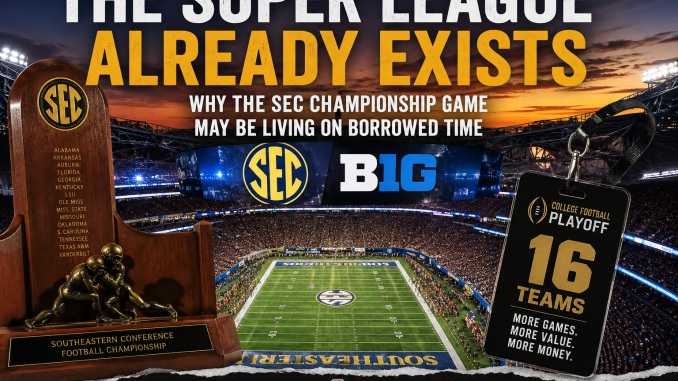
The Super League Already Exists
Everyone keeps asking when the Super League is coming.
Wrong question.
The Super League is already here.
It simply doesn’t have a logo.
For years, college athletics has treated the Super League like some future event. People imagine a dramatic breakaway. A commissioner standing behind a podium. New bylaws. New branding. A slick television rollout announcing that college football has finally entered a new era.
They’re waiting for a ceremony.
They’re missing the economics.
The breakaway didn’t happen in one afternoon.
It happened over twenty years.
Quietly.
One television contract at a time.
One conference expansion at a time.
One playoff negotiation at a time.
The Super League isn’t something the SEC and Big Ten are trying to build.
It’s something they’ve already become.
The only thing left is for the governance structure to catch up.
Look at the numbers.
The Big Ten generated roughly $1.47 billion in conference revenue during its last fiscal year.
The SEC distributed more than $1.03 billion to its member institutions, with each full-share school averaging $72.4 million.
Meanwhile, the ACC generated approximately $826 million.
The Big 12 produced roughly $611 million.
Those aren’t four peer conferences.
Those are two conferences operating on one economic level and everyone else trying to survive beneath them.
That’s no longer a competitive imbalance.
It’s an economic class system.
For years, fans measured conferences by championships.
Today they’re measured by cash flow.
Because championships follow money.
Money doesn’t follow championships.
That distinction matters.
The Big Ten’s television agreement exceeds $7 billion over seven years.
The College Football Playoff’s new television contract is worth approximately $1.3 billion every year.
College football has become what every mature entertainment business eventually becomes.
A television business.
Not an athletic association.
Not an educational enterprise.
Not even primarily a sports league.
It is a premium content business.
And premium content follows only one thing.
Audience.
No conference consistently produces larger audiences than the SEC and Big Ten.
That’s why every major conversation in college athletics eventually circles back to them.
Playoff expansion?
SEC and Big Ten.
Revenue sharing?
SEC and Big Ten.
Scheduling?
SEC and Big Ten.
Transfer reform?
SEC and Big Ten.
Congressional hearings?
SEC and Big Ten.
Even the Protect College Sports Act illustrates the point.
Many observers have framed the legislation as an attempt to rescue college athletics from chaos.
That’s only partially true.
What Congress is really attempting to do is establish rules around an industry whose center of gravity has already shifted.
Notice who continues pushing back against portions of the legislation.
Not the Mountain West.
Not Conference USA.
Not the Sun Belt.
The loudest resistance comes from the SEC and Big Ten.
Why?
Because they’re no longer trying to become powerful.
They’re protecting leverage they already possess.
That is an entirely different negotiation.
It reminds me of watching the cable television business evolve during my years in publishing.
The biggest companies didn’t ask permission to become dominant.
They became dominant.
Regulators arrived later.
College football is following the same path.
The market consolidated first.
The rules are trying to catch up second.
That’s why I believe the phrase “Super League” has become almost misleading.
It implies a future event.
The future event already happened.
The SEC and Big Ten don’t need to announce a Super League.
They simply continue exercising the influence they already own.
That’s the real story.
And once you accept that reality, something else begins making perfect sense.
The SEC Championship Game.
For decades it represented the pinnacle of conference football.
It transformed Atlanta into the capital of the sport every December.
It generated enormous television audiences.
It reportedly produces roughly $80 million annually.
It helped build modern SEC football.
Ironically…
That success may ultimately be what dooms it.
Because businesses don’t evaluate tradition.
Businesses evaluate inventory.
And inventory is exactly what the SEC Championship Game has become.
Not a football game.
A television asset.
The question isn’t whether the game remains valuable.
Of course it does.
The question is whether it remains the highest-value use of that weekend.
That’s a very different conversation.
One that my Tiger Rag Radio co-host Jeff Palermo forced me to think through this week.
When I suggested the SEC Championship Game could someday disappear, Jeff immediately challenged the idea.
Not emotionally.
Logically.
Jeff has spent decades covering LSU and Louisiana sports as News and Sports Director for the Louisiana Radio Network.
His objection wasn’t that fans would revolt.
His objection was far more practical.
Where does the money go?
Television windows aren’t unlimited.
The NFL owns Sundays.
It increasingly owns Saturdays.
Thursday belongs largely to professional football.
Friday has value, but only so much.
You can’t simply erase Atlanta and expect eighty million dollars to magically reappear somewhere else.
Jeff was exactly right.
The calendar matters.
The economics matter.
Which is precisely why the answer isn’t eliminating inventory.
It’s exchanging inventory.
And once you understand that distinction…
The entire future of college football suddenly comes into focus.
PART II
Why the SEC Championship Game Is Living on Borrowed Time
Jeff Palermo’s objection deserved an answer.
Not because he disagreed with me.
Because he identified the single biggest obstacle standing between today’s college football and tomorrow’s.
Money is never the problem.
Logistics are.
The SEC Championship Game isn’t simply another football game.
It is one of the most valuable annual television properties in college sports.
You don’t eliminate an asset like that because someone dreams up a new playoff format.
You eliminate it only when something produces an even greater return.
That’s how every successful business operates.
It doesn’t abandon profitable assets.
It reallocates capital into more profitable ones.
College football has reached that moment.
The SEC Championship Game reportedly generates somewhere around $80 million annually through media rights, sponsorships, ticket sales and related revenue.
That’s an extraordinary property.
But television executives don’t evaluate properties by what they earned yesterday.
They evaluate what they can earn tomorrow.
That distinction is where this conversation changes.
For decades the SEC Championship Game occupied one of the most valuable weekends on the sports calendar.
There was nothing competing with it.
It determined the conference champion.
It often determined the national championship favorite.
It delivered enormous ratings.
Atlanta became college football’s capital every December.
Everything about the model worked.
Then the College Football Playoff arrived.
At first, it wasn’t a threat.
The playoff was simply another event added to the calendar.
Now it has become the calendar.
That is an enormous difference.
Television executives no longer ask whether conference championship games produce ratings.
Of course they do.
They ask a different question.
Could this same weekend produce even more value?
That’s the question businesses ask every day.
Every cable network eventually replaced lower-rated programming with higher-rated programming.
Every streaming service constantly reallocates money toward content that produces more subscribers.
Every professional sports league evaluates inventory based upon future growth rather than historical sentiment.
College football is no different.
In fact, it has become remarkably sophisticated.
The SEC and Big Ten no longer think primarily like athletic conferences.
They think like media companies.
Their inventory happens to be football.
Imagine you’re sitting inside ESPN’s programming offices.
You have one December weekend available.
Option one:
Georgia versus LSU in Atlanta.
One outstanding football game.
Option two:
Georgia hosting Penn State.
Texas hosting Clemson.
Ohio State hosting Tennessee.
LSU hosting Oregon.
Four national playoff games.
Four campus environments.
Four elite television windows.
Four opportunities to sell advertising.
Four opportunities to increase subscriptions.
Four opportunities to dominate an entire weekend of sports conversation.
Which inventory produces greater value?
The answer isn’t even close.
Now expand that thought another step.
The atmosphere matters.
People underestimate atmosphere.
Television doesn’t.
A neutral-site conference championship is a wonderful event.
An on-campus playoff game is something entirely different.
Imagine Death Valley in early December.
One hundred thousand people standing before kickoff.
Every hotel in Baton Rouge filled.
Every restaurant overflowing.
Every television camera capturing one of college football’s most iconic environments with a national championship hanging in the balance.
Now imagine Athens.
Columbus.
Austin.
Happy Valley.
Knoxville.
Ann Arbor.
Those aren’t simply football games.
They’re cinematic events.
Television executives crave authenticity.
Nothing in sports looks more authentic than a college campus hosting a playoff game.
The pageantry belongs to the university.
The crowd belongs to the university.
The traditions belong to the university.
The television pictures belong to everyone.
That’s why first-round campus games would almost certainly outperform most neutral-site championship games.
The SEC wouldn’t lose inventory.
It would multiply it.
And that’s before considering the economics behind the playoff itself.
Some critics argue the SEC would never surrender a proprietary championship game because playoff revenue belongs to everyone.
I don’t believe that’s how the negotiations end.
The SEC and Big Ten aren’t negotiating from weakness.
They’re negotiating from leverage.
Without their brands there is no billion-dollar playoff.
Without LSU.
Without Texas.
Without Alabama.
Without Georgia.
Without Ohio State.
Without Michigan.
Without Penn State.
Without Oregon.
The television value changes dramatically.
The conferences supplying the overwhelming majority of the audience will inevitably argue they deserve the overwhelming share of the financial return.
That isn’t greed.
It’s how every premium-content industry functions.
Movie studios negotiate differently than independent filmmakers.
The NFL negotiates differently than spring football leagues.
The SEC and Big Ten understand exactly where they sit in the marketplace.
The playoff revenue model will eventually reflect that reality.
Then comes the calendar.
Jeff Palermo was exactly right to raise the scheduling issue.
You can’t simply add games forever.
Eventually something has to move.
I believe the solution is surprisingly elegant.
Move the season forward one week.
Week Zero already exists.
Finish the regular season Thanksgiving weekend.
Preserve Army-Navy exactly where it belongs.
Transform conference championship weekend into opening-round playoff weekend.
Friday night.
Saturday noon.
Saturday afternoon.
Saturday night.
No Sunday.
No unnecessary NFL conflict.
Quarterfinals follow one week later.
Semifinals occupy Christmas week.
The national championship remains in early January.
Nothing becomes more crowded.
The inventory simply becomes more valuable.
Notice what disappears.
Not football.
Not television.
Not revenue.
Only redundancy.
Conference championship games once determined who advanced toward a national title.
A sixteen-team playoff accomplishes that directly.
Two postseason systems eventually become one.
That isn’t radical.
It’s efficient.
College football has always evolved toward greater efficiency.
The Bowl Alliance became the Bowl Championship Series.
The Bowl Championship Series became the College Football Playoff.
The playoff expanded.
Revenue sharing followed.
NIL followed.
Federal legislation followed.
Every major structural change arrived because the economics demanded it.
This one will too.
The SEC Championship Game isn’t vulnerable because it failed.
It’s vulnerable because it succeeded beyond anyone’s imagination.
It proved that premium postseason inventory creates enormous value.
Now the playoff can create even more.
That’s how disruption usually works.
The old system doesn’t disappear because it stopped working.
It disappears because it inspired something better.



Be the first to comment