

By TODD HORNE, EXECUTIVE EDITOR
For decades, talk of a college football super league lived in the same fringe as UFO sightings and half-baked realignment graphics – an online debating point for fanatics, a quiet modeling exercise for lawyers, a notepad curiosity for TV executives and a public embarrassment for administrators. It sounded too professional, too commercial, too honest – an admission that college football was already a professional entertainment business, even though its entire structure depended on pretending otherwise.
That pretense is crumbling.
This spring, the super league moved from fantasy into the realm of pure leverage. That does not mean a breakaway circuit is imminent, or that the SEC and Big Ten will walk out of the NCAA next week – or next year. But it does mean the sport’s most powerful figures no longer blush at the idea. And that alone changes everything.
A super league does not have to exist to matter. It only needs to be believable. Today, for the first time, it is. That is the real story – not whether Greg Sankey and Tony Petitti will march into a press room and declare, ‘Welcome to the NFL,’ or whether the NCAA dissolves overnight, or whether a neat 32-team bracket replaces the bowl season. The real story is that the threat itself is already working.
Congress knows it. The NCAA knows it. Television partners know it. Athletic directors know it. And down in Baton Rouge, LSU knows it better than anyone. LSU is not hoping for an invitation. It is one of the reasons the invitation is so valuable. While many schools scramble to protect their seat at the table, LSU is helping inflate the table’s worth.
Because a super league would not be a revolt against today’s system. It would be the logical endpoint of the system already built. Follow the television dollars and you can see the roadmap: NIL, revenue sharing, the House settlement, transfer rules, roster limits, the Protect College Sports Act – all of it flows downstream from media rights. The SEC and Big Ten did not become the gravitational centers of college football on tradition alone. They became the centers because they control the sport’s most valuable inventory – and every realignment cycle, every new media deal and every playoff expansion has only widened the gap.
The sport keeps pretending it is preserving the old college model even as it rewards the forces destroying it. That is not hypocrisy. That is economics. And at the heart of those economics sits LSU.
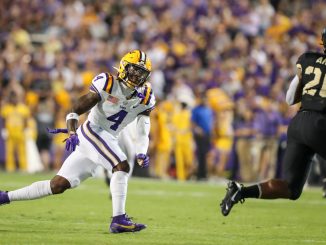
Saturday nights in Tiger Stadium are not local programming. They are national must-see television. They are not a quaint Southern rite the cameras happen to capture. They are assets networks are buying. The SEC may hold the pen, but LSU supplies the ink. When broadcasters lay out billions, they are not paying for NCAA committees or legislative talking points. They are paying for LSU-Alabama, LSU-Texas, LSU-Georgia, LSU-Ole Miss, LSU-Florida and LSU-Texas A&M – the rivalries, the pageantry, the noise, the tension, the history, the national appointment viewing. That is why LSU is a lock in any credible super league model. The real question is how much clout LSU wields once the room’s doors close.
This would not be a meritocracy of final polls or decade-long win percentages or hot coaches at the moment of launch. It would be built on value – brand power, television reliability, national reach, institutional stability, recruiting footprint, donor strength, stadium atmosphere, history and the ability to deliver a compelling November Saturday night. By that measure, LSU is not fighting for a super-league invitation. It is premium inventory that makes the whole model work.
A realistic super league would probably field 28 to 36 teams, mostly from the SEC and Big Ten, with a handful of national brands outside those leagues – Notre Dame, Clemson, Florida State, Miami, North Carolina, Oregon, Washington and the like – not because anyone needs to reward tradition, but because tradition still draws viewers.
Governance would look unmistakably professional: a board of presidents and chancellors, a powerful commissioner, centralized scheduling, officiating, enforcement, postseason control, media-rights negotiations, eligibility rules, roster limits, transfer protocols, revenue-sharing formulas, a discipline system – and likely collective licensing for name, image and likeness. Sooner or later, it would have to deal directly with athletes in ways college sports has worked for decades to avoid.
That is where the fantasy becomes a legal powder keg. The moment the SEC and Big Ten formally detach the highest level of college football from the campus mission, they strip away much of the political cover that still shields the sport. Amateurism has been weakened. The educational frame still matters. A breakaway league would strip much of that away, looking like the NFL without a players’ union.
Which is exactly why the super league is more useful as a threat than as a final product. The threat creates leverage. The detonation creates exposure – especially for LSU. As a public university, LSU would gain wealth but also scrutiny. State politics, public-records laws, legislative oversight, Title IX mandates and athlete-employment issues would intensify, not vanish.
LSU does not need an actual super league. LSU needs everyone to believe one is possible. That belief forces Congress, the NCAA and television partners to take the SEC seriously – or risk losing their grip. The Protect College Sports Act is Washington’s answer and, in some respects, Washington’s containment effort: a bid to write the governance rules before the SEC and Big Ten write them for themselves. The underlying fight is over who writes the script for the next era: Congress, the NCAA, the conferences, the courts, the athletes or some new body yet to be invented.
LSU’s strategic lane is clear: federal stability if it brings enforceable rules and tames legal chaos; SEC power if it keeps Washington’s heavy hand at bay and protects the media value LSU helped create; national NIL, transfer, revenue-sharing and athlete-representation standards; credible breakaway leverage without isolation; athlete compensation without legal chaos; public accountability without competitive suicide.
That narrow road – federal stability without federal control, SEC leverage without SEC isolation – is the lane LSU occupies. Not as a spectator, but as a power source. The schools outside the SEC and Big Ten understand this, and that is why the super league terrifies them. Consolidation mathematically favors the top media brands. Money follows audiences. Players follow money. The postseason follows players. Once that cycle begins, the old structure is finished.
The super league does not have to launch to shape the sport. It already is. Every congressional antitrust debate now happens under the shadow of conference autonomy. Every NCAA governance conversation takes place under the shadow of irrelevance. Every media-rights negotiation unfolds under the specter of consolidation. Every athletic department budget meeting is refracted through the lens of revenue sharing and roster economics.
Every major LSU decision now happens inside that reality. This moment is not just about whether athletes get paid. That fight is largely settled. It is not just about NIL regulation or the House settlement. They are already on the books. It is about who controls the system through which all that money, authority and opportunity flow. Governance is power, and the super league has forced everyone to see where the power really sits: with the audiences, the media inventory, the brands that make people watch, the conferences that control those brands and schools like LSU that supply the crucial asset.
The real question is not whether a super league is coming. It is whether those trying to prevent it can build something stable, enforceable and profitable enough that the SEC and Big Ten decide not to use the option they so clearly possess. That is the negotiation. That is the leverage. That is the future. LSU is not waiting to see if it gets invited. It is one of the reasons any invitation has value. The super league may never officially arrive, but its threat has – and in college sports, sometimes the threat is more powerful than the thing itself.

Be the first to comment