
By TODD HORNE, EXECUTIVE EDITOR
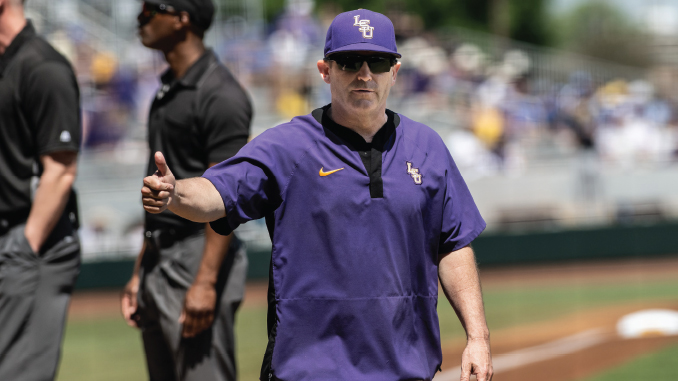
Jay Johnson sounded like a coach Friday night who had stopped pretending.
Jay Clark sounded like a coach Saturday who refused to let one of his gymnasts carry a burden that belonged to the entire team.
Two Jays. Two LSU programs. Two very different weekends.
One Jay is trying to keep a baseball season from completely slipping away.
The other Jay just watched LSU gymnastics come within one rotation, one tenth here, one landing there, of winning its second national championship in three years.
Call them the two Blue Jays of LSU athletics this weekend, if you want. Johnson and Clark both had every reason to sound beaten down. Neither did. Both stayed realistic. Both stayed accountable. Both sounded like coaches who understand where their programs are, what their athletes need to hear and what has to happen next.
But their situations could not be more different.
Johnson is staring at a baseball team that looks like it is probably not going to play in the postseason. That is my opinion. It is also hard to look at LSU’s 23-17 overall record and 6-11 SEC record after back-to-back losses to Texas A&M and pretend the Tigers are anywhere close to the standard of this program. Texas A&M beat LSU 10-4 Friday, then came back Saturday and won 7-2 to take the series at Alex Box Stadium.
Johnson said the quiet part out loud after Friday night’s loss.
“It’s deep rooted,” Johnson said. “We’re off, and it will never happen again. I made some mistakes in constructing the team.”
That is not normal coach language in April. That is not “we need to execute better.” That is a coach admitting the roster build missed. The portal missed. The construction missed. The balance missed.
Then Saturday, Texas A&M confirmed it again.
The Aggies looked older, cleaner and more complete. Aiden Sims held LSU to two runs on three hits over seven innings, improving to 7-0. LSU managed only five hits. Sophomore William Schmidt was hit for seven runs on seven hits with two home runs, four walks and two wild pitches.
But this is where Johnson’s job has changed.
He is still trying to win games. He should be. LSU baseball does not get to treat SEC weekends like instructional league baseball. But Johnson also has to coach the next LSU team now, not just this one.
That was obvious in the way he talked Saturday about Schmidt and freshman Marco Paz.
Schmidt did not have a good final line, but Johnson did not talk about him like a disposable arm in a lost game. He talked about him like a pitcher who still matters.
“William certainly competed at a high level,” Johnson said. “It happened pretty fast, the two-run homer with Harrison, and then Grahovac with a solo homer. And then the top of the order the second time through kind of did their job, put some pressure on him.”
Then Johnson said the more important thing.
“Proud of how he’s competing,” Johnson said. “Even in this game, got some more clarity on things that are next for him in terms of his development.”
That word — clarity — matters.
Johnson is evaluating. He is learning what Schmidt has to become. He is learning how Schmidt’s stuff holds deep into an SEC start. He is learning how he handles damage, fatigue and a veteran lineup adjusting the second time through.
That may not save this season.
It may help save the next one.
Same with Marco Paz.
Paz gave LSU two scoreless innings Saturday, struck out three and got through the top of Texas A&M’s order. Johnson did not downplay it.
“I think he’s going to be one of the best, if not the best, pitchers in the program at some point,” Johnson said.
That is not a throwaway quote. That is a coach telling you who he believes is part of the future. Paz is coming off Tommy John surgery and had not pitched for 18 months before this season. Johnson said his development has accelerated and that his role will continue to expand “as we move toward the end of this season and in the next two years.”
There it is.
The next two years.
That is where LSU baseball is now. Johnson has to develop what can be saved, move on from what cannot and make sure his Friday admission becomes more than a quote. It has to become correction.
Clark, meanwhile, is dealing with a different kind of pain.
LSU gymnastics did not fall apart. LSU gymnastics came painfully close.
The Tigers were one rotation away from winning the NCAA championship Saturday. They needed a strong beam rotation to hold off Oklahoma, but a fall by sophomore Lexi Zeiss in the second spot put pressure on the rest of the lineup, and LSU finished second.
That is brutal.
But Clark immediately did what good coaches do. He protected his athlete.
“This isn’t about Lexi Zeiss,” Clark said. “We can find a tenth all over the place. It takes five out of six on every event. It doesn’t take six out of six. She’s wearing it and shouldn’t, but that’s the kind of competitor she is and we wouldn’t have even been in the spot to think about winning if she hadn’t done what she did on the first two events, so she doesn’t need to wear that.”
That is leadership.
Clark knew what everyone else would see. They would see the fall. They would see the final rotation. They would look for one moment to explain an entire championship miss.
Clark refused to let that happen.
He was right.
Gymnastics titles are not lost by one athlete in one moment. They are won and lost across four events, across landings, handstands, tiny steps, tiny checks, tenths hidden everywhere. Clark said exactly that. LSU could “find a tenth all over the place.”
That is not an excuse. It is the truth of the sport.
It is also the opposite of panic.
LSU was trying to win its second national title in three years. That matters. The program is no longer just happy to be close. It is close enough now that second place hurts. That is the price of becoming elite.
And Clark sounded like a coach who understood both sides of it. He was disappointed. He was protective. He was also proud.
“I’ve been a part of a lot over the years and I don’t know if I’ve ever been prouder of a team,” Clark said. “They’re gutsy and they fought and fought and fought — through injury and all sorts of adversity, some of which was known and some which was not. There’s nothing for these kids to hang their heads about. They just did everything a coach could ask for them to do.”
That is the difference between the two LSU stories.
Johnson is trying to find future pieces inside a season that has gone wrong.
Clark is trying to keep a championship-caliber team from feeling like it failed because it finished second.
Both jobs require honesty.
Both require optimism that is not fake.
Sophomore Kailin Chio gave LSU gymnastics the line that should carry into next season.
“We’re going to come back next year and get it done,” Chio said.
That is the voice of a program that still believes.
LSU baseball needs to find that again. LSU gymnastics already has it.
So Saturday night left LSU with two Blue Jays saying different versions of the same thing.
Johnson’s version is harder: We missed, we are off, and it will not happen again.
Clark’s version is closer to heartbreak: We were right there, we fought, and we will be back.
One program is trying to rebuild belief.
The other is trying to turn belief into the final tenth.
That is where LSU athletics stood this weekend — one Jay trying to save the future from a disappointing present, the other trying to make sure a near championship does not feel like failure.
Both stayed upbeat.
But only one of them is close enough to the top to see exactly what it takes to get there.


Be the first to comment