By GLENN GUILBEAU, Tiger Rag Editor
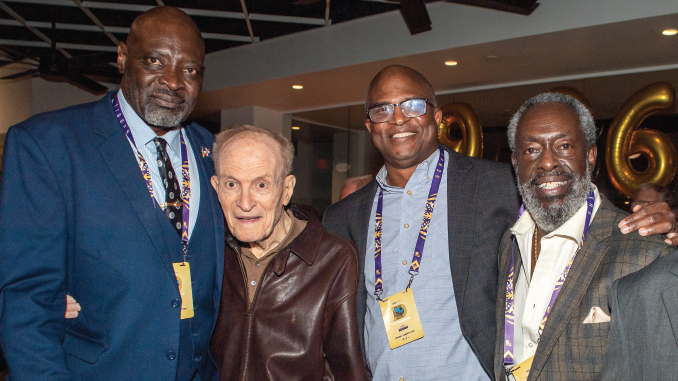
One thing about College Basketball Hall of Fame coach Dale Brown of LSU – his players still remember what he preached four decades later.
And in the case of center Jose Vargas of the 1985-86 Final Four team that celebrated its 40th anniversary recently at Drago’s restaurant in Baton Rouge – maybe too well.
LSU’s OWN “GLORY ROAD” IN 1986 FEATURED A STRETCH DOWN THE CHICKEN POX HIGHWAY
“None of us ever quit, because this guy taught us to never quit in life,” Vargas, a 6-foot-10 center whom Brown recruited from La Romana in the Dominican Republic, said pointing at Brown, now 90.
“That is important for all of us,” Vargas, who made the trip to Baton Rouge from Brazil, where he runs a Eucalyptus tree farm, a coffee business and raises cattle with his wife, with whom he raised six children.
“Every day, get up and fight. Every day,” Vargas said. Doesn’t matter. Put up a fight. So, coach Brown, thank you so much for teaching me how to fight for life.”
And that included fighting Brown himself, in a way.
“Even though, when you told me, ‘Jose, don’t shoot the ball,’” and the crowd of former players, their families and fans familiar with the story laughed loudly.
That was when the No. 17 Tigers were playing at Georgetown on Sunday, Feb. 2, 1986, on national television.
During a timeout with the score 72-72 in the final seconds, Brown gave his team instructions, finishing with, “And Jose, don’t shoot.”
Vargas was a sophomore backup, averaging just 3.0 points on 46 percent shooting. And Brown had such stars as forward John Williams, guards Derrick Taylor and Anthony Wilson, Ricky Blanton, a guard turned center because of injuries and Nikita Wilson’s suspension, and flashy forward Don Redden, who died of heart failure in 1988 at age 24.
But Vargas remembered something else Brown had preached.
“He was trying to break me,” Vargas said 40 years later. “Well, ‘He ain’t going to break me,’ I said. Because he said that to all of us – ‘Look, we’re going to try every day to break you. And if you break, you’re done for life.’”
So, Vargas mixed the message.
“The first ball that came to my hand in that game, I shot it,” Vargas said as laughter roared again. “And the worst part of it was, it was terrible.”
He missed a 10-foot jumper with :07 remaining, and Redden fouled Michael Jackson on the rebound. Jackson hit both free throws for a 74-72 win.
“But you know what? I’m still shooting the ball,” Vargas said. “That’s what’s important.”
40 years ago, the 1986 Final Four team made one of the greatest runs in our program's rich history.
— LSU Basketball (@LSUBasketball) January 16, 2026
On Saturday, we celebrate and honor their achievements and contributions to Tiger Basketball! pic.twitter.com/5JldmwtA1d
That was the Tigers’ fourth straight loss amid the last stages of a crazy chicken pox epidemic that had left Brown with a minimum of players. Williams, the No. 1 recruit in the nation out of Crenshaw High in Los Angeles when he signed for the 1983-84 season, was hospitalized for several days along with backup forward Bernard Woodside. Williams averaged 17.8 points, 8.5 rebounds and 3.3 assists that season before he was the 12th pick of the first round in the ’86 NBA Draft by the then-Washington Bullets.
But they didn’t quit. The Tigers won two days later at Auburn, 63-61 – in a game that Brown was able to somehow get the SEC to reschedule because of the chicken pox.
“I think coach may have used a red marker on some of the kids,” said retired LSU associate athletic director Bo Bahnsen, who was an administrative assistant under Brown that season.
“The whole season was a test,” Brown remembered.
Our 1986 Final Four Tigers in the house 🤩 https://t.co/9MEwEcjH2C
— LSU Tigers (@LSUsports) January 17, 2026
The win over Auburn was the first of five victories in seven games. They finished the regular season at 22-11 and 9-9 in the SEC for a No. 11 NCAA Tournament seed.
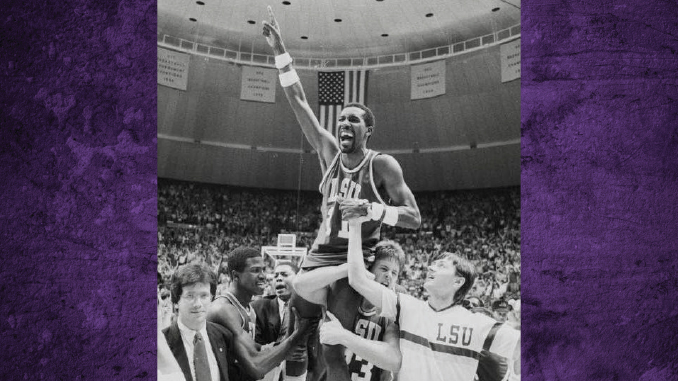
And the Tigers made an historic run that to this day has not been surpassed. No team worse than an 11 seed has ever made the Final Four. LSU got its first two games of the NCAA Tournament at home – which no longer happens – and knocked off No. 6 seed Purdue, 94-87, in two overtimes and No. 3 seed Memphis State, 83-81, on a buzzer jumper by Anthony Wilson.
Then LSU beat No. 2 seed Georgia Tech in its home city of Atlanta, 70-64, and No. 1 seed Kentucky, 59-57, after losing three times to the Wildcats during the season. LSU remains the only No. 11 seed in NCAA Tournament history to beat a No. 1, 2 and 3 seeds to reach a Final Four.
It was one of the most disappointing losses in Kentucky’s storied NCAA Tournament history. Kentucky and first-year coach Eddie Sutton, formerly a Final Four coach at Arkansas, hit Atlanta apparently on a national championship run at 32-3 on the season with Southeastern Conference regular season and tournament titles. But Kentucky failed as Duke would strangely at the hands of LSU 20 years later.
“If I’d have known, I would’ve brought some umbrellas.”
— Glenn Guilbeau (@SportBeatTweet) April 4, 2026
-LSU coach John Brady on Tigers’ Second Line dance to the Final Four in Indianapolis 20 years ago this weekend.https://t.co/H9z6JDEoHf
The 2006 NCAA Tournament No. 1 seed Blue Devils, 32-3 like Kentucky with Atlantic Coast Conference regular season and tournament crowns, lost to upstart No. 4 seed LSU, 62-54, also in Atlanta in the Sweet 16 round.
Sutton never recovered from his 1986 loss to LSU as Kentucky’s coach as he never sniffed the Final Four again with the Wildcats and was fired just three years later amid an NCAA cheating scandal.
“After losing to Kentucky three times, they just kept fighting and finally beat them in the fourth try,” Bahnsen said. “The pride that LSU left the floor with that night sent chills through you.”
Brown so loved to beat Kentucky and helped take the net down with his teeth in one of his finest hours.
“We were the biggest thing in the state, which really had a struggling economy at the time because of the oil bust,” Bahnsen said. “We were playing for more than LSU, we thought.”
LSU’s fairy tale ended against No. 2 seed Louisville, 88-77, at the Final Four in Dallas.
“They came from all countries,” Brown said at the reunion.
“Right, Zor?” he asked 7-foot center Zoran Jovanovich, who journeyed from his hometown of Belgrade, Yugoslavia, for the reunion, even though he missed most of the season because of a knee injury in December of 1985.
Former LSU forward Jerry Reynolds also made the reunion, even though he left the team after the previous season for the NBA Draft and became the 22nd pick of the first round by Milwaukee.
“I should’ve stayed another year,” Reynolds said at the reunion. “There would have been no stopping us.”
Williams said the same thing at the 20-year reunion in 2006.
“We would’ve got to the Final Four again in 1987,” Williams said. LSU lost to Indiana in the Elite Eight in 1987, missing a Final Four in New Orleans.
“If anybody would like to draw a picture of what love is, what coaching is, what a team is – how about the love and compassion that you’ve shown tonight,” Brown said. “Thank you for coming. It was the highlight of my life.”
And that of Vargas.
“Coach told us, “If you make it here, you will make it through life,’” he said. “And that’s why each one of us 40 years later, we’re still here making it in life. So, to each one of you, from the bottom of my heart, thank you.”
Be the first to comment