
By TODD HORNE, EXECUTIVE EDITOR
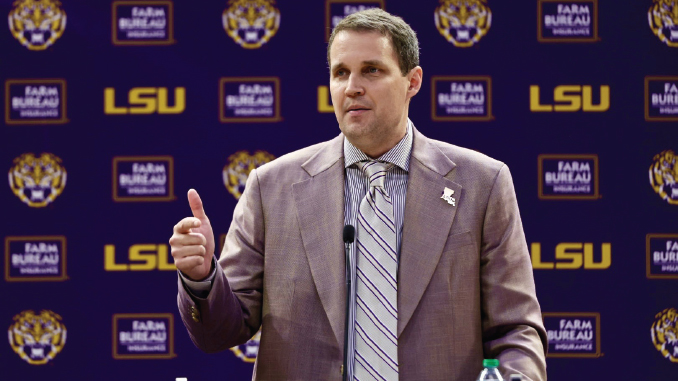
LSU did not just bring back Will Wade.
It brought back belief. Expensive belief. Aggressive belief. The kind measured not in press releases, slogans or old memories of the PMAC rocking, but in money, structure and institutional alignment. Wade’s own introductory press conference made that plain. He did not show up selling nostalgia. He showed up selling urgency. “We’re gonna win,” Wade said. “LSU and Louisiana deserves a winner and that’s what we’re going to deliver. We’re going to deliver that in short order.”
That is the real story.
Matt McMahon had about $5.5 million in NIL money to work with. Wade is stepping into roughly $12.5 million. Revenue share is a fixed percentage either way, so that is not the differentiator. The differentiator is that LSU has decided to raise the men’s basketball NIL bet by about $7 million. That is not a tweak. That is a declaration.
And the question is obvious.
Why is LSU suddenly willing to go all-in now when it would not do so for McMahon?
Because LSU believes Wade changes the return on every dollar.
That is the answer. Not the polite answer. The real one.
This is not a sympathy column for McMahon. He had four seasons, never made the NCAA Tournament and LSU drifted into irrelevance in the SEC under his watch. That is failure in this league, and no serious program can decorate it with excuses.
But this is absolutely a column about institutional truth.
Schools talk with words. They confess with money.
And LSU’s money is confessing now.
It is confessing that the university’s power structure, its donors and the people now aligned around men’s basketball believe Wade can turn money into wins, roster talent, noise and relevance faster than McMahon ever could. LSU did not suddenly discover that men’s basketball matters. LSU decided Will Wade was worth funding at a level Matt McMahon never was.
And let’s stop dancing around the modern reality of SEC basketball: roster expenditure now delivers wins. Not automatically. Not perfectly. But enough that nobody serious in this league can pretend otherwise. Coaching still matters. Evaluation still matters. Development still matters. But if one LSU coach had $5.5 million in NIL and the next one gets $12.5 million, then LSU is not just buying players. It is buying a much better chance to win in the talent market that now helps decide this league.
Wade’s own words fit that financial reality perfectly. “This not something that’s going to take long,” he said. “We’re going to get in that portal when it opens next Monday and we’re going to put together a winner because everybody in here deserves a winner.” That is not rebuild language. That is acceleration language. That is a coach talking like someone who knows he is being handed real ammunition.
That is the blunt truth of this hire.
And there is a second truth right behind it: LSU is no longer treating men’s basketball as a side room in the department. It is rebuilding it as a power center.
That is where Heath Schroyer comes in.
Schroyer is not just another administrator filling a chair. He is there to help drive external revenue and business momentum around men’s basketball. He arrives with a relationship to Wade, not as some natural extension of Kim Mulkey’s side of the building. That matters because for four years Mulkey has been LSU basketball’s unquestioned alpha — biggest winner, biggest personality, biggest fundraiser, biggest internal force. Wade now returns not only with more NIL money than McMahon ever had, but with an administrative ally positioned to help build the business around him.
That changes the balance inside LSU athletics.
And it also helps explain why men’s basketball suddenly matters more now.
Not because NCAA tournament units are about to directly flood LSU’s bank account. In the SEC, postseason money does not simply rise and fall directly to LSU based on one run. The better financial argument is local: ticket demand, premium seating, sponsorship value, donor energy, game-night spending and simple relevance in Baton Rouge.
That is the business case.
Kim Mulkey has given LSU basketball stature, prestige and national force. A revived men’s basketball program gives LSU something else: a far more scalable in-house revenue engine. That is not a shot at Mulkey. That is a statement about business models. Men’s basketball, when healthy, can become an event machine, a donor machine and a sponsorship machine all at once.
That is why this is bigger than Wade versus McMahon.
LSU is looking at men’s basketball and seeing a sport that can matter competitively, matter politically and matter financially at the same time. And once the people in charge decided Wade was the coach most likely to unlock that, the money followed.
That is the sequence.
Not the other way around.
McMahon never inspired that level of donor adrenaline. Wade does. McMahon never generated that kind of certainty in the building. Wade does. McMahon never had the sort of internal ecosystem now being assembled around men’s basketball. Wade does.
So no, Wade is not inheriting McMahon’s job.
He is inheriting a richer, more aggressive, more heavily armed version of it.
And that leads directly to Kim Mulkey.
Of course this impacts her.
It has to.
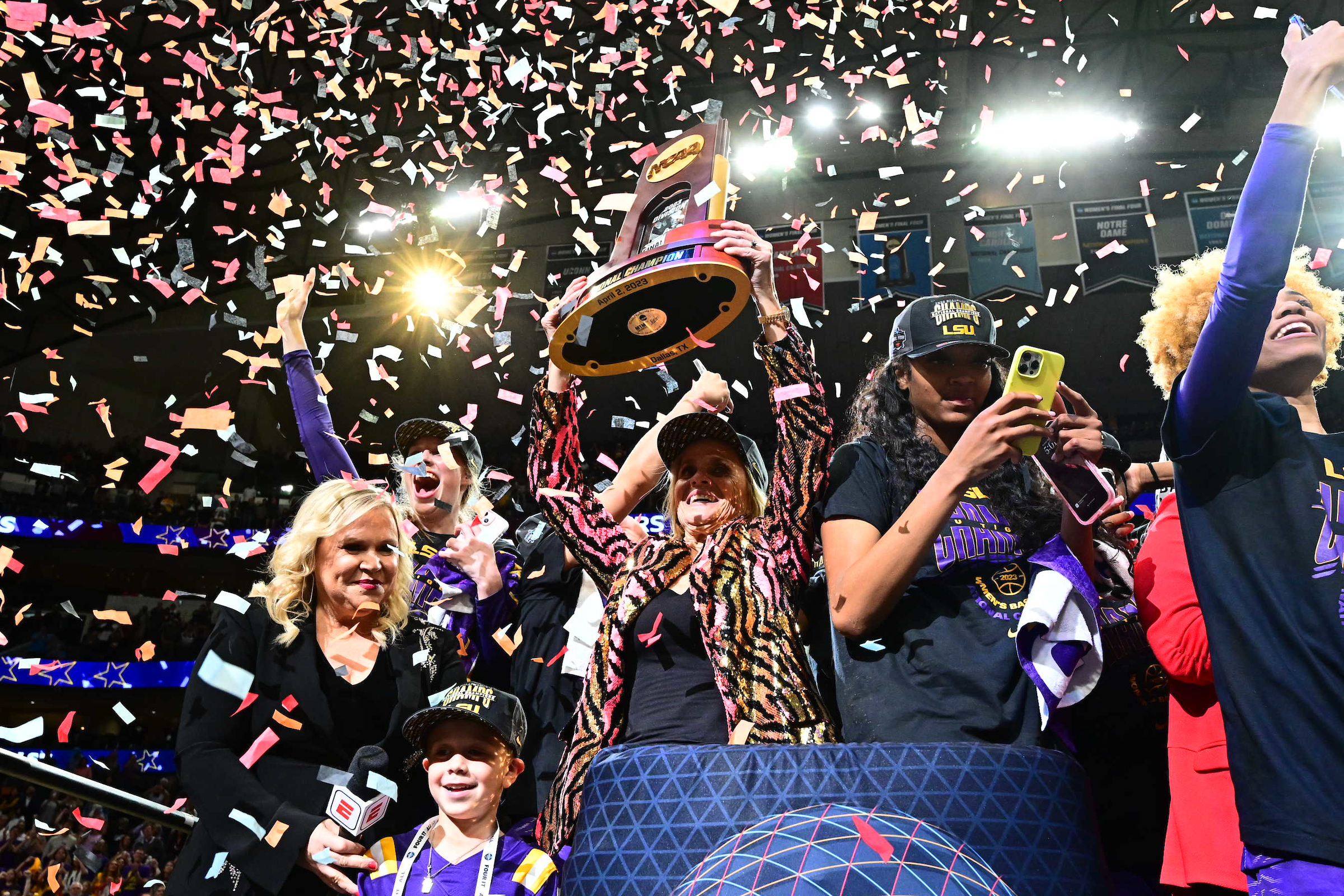
Mulkey has spent four years building LSU women’s basketball into the dominant basketball force on campus. She wins big. She commands attention. She raises money relentlessly. More than once, McMahon explained he was having to compete for NIL dollars. That tells you exactly how the internal basketball economy at LSU has worked. Mulkey did not just build a winner. She built a financial machine.
Now LSU is building one on the men’s side, too.
That does not diminish Mulkey. It does mean she now has a true in-house competitor for donor oxygen, sponsor attention and basketball-centered institutional energy. Wade’s return, plus Schroyer’s arrival, means men’s basketball is no longer being left to survive. It is being built to attack.
Wade made another part of this clear Monday. He is not trying to soften the edges of what LSU just did. He embraced the fight. “I know people have been talking about us a little bit,” he said. “I understand, I’m not for everybody and we understand also that LSU isn’t for everybody. But one thing we both understand is I’m for LSU and LSU is for me.” That is not the voice of a cautious hire. That is the voice of an aggressive one.
He also laid out the kind of basketball LSU is now paying for. “We’re going to be rooted in aggression,” Wade said. “We’re going to be rooted in toughness and be rooted in discipline.” He promised a top-10 offense and a top-10 defense. That matters because it shows this is not just a money play. LSU believes it is funding a coach who can quickly convert that money into an identifiable, winning product.
And the immediate fan response matters too. Hundreds of fans turned out for Wade’s introductory press conference, a level of live energy that looked stronger than some of LSU’s late-season home crowds. That matters because it is the earliest possible proof of the business argument. Wade changes the temperature of the building before a single game is played.
And that may be the biggest truth of all.
LSU did not simply fire Matt McMahon and rehire Will Wade.
It changed its level of belief in men’s basketball. It raised the NIL commitment. It brought in structural help around the program. It aligned people in power who believe the sport should once again matter loudly and immediately.
That is not just a coaching move.
That is a structural move.
That is a financial move.
That is a power move.
And it comes with pressure.
A lot of pressure.
Nobody gets handed $12.5 million in NIL support and then gets to ask for patience. LSU is not buying a honeymoon. It is buying expectation. It is buying acceleration. It is buying the right to demand that men’s basketball become relevant again fast.
So yes, Will Wade is the headline.
But the deeper story is that LSU finally decided men’s basketball was too strategically valuable to leave half-funded and half-alive any longer.
And in the SEC, where roster money is no longer decoration but competitive reality, LSU’s $7 million jump in NIL backing is the clearest statement it could make.

Be the first to comment