

By TODD HORNE, Executive Editor
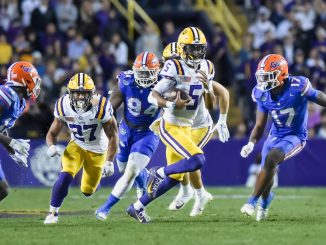
On a Saturday night in Death Valley, 102,000 souls roar as one.
Smoke curls from tailgate grills, golden helmets flash under floodlights, and a grandfather lifts his grandson onto shoulders worn smooth by decades of the same ritual.
“This is why we bleed purple and gold,” he whispers, voice cracking.
But in the fluorescent-lit offices across the street, the mood is grim.
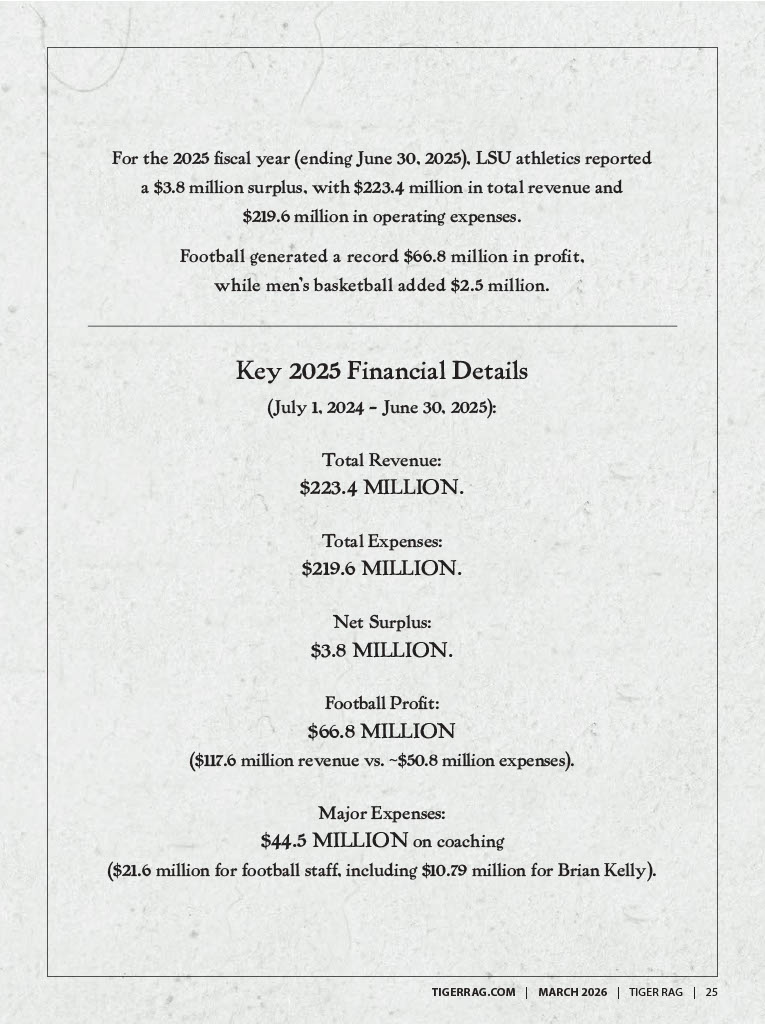
LSU Athletics closed Fiscal Year 2025 with $223.4 million in revenue and a slender $3.8 million surplus — football’s record $66.8 million profit carrying the load.
One year later, a $25–$35 million deficit looms, fueled by revenue sharing, a $54 million coaching buyout, and a new $91 million contract.
New Athletic Director Verge Ausberry calls the model “broken” and “not sustainable. Not at all.”
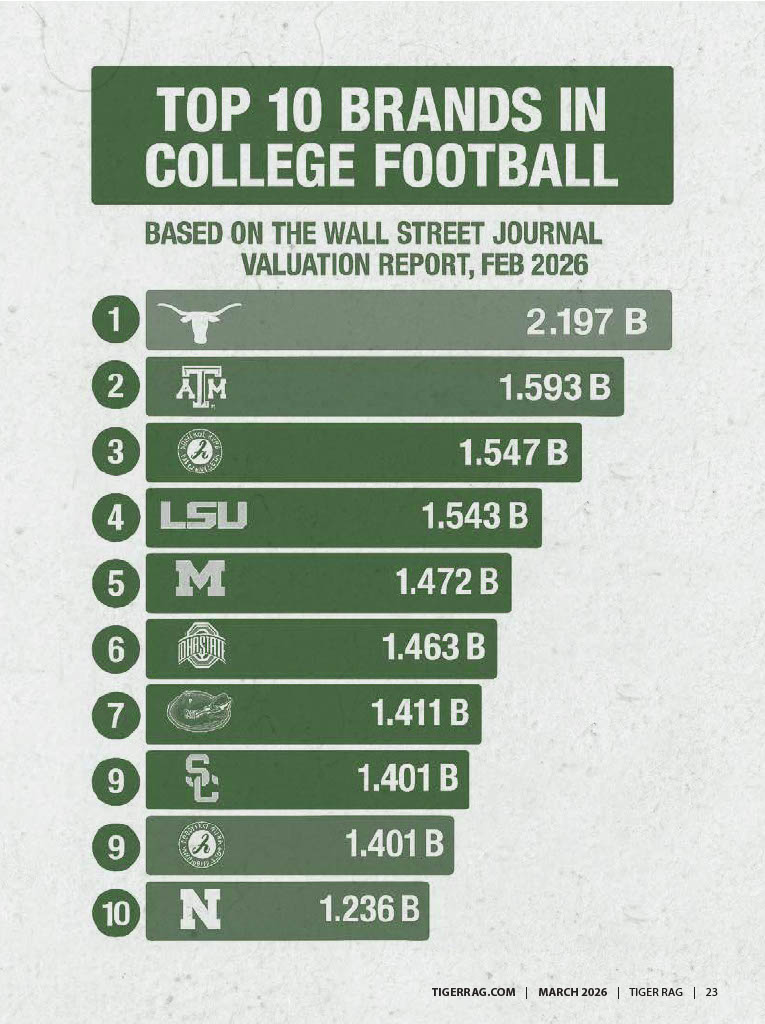
Yet LSU’s $1.543 billion brand — fourth nationally — offers hope.
In Louisiana, the Tigers aren’t just a program. They’re woven into life itself. And that devotion, Ausberry believes, will endure.
How the Tigers Are Betting the
House on Football’s Future
The Last Surplus:
How Football Printed Money in 2025
It’s a Saturday night in Death Valley, and more than 102,000 fans are roaring as the Tigers march downfield under the lights.
The band blares, the golden helmets gleam, and for a moment everything feels eternal.
In the stands, a grandfather lifts his grandson onto his shoulders — same spot he sat with his own dad decades ago. “This is what it’s all about,” he tells the boy, voice thick.
But behind the pageantry, spreadsheets tell a different story — one that ends, for now, on a high note.
Fiscal Year 2025 (July 1, 2024–June 30, 2025) was the final chapter of the old world.
LSU Athletics posted total revenues of $223.4 million — the third straight year above $200 million — and closed with a modest surplus of $3.8 million. Football alone brought in $117.5 million while costing just $50.7 million to operate, producing a record profit of $66.8 million. That single sport subsidized everything else: women’s basketball, baseball, gymnastics, track, the works. To put this in perspective, LSU’s overall athletic department expenses totaled $219.6 million, with the highest costs stemming from $82.7 million in combined compensation for coaches, support staff, and administration, alongside $27 million in unspecified operating expenses. This surplus marked a rebound from previous years, ending a streak of deficits and highlighting the department’s financial resilience before the storm of new economic pressures.
“Football isn’t just our identity — it’s our economy,” former athletic director Scott Woodward said in a 2024 interview, words that ring truer than ever looking back.
“As long as Death Valley roars and the checks clear, we can do anything.”
The money flowed from familiar places. Ticket sales remained strong ($43.6 million from football alone). SEC media distributions jumped to $53.1 million as the conference’s ESPN deal continued its escalation. Sponsorships, handled through Playfly Sports Properties, kept growing. And the Tiger Athletic Foundation (TAF) transferred tens of millions more in donor pledges tied to premium seating. Additional boosts came from multi-million-dollar increases in media rights ($18.6 million) and conference distributions of bowl-generated revenue ($13.1 million), underscoring the SEC’s escalating financial power.
“We were riding high,” one longtime TAF member recalls anonymously over coffee in Baton Rouge, steam curling from his cup like tailgate smoke. “I remember one donor — a private equity guy raised in Baton Rouge but who built his empire back east — handing over a seven-figure check after the baseball title. He flew in just for the celebration, still wearing his pinstripe suit, and shook my hand like we were closing a deal. ‘This one’s for the kid I used to be,’ he said, voice catching. ‘Growing up, all I had was a cheap radio under the covers on summer nights, listening to Skip Bertman’s teams. Baseball was my escape — still is. Now I can give back to the program that gave me hope when nothing else did.’”
It was the last year without direct player pay. No $20.5 million revenue-sharing line item. No monthly $800,000–$900,000 reminders of a coaching buyout.
Just pure, old-school college football economics — football prints money, everything else spends it, and the surplus covers the gap.
Administrators knew the party was ending.
“This was the calm before the storm,” one senior athletics staffer said off the record last fall, voice dropping as he stared out at the practice fields. “We’d just come off a gymnastics championship, baseball was scorching — everyone felt invincible. But we knew 2026 would hit like a hurricane.”
They were right.
The Shockwave:
Why 2026 Looks So Different
November 2025. Brian Kelly is out. Lane Kiffin is in. The headlines scream chaos, but the real explosion happens quietly, in budget projections. LSU is staring at a deficit projected between $25 million and $35 million for Fiscal Year 2026 — the worst in modern program history.
“It felt like someone pulled the plug on our bathtub,” a department insider says, shaking his head in a dimly lit hallway lined with championship trophies. “One minute we’re counting surplus; the next, we’re staring at red ink deeper than anyone expected.”
The triggers are straightforward, brutal, and intertwined:
1. Revenue Sharing Hits
The House v. NCAA settlement is now fully live. LSU, like every Power 4 peer that wants to compete, is paying the full $20.5 million cap directly to athletes. Roughly 75%—$15–$16 million—goes to football. “I sat in a meeting where a player asked, ‘Does this mean we’re employees now?’” the insider recalls, laughing ruefully. “We said no, but the check sure felt like a paycheck.” This cap, set at approximately 22% of the average Power 5 conference revenue from media rights, ticket sales, and sponsorships, is expected to rise by about 4% annually, reaching an estimated $32.9 million by 2034-35, excluding scholarships and other benefits.
New Athletic Director Verge Ausberry breaks it down plainly: “The $20.5 million revenue share is for your whole department—75 percent for football, 15 percent for basketball, five percent for women’s basketball, five percent for other sports. That’s how we have our revenue share.”
2. The Kelly Buyout
The $54 million obligation is real and ongoing. After a brief legal skirmish, LSU agreed to pay the full amount in monthly installments through 2031. No single anonymous donor is covering it, despite early rumors. The money comes from self-generated athletics revenue. That’s roughly $800,000–$900,000 leaving the budget every month unless Kelly mitigates by taking another job.
“People thought some oil tycoon was writing a check,” a Baton Rouge booster laughs bitterly over po’boys at a downtown dive. “My phone blew up with texts—‘Who’s the hero?’ Reality hit hard when the monthly bills started coming.” Ausberry is unequivocal: “No, that’s not true at all. Not true at all. That’s our buyout. You have the head coach’s buyout That’s about a $800K-$900K.” He adds, “If we didn’t have that buyout with coach Kelly, we’d be in great shape. But right now, with the buyout, yeah that’s going to strain us a little bit.”
3. Kiffin’s Price Tag
Lane Kiffin’s seven-year, $91 million deal averages $13 million annually — second-highest in college football. Add staff salaries (Defensive Coordinator Blake Baker at $3 million, others in the seven figures) and a $3 million buyout to Ole Miss, and the coaching line item balloon. Kiffin’s contract includes a base salary of $400,000 supplemented by $12.6 million in additional compensation, with incentives that could elevate his pay to the nation’s highest if he secures a national championship.
“Lane’s worth every penny if he wins,” the booster says, pausing to watch old highlight reels on his phone. “But right now, it feels like we’re paying for yesterday’s mistakes and tomorrow’s hopes at the same time.”
Ausberry sees the necessity but draws a hard line on the cycle: “All these big buyouts have to stop. Sometimes, you might say, ‘You know what, I’ve got to keep this coach an extra year.’ We can’t be so active with firing coaches and changing coaches. That’s why you see a shorter-term contract with Lane Kiffin… Money’s about the same, but it’s a shorter term. We’re not hooked with a burden for so many years.” He continues, “Lane did already cut staff. He doesn’t have as much staff as Brian Kelly had. They made some cuts, especially in the personnel area.”
4. Lingering Obligations
Ed Orgeron’s final payment cleared in December 2025, but the ripple effects of multiple staff transitions remain. For a fleeting moment, LSU was effectively paying three head-coach-level salaries at once. “We joked it was the most expensive coaching staff in history,” the insider adds with a wry smile, “and none of them were on the sideline together.” This echoes past payouts, like Orgeron’s $17 million exit in 2021, all funded internally without legislative intervention, drawing from football profits and SEC media cash.
The department’s own football profit — still expected to exceed $60 million — can’t fully absorb the department-wide bleed.
The Hidden Strain:
TAF’s Pivot and the Limits of Booster Generosity
For decades, the Tiger Athletic Foundation was the ultimate safety valve.
Need a new football operations building? TAF.
Scholarships? TAF.
Coaching supplements? TAF.
That era is over.
In 2024, TAF transferred a record $88 million (cash plus completed facility assets), draining liquid reserves. The foundation’s mission has shifted dramatically: from splashy capital projects to funding $17 million in annual scholarships and helping bridge the new revenue-sharing gap. This pivot reflects broader donor fatigue amid rising NIL demands and ticket prices, with TAF now prioritizing sustainability over endless bailouts.
“We’re not a bottomless ATM anymore,” a TAF member admits candidly over coffee in Baton Rouge, steam rising like tailgate smoke. “I’ve been giving since the ’80s. Back then, a new scoreboard felt like immortality. Now donors ask, ‘Is my money for lights or players?’ That question stings — like telling your kid Santa’s on a budget.”
Ausberry is blunt about the foundation’s role and its limits.
“Really, the Tiger Athletic Foundation has been bailing us out for a long time — for the last 10 years at close to $100 million. They’ve been bailing us out year after year. And we have to start protecting TAF, too. They can’t keep just bailing us out. What’s that model going to look like?” He extends the concern to the entire donor base: “There is donor fatigue. There’s NIL-donor fatigue. There’s ticket price fatigue — our customers’ fatigue. We can’t just keep going up, going up and asking donors for this and that. We’re straining the whole system. This system we’re sitting in today is not sustainable. Not at all. This model is broken.”
No one is walking away — Louisiana’s love for LSU runs too deep — but the blank-check days are gone.
TAF’s new reality is sustainability, not rescue missions.
The Escape Plan:
How LSU Intends to Climb Out
LSU isn’t panicking.
Administrators project a return to balanced budgets by 2027–28. The plan is aggressive, multi-layered, and built on the one asset no deficit can erase: the brand.
“We’ve been through storms before,” Verge Ausberry says in his office, championship rings catching the light. “Katrina, probation, coaching changes — this one’s big, but we have tools we didn’t have ten years ago.”
Ausberry’s blueprint is unflinching:
1. New Revenue Streams
Jersey patches (Woodside Energy), on-field corporate logos, expanded premium seating — these previously forbidden avenues are now open and already generating seven-figure gains. The Woodside Energy partnership, unveiled in early 2026, features the company’s logo on all 21 varsity uniforms starting in the 2026-27 season, potentially adding millions annually as part of the NCAA’s evolving sponsorship landscape.
2. SEC Windfall
February 2026 brought record conference distributions: LSU received $72.4 million, an $18.6 million jump year-over-year. That increase nearly offsets the entire revenue-sharing cap by itself. The SEC’s total distribution for 2024-25 reached $1.03 billion, a $200 million increase from the prior year, driven by escalating TV contracts and playoff revenue.
3. Football’s Eternal Buffer
Even in a deficit year, football is projected to remain wildly profitable. That $60+ million surplus continues to subsidize the rest of the department. Ausberry prioritizes ruthlessly: “The bottom line is we have to understand… that building sitting over there across the street, if football is not winning, then we’ve got more problems than anything. Then, nothing’s winning. And that’s the key. So, when you prioritize these things, you’ve got to sit there and say, ‘Hey, look, what are we going to be great at? What do we have to be great at?’ And that’s the football team.”
He frames it as the ultimate gamble: “We think if you win in football, you make it up. We get to the playoffs. You start making that up. That’s the gamble we have here. That’s what we’re doing. We’re putting all our eggs in football. We have to.”
4. Targeted Cuts
Hiring freeze. $4.3 million trimmed from non-essential travel, banquets, and ceremonies. Incremental belt-tightening across the department. These measures build on past efficiencies, such as the $4.3 million in savings from reduced administrative overhead, ensuring cuts are sustainable without gutting core programs.
Ausberry favors sustainable trimming over drastic slashes: “I would like to have all my executive teams come up with a five percent cut. Just a natural cut. And cuts that can’t be unwound, so you make the cut, it’s a cut. Then after we look at that, we might look at it again — another five percent cut… I would rather promote from within and sometime do with one less person. Spread the salary around and do some extra work. That’s how we have to start looking at things.”
5. The Long Bet
Spend heavily now on roster and staff to win championships, which in turn drive future ticket sales, donations, and media value. “Win a couple playoffs,” a booster says, eyes lighting up, “and this deficit becomes a footnote.” This strategy aligns with historical trends, where playoff appearances have boosted revenue by tens of millions through increased merchandise, sponsorships, and fan engagement.
Ausberry remains cautious on extreme measures like private equity: “Well, you do a private equity firm, that’s a different ballgame. They come in with a certain percentage long term, how does that look? … You deal with private equity, they’re going to want some long-term inventory. Once you get certain benchmarks, how long does that go? Short term or long term? And a lot of times with private equity, they come in and start controlling things. You lose some control when you deal with private equity.” He sums up the urgency: “We can’t afford to keep paying coaches, paying players the way we are. It’s not sustainable. The money has to come from somewhere… Like, soon. Very soon. We have to figure out as administrators, what is this going to look like?”
Billion-Dollar Tiger:
Why Deficits Won’t Derail the Brand
Here’s the paradox: LSU is running deep red ink, yet its brand valuation sits at $1.543 billion — No. 4 nationally behind only Texas, Texas A&M, and Ohio State. This valuation, as assessed by a Wall Street Journal analysis in early 2026, factors in decades of success, national visibility, and market position, placing LSU just behind Ohio State’s $1.547 billion and ahead of Georgia’s $1.472 billion.
“Numbers on a spreadsheet don’t scare networks or recruits,” an industry analyst observes over lunch. “They scare accountants. LSU’s brand scares living defenses.”
Deficits don’t scare evaluators in 2026. They see reinvestment.
Paying the full revenue-sharing cap signals commitment to elite status. Record football profits signal health. A passionate, football-obsessed state signals durability.
Ausberry highlights the brand’s magnetic pull.
“I’m talking with corporations, and they’re telling me, ‘We want to be part of LSU right now. Your brand is the strongest.’ Even people who have given other schools around the country a lot of money are saying, ‘Hey, we want a piece of LSU.’ We’re one of the top three brands in the country.”
He credits the coaches who amplify it: “Kim Mulkey is part of that. Jay Johnson is part of that. Lane Kiffin is part of that… What Kim Mulkey brings to the table for us, we can’t buy. It’s priceless.”
Outside Tiger Stadium, a lifelong season-ticket holder watches his grandson toss a miniature football under the oaks. His voice cracks with emotion: “We don’t just play football in Louisiana — we live it. My dad brought me here in ’59, I brought my kid, now it’s his turn. And that kind of devotion doesn’t vanish with red ink — it endures.”
In fact, LSU isn’t just surviving this new era — it’s built for it.
The brand travels nationally, recruits globally, and commands premium media money. Recent roster valuations estimate LSU’s 2026 team at $25-40 million, bolstered by high-profile transfers like quarterback Sam Leavitt and offensive tackle Jordan Seaton, reflecting the brand’s pull in the NIL era.
In a world stratifying into 24–36 true powers, LSU is locked in the top tier.
The deficit is real.
The pressure is intense.
But as long as Death Valley roars on Saturday nights, the spreadsheets will eventually balance. Because in Louisiana, LSU isn’t just a program. It’s woven into the fabric of life. And that kind of devotion carries on.
Why No Single Donor Could Simply Write A Check To Obliterate Brian Kelly’s Colossal $54 Million Buyout
When LSU severed ties with Brian Kelly in November 2025, rumors thundered through Baton Rouge and the state: Could a billionaire booster swoop in and erase that staggering $54 million obligation with one sweeping check?
Fans pictured a chicken-fingered founder or a diehard alumni with NBA championship-ringed fingers swooping in like caped crusaders.
But Athletic Director Verge Ausberry crushed that fantasy instantly.
“No, that’s not true at all. Not true at all. That’s our buyout,” Ausberry said.
“You have the head coach’s buyout. That’s about $800 to $900k a month.”
The truth is a labyrinth of legal traps, policy roadblocks and political landmines prevent a billionaire donor from carrying the full load of Kelly’s buyout.
The Contract Is a State Obligation
Brian Kelly’s contract isn’t a private promise — it’s a binding pledge to the LSU Board of Supervisors, a public arm of the State of Louisiana. That means:
•
The buyout sits on the state’s books, not in a private account. LSU must slash those installments — about $800K–$900K every month through 2031 — using its own revenue.
•
No donor can unilaterally assume or pay off that debt without ripping up and rewriting the contract — a move certain to spark lawsuits, IRS probes and political fireworks.
•
Private dollars can only flow through narrow, approved channels into the athletic department, which then disburses the payments. No secret back-door transfers allowed. Louisiana law flatly bans using taxpayer or academic funds for athletic buyouts. LSU is forced to fund these payouts through ticket sales, media deals, sponsorships and private support — but the university itself remains the payer of record.
TAF’S FIDUCIARY IRON RULES
The Tiger Athletic Foundation (TAF), LSU’s primary fundraising arm, pours nearly $100 million annually into facilities, scholarships and coach supplements.
But as a 501(c)(3) nonprofit, it operates under ironclad fiduciary constraints.
•
Donor intent is sacred. Gifts earmarked for new scoreboards or endowed scholarships can’t be repurposed to wipe out a coach’s exit package—doing so would trigger lawsuits, IRS investigations and the loss of tax-deductible status.
•
Once TAF funds hit LSU’s books, they convert into public money, instantly subject to audits, transparency requirements and legislative oversight. A massive, untagged gift to cover a buyout would set off every alarm in Baton Rouge.
•
TAF is shifting focus toward scholarships and long-term revenue-sharing initiatives, not bleeding reserves to rescue past hiring decisions.
Ausberry underscores the broader strain: “Really, the Tiger Athletic Foundation has been bailing us out for a long time — for the last 10 years at close to $100 million. They’ve been bailing us out year after year. And we have to start protecting TAF, too. They can’t keep just bailing us out.”
THE NIL FIREWALL:
SEPARATE POOLS, SEPARATE PURPOSES
Modern boosters divide their support between TAF and independent NIL collectives like Bayou Traditions.
•
NIL dollars flow directly to players, fueling LSU’s fight to recruit and retain talent.
•
Legally, NIL money can never pay university debts or coach buyouts — doing so would flout NCAA rules and tax law.
•
Every dollar sent to NIL is a dollar unavailable to TAF for offsetting legacy costs, creating a brutal donor-arithmetic dilemma.
THE HARSH TRUTH:
NO LONE WOLF CAN FINISH THE JOB
Sure, private donors have chipped away at past buyouts — recall the partial bailout of Ed Orgeron’s $17 million exit –and athletics revenue, aided by TAF transfers, ultimately covers the cost.
But no single benefactor can stealthily or directly assume the full $54 million without traversing an avalanche of legal, fiscal and structural landmines. This broken model — escalating contracts, revolving-door coaching changes, ballooning buyouts — strains everyone. Until college athletics confronts these realities, LSU will shoulder Kelly’s buyout one brutal monthly installment at a time, mitigated only if Kelly takes another job.
In Louisiana, Tiger passion runs deep, but legal firewalls run even deeper.
The Raw Mechanics Behind LSU Athletics’
$30 Million Blitz to Buy Out Brian Kelly
In the actual 2025 showdown, LSU first dangled a $25 million settlement, then cranked it to $30 million (with a two-installment sweetener) hoping to snatch a quick, discounted exit.
Kelly rebuffed both offers, sparking a legal firefight that ultimately forced LSU to swallow a staggering $54 million in stretched-out monthly installments (complete with mitigation carve-outs).
Had Kelly accepted a $30 million lump sum, LSU Athletics would have unleashed its own war chest of self-generated revenue — backed indirectly by private boosters through the Tiger Athletic Foundation (TAF).
Here’s the breakdown of how LSU (and other blue-blood programs) would have funded this heavy hit:
1. Primary Arsenal: Athletics Department Revenue
•
Football Cash Engine: LSU football cranks out eye-popping annual profits ($55–$66 million+), fueled by ticket sales, SEC media windfalls (a record $72 million recently), corporate sponsorships and premium seating. Even in lean years, football functions as the department’s economic juggernaut, instantly convertible into a six-figure-a-month payoff.
•
Liquid Reserves on Deck: The department sits on massive cash reserves and incoming revenue streams. Drawing down a one-time $30 million drop wouldn’t even faze its balance sheet — just a brief flicker on the profit radar.
•
Zero State Aid: Louisiana law yanks public education dollars out of buyouts — no taxpayer bailout here. Every cent would come from athletics’ self-generated coffers to dodge political landmines.
2. Precedent from Past Payouts
•
Orgeron’s $17 Million Exit (2021): Paid in installments directly from the department’s revenue, proving LSU doesn’t blink at big buyouts.
•
A Decade of Doorbuster Deals: Over $43 million shelled out in recent coach departures — all financed internally, no legislature intervention required.
3. Private Booster Backstop (TAF & Donations)
•
TAF Fuel Transfers: As a private 501(c)(3), TAF routinely pumps tens of millions into athletics for operations, scholarships and facilities. Those boosts feed straight into the department’s budget, beefing up liquidity for obligations like coach buyouts. While TAF doesn’t hand off a dedicated buyout check, it can accelerate unrestricted transfers to supercharge cash on hand.
•
Collective Booster Power: No single donor foots the entire bill — contrary to rumor. Instead, a chorus of boosters via TAF bulks up the department’s war chest. Restricted gifts stay locked to projects, but operational or “use-anywhere” donations remain fully deployable.
4. Why a Lump Sum Made Ruthless Sense
•
Cash-Flow Rampage: With colossal SEC payouts and relentless football revenue, LSU could swallow a $30 million slug without blinking.
•
Discounted Decapitation: Taking the lump sum saves roughly $24 million versus stretching out payments — and slams the door on years of $800k–$900k monthly drains. That liberates future budgets for revenue sharing, top-tier hires (think Lane Kiffin) and competitive upgrades.
•
No Loans, No Panic: High-revenue Power Four programs don’t borrow for buyouts — they rely on war chests and incoming streams.
Bottom line: LSU Athletics would simply have treated Kelly’s exit fee as an operational line-item — drawing on football profits, SEC media cash and TAF transfers.
Officials like then board chairman Scott Ballard made it clear: this money comes 100% from self-generated and private sources.
Offering $30 million in cold, hard cash signaled LSU’s confidence that it could absorb the hit without derailing any other priority.
As Ausberry reflected on the fallout: “If we didn’t have that buyout with coach Kelly, we’d be in great shape. But right now, with the buyout, yeah that’s going to strain us a little bit.”
Football Drives the SEC Machine –
And It’s Not Even Close
When the NCAA’s agreed-upon procedures reports for Fiscal Year 2025 landed in January 2026, they painted the same unmistakable picture that has defined Southeastern Conference athletics for decades: football is the undisputed economic engine, and everything else rides in its wake.
Across the league, football programs generated the overwhelming majority of self-sustaining revenue while remaining the only sport consistently in the black.
The numbers filed by the 16 SEC members tell the story plainly.
At LSU, football alone posted $117.6 million in revenue against $50.7 million in expenses, delivering a record $66.9 million profit that subsidized every other sport on campus. League-wide, the pattern held firm: massive ticket sales, bowl payouts, and above all, the escalating media rights deals tied directly to football pushed the conference to distribute a record $1.03 billion to its members – with the lion’s share traceable to the football fields. This represented a 23.7% increase from the previous year’s $808.4 million, highlighting the conference’s explosive growth amid new TV deals and playoff expansions.
The SEC’s television contracts, College Football Playoff appearances, and championship game – all football products – fueled the billion-dollar windfall.
No other sport comes close.
Men’s basketball, baseball, and the Olympic sports combined rarely break even, much less turn the kind of profit that keeps entire athletic departments afloat.
Verge Ausberry has no illusions about where the money comes from, and he isn’t shy about saying it out loud.
When asked about rumors that some SEC programs are quietly de-emphasizing football – shifting resources to baseball or men’s basketball because they believe they can’t compete for national titles on the gridiron – Ausberry didn’t hesitate.
“I’ve heard that,” he said.
“We’re dealing with it. As one of the top football programs in the SEC and in the country and 75 percent of the revenue share going to football, I think if teams don’t want to invest in their football, they’re making a mistake. Because football pays for everything in the SEC, even from those schools that don’t compete for national championships in football.
“So, bottom line, if you’re not putting it into football, and I’m going to go ahead and say this. You know what, then maybe the top schools need to get a portion of the distribution from the schools not going as heavy into football. I might get slapped on the hand on this here, but if you’re not invested in a sport that’s generating the money for the SEC? And if you don’t want to invest in football as much as the others? Then you know what? Then LSU, Texas, Texas A&M, Alabama, Georgia, Florida and Tennessee that are investing, they should get a percentage, because the money’s not coming from all those other sports.
“Football drives the show. It’s not even close. So, if they don’t want to invest, then they’re not driving the big revenue pot that we’re all getting and sharing. If they don’t want to do that, that’s fine. But start giving us more. The SEC is built on football. Those TV contracts – all that big money – is from football.”
At LSU, that philosophy isn’t changing – not now, not ever.
Death Valley remains the economic heartbeat of the athletic department, and as long as Verge Ausberry is steering the ship, football will continue to get the priority, the investment, and the resources it needs to stay elite.
Because in Baton Rouge, just like across the SEC, football isn’t just the flagship sport. It’s the only one paying the bills.
Be the first to comment