
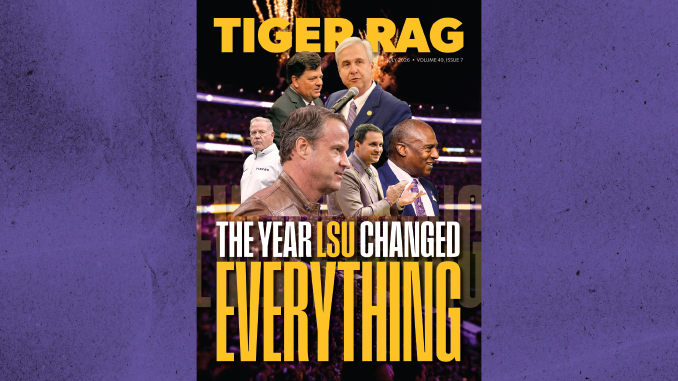
The Year LSU Changed Everything
Brian Kelly was fired. Scott Woodward was toppled. Wade Rousse assumed control. Verge Ausberry took command. Lane Kiffin arrived at the nation’s loudest stage. Will Wade returned from exile. In one season, LSU did not merely change coaches. It changed the power structure.
There are years that fit neatly inside a record book. LSU’s 2025-26 year did not. It belonged in a war room, a board room, a governor’s office, a donor’s text thread and, finally, back on the fields and courts where the consequences of all that power were supposed to show up as wins and losses.
The games mattered. They always do at LSU. But this was not a year defined only by final scores. It was the year the machinery behind those scores came out from behind the curtain. The football coach with the nine-figure contract was fired. The athletic director who wrote the contract was removed days later. A new university president arrived from McNeese with immediate authority over an institution in public upheaval. LSU separated its president and chancellor roles for the first time since 2012. Verge Ausberry, long one of the most influential men in the athletic department, moved from the background to the front of the room. Lane Kiffin became LSU’s football coach after the most watched coaching chase in the country. Will Wade, once fired in scandal, returned as men’s basketball coach with the same blunt force that made him both combustible and impossible to ignore.
LSU did not experience a normal transition. It experienced a regime change.
LSU did not experience a normal transition. It experienced a regime change. And the most important story of the year is not any single firing, hiring, press conference or buyout. It is the combined force of all of them. The old LSU collapsed in public. A new LSU, more expensive, more political, more professionalized and more desperate to win immediately, began taking shape in real time.
The 2025-26 season should be remembered as the year LSU stopped pretending its athletic department was merely a department. It behaved like what it has become: a billion-dollar public sports enterprise, run through public offices, private influence, political pressure, donor urgency, media scrutiny and an unforgiving fan base that has no patience for explanations when football falls behind.
The First Domino: Brian Kelly Runs Out of Road
Brian Kelly’s LSU tenure did not end slowly. It ended with the violence of a snapped cable. Less than 24 hours after a 49-25 loss to No. 3 Texas A&M in Tiger Stadium, LSU fired the winningest active coach in college football. Kelly had arrived from Notre Dame with a 10-year, $100 million contract and the polished confidence of a coach hired to professionalize LSU football. Four seasons later, he left with a 34-14 record, a 19-10 SEC mark, one SEC West title, no College Football Playoff appearances and the largest buyout LSU had ever faced.
The firing itself was not the surprise. The timing, scale and financial consequence were. Kelly’s contract called for roughly $54 million if LSU fired him without cause in 2025. LSU’s public language suggested the separation terms were still being worked out, but the contract was the contract. The money was not a rumor. It was the price of LSU’s impatience and Scott Woodward’s wager.
Kelly was hired to make LSU more orderly. Kiffin was hired to make LSU dangerous again.
Kelly’s LSU years will always be difficult to summarize because he was neither a disaster nor a success. He stabilized a program that had cratered after the 2019 national championship. He won the SEC West in his first season. He recruited. He spoke the language of process, alignment and development. But LSU does not pay for process. LSU pays for Saturdays. By the time Texas A&M walked into Tiger Stadium and left with a 24-point win, patience was gone.
The problem was not merely that Kelly lost. It was that LSU had stopped believing in the direction of the program. His teams too often looked incomplete. The defense lagged behind. The edge was missing. The fan base saw a coach with a Notre Dame resume but not enough LSU voltage. At LSU, that distinction matters. The job requires organization, but it also requires combustion. Kelly brought structure. He never fully brought belief.
That is why the Texas A&M loss became more than one bad night. It became a referendum. LSU had entered the year with national expectations and a No. 9 preseason ranking. By the end, the program was 7-5, 3-5 in the SEC and staring at the possibility that the new revenue-sharing era would bury any program too slow to act. Kelly did not get fired only because of what happened in 2025. He got fired because LSU looked at the future and decided it did not trust him to lead it there.
His final message to the players was brief: love you, finish the season. Then he was gone. That was the human ending. The institutional ending came next, and it was louder.
The Second Domino: Scott Woodward Gets the Blade
If Kelly’s firing shook LSU football, Scott Woodward’s removal shook the entire university power structure. Athletic directors at LSU are not middle managers. They are power brokers, fundraisers, political operators, brand stewards and, in football, the people who either solve the central problem in Louisiana or become the problem themselves.
Woodward had arrived in 2019 like a conquering son of Baton Rouge power. He replaced Joe Alleva, who was pushed out not long before Ed Orgeron, Alleva’s hire, delivered the 2019 national championship. Woodward then built an extraordinary non-football resume at LSU. He hired Kim Mulkey, and LSU won the 2023 women’s basketball national championship. He hired Jay Johnson, and LSU baseball won national titles in 2023 and 2025. He promoted Jay Clark, and gymnastics won the 2024 national championship. On paper, few athletic directors in America could match that trophy case.
Woodward had fired Kelly. Then Woodward was fired for hiring Kelly.
But football is not one line on the LSU balance sheet. Football is the balance sheet. Woodward’s signature football hire was Brian Kelly, and the Kelly contract became the instrument of Woodward’s undoing. When LSU fired Kelly and the $54 million buyout came into view, Gov. Jeff Landry did not speak like a spectator. He spoke like someone determined to seize the process. Landry said Woodward would not pick the next coach. He even joked that he would let Donald Trump pick the coach before Woodward. The line was outrageous, memorable and devastating. Once the governor said it publicly, Woodward’s authority was effectively gone.
LSU’s Board of Supervisors finished the job. Woodward was out days after firing Kelly, a coup following a coup. He had ruled with the aura of a man who could hire national championship coaches across the athletic department. But his football miss was too expensive and too visible to survive. The irony was pure LSU. Woodward had fired Kelly. Then Woodward was fired for hiring Kelly.
His departure exposed what had been true all along. LSU athletics is not insulated from Louisiana politics. It never has been. The difference this year was the lack of disguise. The governor’s voice entered the coaching search. The board acted quickly. The athletic director was removed. Verge Ausberry was elevated. LSU’s internal hierarchy changed in less than a week.
Woodward leaves a complicated legacy. He made LSU richer in championships. He also left LSU with one of the most expensive football corrections in the sport’s history. That contradiction is not a footnote. It is the story. In modern college athletics, excellence in every sport cannot save an athletic director if football becomes a financial and political liability.
A New President, a Split Chancellorship and a Search Under Fire
While LSU athletics was coming apart, the university itself was undergoing its own power shift. The Board of Supervisors named Wade Rousse, the president of McNeese State, as LSU system president and picked University of Alabama Provost Jim Dalton as chancellor and executive vice president. The decision separated the system presidency from the main campus chancellorship for the first time since the roles were merged in 2012.
That structural change mattered. LSU was not just hiring two administrators. It was creating a new division of labor at a moment when athletics, academics, politics and public trust were all colliding. Rousse said he and Dalton had agreed in principle that Rousse would handle athletics, external affairs and government relations, while Dalton would oversee academics and research. In plain English, Rousse would sit closest to the heat.
LSU was not just hiring two administrators. It was creating a new division of labor.
Rousse arrived with support from powerful figures but skepticism from faculty. His background was nontraditional for LSU’s top job. He had been president of McNeese only since 2024, after holding other administrative roles there since 2019. He was not the conventional research-university president rising through a long academic ladder. He argued that his experience was an asset. Critics wondered whether he had the scholarly profile and institutional depth required for LSU.
Dalton’s arrival helped answer part of that concern. As Alabama’s provost since 2020, with experience at Michigan, Ohio State and Tennessee, Dalton gave LSU a more traditional academic hand over the flagship campus. Faculty Senate leadership indicated that putting Dalton over academics helped mitigate concerns about Rousse. But the timing was still brutal. LSU had interim officeholders across major positions, including provost, chief financial officer, enrollment management and multiple deans. The university needed stability at exactly the moment its search process had generated arrests, nondisclosure agreements and public criticism.
Seven students were arrested at an Oct. 1 presidential search committee meeting after they were ordered out for exceeding their allotted public comment time. Search committee members were required to sign nondisclosure agreements that restricted discussion of the committee’s work. Finalist forums were held over three business days with sparse attendance and little advance notice on campus. For a university already battling suspicion over transparency, the optics were terrible.
Then Rousse inherited the football crisis almost immediately. LSU did not need a ceremonial president. It needed someone who could stand in the middle of athletics, politics, government relations and public confidence without making the confusion worse. That challenge arrived before Rousse had even learned the room.
The Verge Ausberry Question
Into that uncertainty stepped Verge Ausberry, one of LSU’s most familiar internal power figures and, suddenly, its most important athletic decision-maker. Ausberry had been deputy athletic director since 2019 and had worked inside LSU athletics in various capacities since 1991. He had been involved in major football coaching searches across eras: Nick Saban, Les Miles, Ed Orgeron, Brian Kelly and now Lane Kiffin. He knew the place. He knew the donors. He knew the politics. He knew the sport. Most important, he knew LSU from the inside out.
That should have made his elevation clean. It did not. Rousse’s early comments created confusion over whether Ausberry was interim, acting or permanent. Sources indicated Rousse had effectively made him the athletic director. Rousse then told Piper Hutchinson he would remove the interim tag and assess the situation, adding that he could not make a good decision after being on the job for eight hours. Later, he called Ausberry the acting athletic director with full authority to find a football coach.
When the person leading the search is described as interim one day, acting the next and potentially permanent later, LSU creates its own leverage problem.
At most universities, this would be a communications stumble. At LSU, during a football search, it was dangerous. Agents listen for weakness. Coaches listen for uncertainty. Donors listen for alignment. When the person leading the search is described as interim one day, acting the next and potentially permanent later, LSU creates its own leverage problem.
Ausberry deserved clarity because LSU needed clarity. He had a broader resume inside the athletic department than most people outside the building understood: academics, fundraising, corporate relations, marketing, game management, sports administration, life skills, sports medicine and performance, equipment, alumni relations, external relations and government relations. He was not a mascot hire or a caretaker. He was an institutional operator.
There was also legitimate baggage. Rousse said he was not familiar with Ausberry’s 2021 suspension tied to LSU’s handling of sexual assault accusations after the Husch Blackwell investigation. That admission raised its own questions. Anyone assessing Ausberry for the permanent job needed to know the full record. But knowing the full record is different from pretending Ausberry did not have the experience to run the department. He did.
The larger point was simple: LSU was asking Ausberry to land the biggest football coach on the market while leaving public ambiguity around his title. In the end, he did what LSU needed him to do. He got Lane Kiffin. That result changed the conversation.
The Lane Kiffin Hire: LSU Chooses Combustion
Lane Kiffin’s hiring was the year’s biggest athletic move and the clearest statement about what LSU wanted to become. After Kelly, LSU did not hire another corporate stabilizer. It hired voltage. It hired offense. It hired personality. It hired adaptability. It hired the coach Woodward had passed on after the 2021 season.
Kiffin was LSU’s original target once Kelly was fired. He was also the most sought-after college football coach available. Florida pursued him. Ole Miss fought to keep him. Kiffin considered staying at Ole Miss, where he had built the Rebels into a College Football Playoff team and delivered the first 11-win regular season in school history. He wanted to coach Ole Miss through the playoff even after accepting LSU, with guardrails to protect both programs. Ole Miss athletic director Keith Carter refused. Kiffin left for Baton Rouge.
This was not a rebuild on a budget. It was a declaration that LSU intended to spend like a national title contender immediately.
The scene captured the modern sport perfectly: two LSU planes, a departing playoff coach, a furious old school, a restless new school, social media tracking flights and statements, and a fan base reading every minute as evidence of either triumph or chaos. Kiffin landed in Baton Rouge around 5 p.m. on Nov. 30 and was introduced the next day. The Lane Train had arrived.
For LSU, the contract told the truth. Kiffin’s deal was expected to be about seven years and $91 million, roughly $13 million annually, with LSU also planning a massive annual talent procurement package through the transfer portal, recruiting and NIL. This was not a rebuild on a budget. It was a declaration that LSU intended to spend like a national title contender immediately.
Kiffin’s resume fit the moment. At Ole Miss, he went 55-19 overall and 32-17 in the SEC from 2020 through 2025. After the COVID year, he went 50-14 over the next five seasons. He had rebuilt himself after USC, modernized Alabama’s offense under Nick Saban, won national championships as an assistant and become one of the sport’s most creative offensive minds. He also became the first coach in SEC history to lead three current SEC programs: Tennessee, Ole Miss and LSU.
But the fit was not only tactical. It was cultural. LSU is not a quiet job. It is not a place for a coach who wants to disappear into process language. It is loud, emotional, political, theatrical and ravenous. Kiffin understands spectacle without being consumed by it. He understands the portal. He understands quarterbacks. He understands attention. He understands that in the new era, coaches are no longer just coaches. They are roster CEOs, media brands, offensive architects, negotiators and daily crisis managers.
Kelly was hired to make LSU more orderly. Kiffin was hired to make LSU dangerous again. That does not guarantee success. It does clarify the bet. LSU chose the coach most capable of turning chaos into advantage. After a year in which the institution itself seemed to be on fire, that was not accidental. It was the job description.
Will Wade Returns: The Exile Comes Home
If Kiffin’s hire was the football swing, Will Wade’s return was the basketball thunderclap. LSU hiring Wade back after firing him in 2022 was one of the strangest and most revealing moves in modern college sports. It was not just a coaching hire. It was a verdict on the old rules, the new marketplace and LSU’s tolerance for reputational risk when losing becomes intolerable.
Wade was fired on March 12, 2022, after FBI and NCAA investigations tied him to major Level 1 recruiting violations at LSU. The NCAA later said Wade obstructed its investigation by concealing evidence and lying to investigators. It charged him with unethical conduct, including allegations involving the use of his wife’s bank account to funnel money to a recruit. He received a two-year show-cause penalty. McNeese accepted restrictions when it hired him in 2023.
In the new SEC, losing quietly is not a moral victory.
Then Wade won. That is the part that changed everything. He took McNeese, a downtrodden program, to NCAA Tournaments in 2023-24 and 2024-25. He moved to North Carolina State and took the Wolfpack to the NCAA Tournament in his first season. Meanwhile, LSU men’s basketball under Matt McMahon collapsed into three losing seasons in four years and a brutal SEC record. The program had become irrelevant in a league that was getting stronger and more expensive.
So LSU did what LSU often does when the stakes get high enough. It made the uncomfortable move and dared everyone else to keep up. Wade returned at 43, not as a rehabilitated unknown, but as a known force with a known past and a known ability to build rosters fast. The decision reunited him with familiar Lake Charles connections: Wade Rousse, the former McNeese president now leading LSU, and Heath Schroyer, the McNeese athletic director who hired Wade and then accepted a senior LSU role.
The Wade move also revealed how radically the sport had changed since his firing. What once existed in the shadows of recruiting now exists, in different form, in the open economy of NIL, revenue sharing and roster budgets. That does not erase the NCAA findings. It does explain why many fans viewed Wade less as a pariah than as a coach punished for operating before the market admitted what it was becoming.
The risk remains real. LSU cannot afford compliance sloppiness. It cannot afford another scandal. It cannot pretend Wade’s record is clean. But the calculation was obvious. In the new SEC, losing quietly is not a moral victory. Wade gives LSU basketball immediate relevance, immediate recruiting credibility and immediate edge. Like Kiffin, he is not a safe hire. He is a high-ceiling hire. LSU chose ceiling.
The Common Thread: LSU No Longer Has Time for Slow Fixes
Put the six moves together and the pattern becomes unmistakable. Kelly was fired because LSU did not believe he could deliver a championship future fast enough. Woodward was fired because his football contract turned patience into a $54 million liability. Rousse was hired into a structure that put him close to athletics and government relations immediately. Dalton was hired to stabilize academics while Rousse handled the external heat. Ausberry was elevated because LSU needed an internal operator who could move quickly. Kiffin was hired because LSU wanted a coach built for the portal, NIL, offense and attention. Wade was rehired because LSU basketball could no longer afford irrelevance.
This was not a year of patience. It was a year of acceleration.
The year in review, then, is not a clean celebration. It is a warning with a pulse.
The new economics of college sports made that acceleration unavoidable. Revenue sharing, NIL, transfer freedom and media money have compressed timelines. Coaches do not get five years to build culture while the roster matures. Athletic directors do not get unlimited goodwill when contracts explode. Presidents cannot treat athletics as a side matter when athletics drives public attention, donor behavior and political pressure. Every decision is faster now because every mistake is more expensive.
LSU’s response was messy because LSU is messy. But it was not timid. The university spent. It fired. It hired. It absorbed criticism. It let politics into the open. It accepted reputational risk. It gambled that elite coaches and institutional urgency could restore momentum faster than caution ever could.
That approach can work at LSU because LSU has advantages few programs can match: brand power, recruiting territory, SEC membership, fan obsession, donor passion, national titles across multiple sports and a cultural identity that still sells. But it can also backfire because LSU’s greatest strength is also its weakness. The place runs hot. When aligned, that heat creates championships. When mismanaged, it burns through coaches, administrators and public trust.
The year in review, then, is not a clean celebration. It is a warning with a pulse. LSU has put itself back at the center of the national conversation. It has also raised the cost of failure. Kiffin and Wade do not get to be interesting. They have to win. Rousse and Ausberry do not get to be symbolic. They have to govern. Dalton does not get to be a footnote. He has to protect the academic credibility of a flagship university while athletics consumes oxygen.
What It Means Going Forward
The next year will tell whether LSU experienced a correction or merely another convulsion. Kiffin will be judged immediately because football at LSU is judged immediately. His first roster, first quarterback decision, first SEC road game and first November loss, if it comes, will be interpreted as evidence. That is unfair only in the way LSU has always been unfair. The job pays too much and matters too much for patience to be the default setting.
Wade will be judged differently but just as intensely. Fans will expect the PMAC to matter again. They will expect portal wins, SEC wins and March relevance. His return gives LSU basketball a jolt it badly needed, but it also reopens every question about oversight. If Wade wins cleanly, LSU will claim it saw the future before others admitted it. If trouble follows, the university will own the decision completely.
The job pays too much and matters too much for patience to be the default setting.
Ausberry’s future may depend on whether the Kiffin hire becomes what LSU believes it can become. His case for permanence became stronger the moment Kiffin chose Baton Rouge. But running the department is bigger than landing one coach. LSU now sits in a world of revenue sharing, roster budgets, legal uncertainty, facility pressure, media scrutiny and public-records fights. The next athletic director is not just hiring coaches. He is managing a sports corporation inside a public university.
Rousse’s challenge is broader. He must prove he is more than the beneficiary of political support and Lake Charles connections. He must win faculty trust, manage athletics without being swallowed by it, and show that LSU’s split leadership model can work. Dalton must make the academic side feel seen, protected and serious. If athletics becomes the only visible priority, the new structure will be judged harshly.
And Woodward’s shadow will remain. His hires produced championships. His football contract produced a reckoning. That dual legacy will haunt every major LSU decision for years because it captures the modern dilemma perfectly. At the top of college sports, ambition is mandatory. But ambition without accountability becomes a bill someone else has to pay.
That is what made 2025-26 different. LSU was not simply replacing names on doors. It was learning, painfully and publicly, what the new era costs.
Be the first to comment