
By KACE KIESCHNICK, Tiger Rag Staff Reporter
Wandering legislation, the value of a nine-game Southeastern Conference schedule, the future of the College Football Playoff and the SEC Championship Game and the potential of a self-governing SEC if it doesn’t get its way.
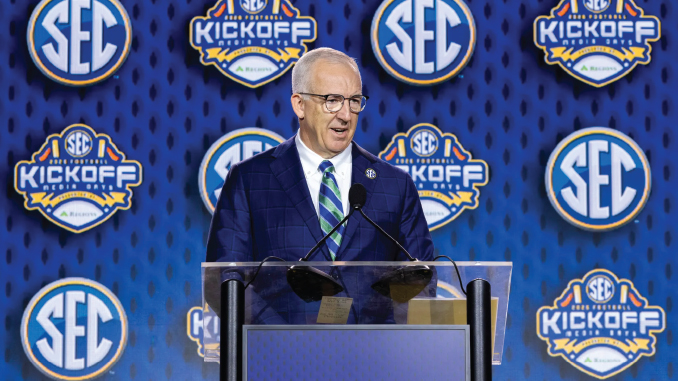
These were some of the trending issues SEC Commissioner Greg Sankey confronted in his “State of the SEC” address at SEC Media Days in Tampa, Florida, on Monday morning.
The wandering legislation, of course, refers to the development of the Protect College Sports Act. The bill authored by U.S. Senators Ted Cruz and Maria Cantwell has faced pushback from the SEC and Big 10 for its failure to consult the nation’s top conferences, although the nation’s top conferences asked them for help when they failed to solve their issues.
SEC Media Days has kicked off, but you’ll have to wait until Thursday to see the Main Event.https://t.co/qAaOStw0gy
— Glenn Guilbeau (@SportBeatTweet) July 20, 2026
Sankey echoed the sentiment of official statements from the conferences recently and member institutions that oppose the bill in its current form.
“We support the effort behind the Protect College Sports Act,” Sankey said. “However, we believe changes to the act are necessary to make it most effective, and the changes we’ve suggested are both achievable and reasonable. And we’re committed to working with Congress to move the legislation across the finish line.”
His primary grievance and that of the Big Ten is the bill’s desire to pool nationally the lucrative media rights in which those two leagues have been enjoying the lion’s share and that the bill’s new rules are enforceable by the NCAA.
“If Congress establishes national rules, individuals and organizations who comply with those rules should not be subject to litigation simply for following the law,” Sankey said.
He also listed a need for national regulations to fully replace the state laws that currently govern college athletics and provide varying rule sets for different institutions. Sankey only briefly mentioned the critical media rights.
“The legislation should treat similarly situated organizations equally while preserving institutional choice,” Sankey said. “Whether discussing conference structure or media rights, federal law should establish fair and consistent standards, not different rules for different organizations, and should preserve the voluntary decision making rather than mandating outcomes.”
But, Sankey did want Congress involved. Now, he’s upset about the bill for which he asked.
Sankey then set the College Football Playoff Committee in his sights.
SEC teams will play nine conference games in the regular season for the first time this season. Sankey proclaimed the challenges of the schedule, calling the SEC the best conference in college football – though no national titles since 2022 with the Big Ten taking the last three – and repeated again how his league has the most difficult schedules.
“The fact that our head coaches are here tells me they’re embracing the challenge,” Sankey said. “I’m actually one who believes competitors want great challenges, and I’m unapologetic about that reality.”
But Sankey said he had an “unsatisfactory conversation” with College Football Playoff staff regarding how that strength of schedule would be rewarded come selection time.
In addition to the regular season schedule, Sankey discussed how the expanded playoff could affect conference championship games. With selection controversy and potential scheduling conflicts, the need for the championship games have been called into question and called archaic.
Sankey first said the SEC is no stranger to being the only conference with a championship game. The conference held the first ever in 1992 and was not joined by another until the Big 12 held its inaugural game in 1996. But that was a different long ago.
He did say SEC officials were reviewing the current format and weighing the pros and cons of the SEC Championship.
“We will have a conference championship game the first Saturday in December of 2026,” Sankey said. “We have contracts and plans in place well beyond that, but we have time for consideration. and one of the factors for us is what will happen with that College Football Playoff.”
Finally Sankey addressed rumors that the SEC could be looking to break away from the NCAA and form a self-governing body.
“They’re real,” Sankey said. “People have talked about that. They’ve opined about the frustrations that bring them to the point of saying we should look at something significantly different.”
He said those conversations have been fueled by a growing frustration with the NCAA’s failure to govern and enforce its own rules. Sankey also said the SEC is tired of waiting around for its proposed changes to be made due to hesitation from other members.
Be the first to comment