
By GLENN GUILBEAU, Tiger Rag Editor
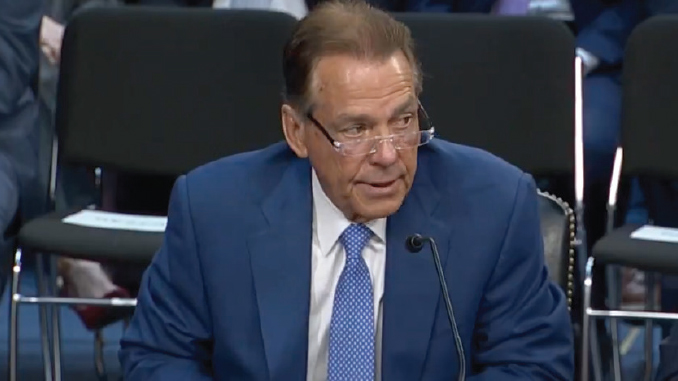
Mr. Saban goes to Washington.
And Capitol Hill just got Saban-ized.
Former seven-time national champion Alabama and LSU football coach Nick Saban took over Washington D.C., Congress, the U.S. Senate and The Beltway Wednesday as if it was a fall Saturday afternoon at Bryant-Denny Stadium in Tuscaloosa, Alabama, or a Saturday night in Tiger Stadium.
But this time, the opponent was the out of control state of college athletics, particularly football, because of the manic growth and COVID-like spread of Name, Image & Likeness-related pay for play and the no-sit-out-a-year NCAA Transfer Portal. That all started small in the summer of 2021 when Saban was still coaching Alabama and has grown in some ways like The Blob – a horror thriller from 1958 – oozing Saban into retirement after the 2023 season.
The state of college athletics left to sprawl also threatens to end or severely damage the non-revenue sports, which are basically all of them other than football and men’s basketball, because athletic departments and their various collectives are devoting so much cash flow to football and men’s basketball.
Saban, 74 and still rockin’, was the first witness to testify concerning a new bipartisan bill called the “Protect College Sports Act,” just introduced last week by Senators Ted Cruz (Republican, Texas) and Maria Cantwell (Democrat-Washington). It is designed to regulate soaring payments to athletes and limit the ridiculous, unlimited automatic transfers, among other things.
Cruz called it “the last, best hope we have to save college sports.”
But it is already facing criticism, particularly from the very sources that asked Congress in the first place to help solve the problems they largely let happen and haven’t been able to fix – Southeastern Conference and Big Ten commissioners Greg Sankey and Rick Petitti. Their most powerful leagues could lose millions of their millions with the changes the bill provides, particularly concerning their treasure trove media rights. The NFL pools those. That’s what this bill wants to do, but Sankey and Petitti are naturally against that.
Careful what you wish for, Greg Sankey, particularly from Congress. @btoppmeyer https://t.co/cbCZvaLYRm
— Glenn Guilbeau (@SportBeatTweet) June 3, 2026
Cantwell aimed at both Sankey and Petitti.
“They fear a more level playing field and the idea that somebody’s going to come in and rearrange the deck chairs of those conferences, steal the eyeball schools, and then basically leave everybody with everything else,” she said.
“We’re going to get the votes,” Cruz said. “If we do nothing, there is no alternative. College sports is facing a crisis.”
So, this is a job for … Super Saban.
“Thank you Chairman Cruz, I could use a little of that Cuban coffee,” Saban began in his testimony to the Senate Committee on Commerce, Science and Transportation and proceeded to be the ultimate eye opener. “I didn’t sleep much last night because of this testimony. Ranking Member (Maria) Cantwell, and members of the Committee, thank you for the opportunity to testify.”
And he was off.
NICK SABAN HINTED AT RETIREMENT MONTHS BEFORE HE DID – OUTKICK FLASHBACK
“I really want everybody to know I’m not here to represent a conference or a team, but to preserve college athletics as a whole,” said Saban, who played defensive back at Kent State from 1970-72 and was an assistant coach or head coach from 1973-2023. “I think we all have to ask ourselves a question. What is our guiding principles for the future of college athletics, including Olympic, women and non-revenue sports.
“I have spent my adult life in college athletics. I believe in it. I have seen players come into a program who need structure, need discipline, need coaching, need academic support, need accountability, and I have seen them leave with a degree, a career, a family, and a better chance to be successful in life. I think the current system of what we have in college athletics right now makes it more and more difficult to do these things. We moved away from development to focusing on money and not life skills.”
Saban also made himself rich as a coach, yes, largely because of what athletes did for him. His last salary as Alabama’s coach in 2023 was $11.4 million. But that was their choice. It wasn’t “off their backs,” as some idiots have been tweeting. And even before NIL, athletes were well compensated by a scholarship – whether that was important to them or not – and other benefits that grew as the years progressed. Believe me, they weren’t hurting. It is conveniently forgotten that poor athletes can and have received thousands of dollars a year through the Pell Grant for decades, and there have always been other student assistant programs.
They also got to be coached by Saban, who became a multi-millionaire multiple times over is because of his American work ethic, and because he was the best for decades. And Saban didn’t make a million-dollar salary until he was in his late 40s in 1999 when LSU hired him.
And Saban is not against continuing to see athletes compensated, but just with guardrails and a cap.
“First of all, I think student-athletes should profit from Name, Image, and Likeness, as long as those things are authentic endorsements,” he said. “They create branding for themselves. They sign with the company. They do promotions. I think these things are all healthy for their education, as well as their quality of life. But I think Name, Image, and Likeness has become pay-for-play.”
He explained how NIL and collectives, which tend to be a fancy name for what is similar to money laundering, grew out of control.
“My first year with NIL (2021), we had collective at Alabama of $2.7 million,” Saban said. “Next year, $7 million. Next year, $10 million. I retired. Next year, $17 million. Next year, $24 million. Now you have schools that have close to $40 million rosters. So, if we continue to do that, we’re going to lose Olympic sports. We’re going to lose non-revenue sports. We’re going to lose scholarships, and basically, what’s going to happen is, you’re going to have football and basketball succeed, and we’ll have club sports for everything else with no scholarships.”
Saban did drive a Honda S2000 while he was LSU’s coach, and he has owned several Mercedes-Benz dealerships for years. So, naturally, he used an excellent sports car example on Wednesday.
“To put this in perspective, if you had the biggest, baddest Ferrari that you could ever have, and it was going 150 mph toward the Grand Canyon, somebody needs to tap the brakes,” he said. “And that’s what I think we all need to do here. I’m going to veer (another driving visual) a little bit from my testimony and just give you some examples of things that I think people may not know that are happening in college football that are huge problems.”
And no one would no better than Saban, who has more than maintained his rock star coach status as a game analyst for ESPN since his retirement from coaching.
“I think Name, Image and Likeness has turned into pay-for-play,” he said. “I said, five or six years ago, when a school I’m not going to mention who didn’t do anything wrong, had what is called a collective. A collective is an organization that raises money, basically from alumni, to be able to pay players and disguise it (laundering) as marketing opportunities. When a school did that, the first school that did it, I said, is this what we want college football to become? And I got really criticized by them. But it has become that. It’s become pay-for-play.”
THE NICK SABAN-JIMBO FISHER FEUD
Saban was talking about his controversial comments in 2022 about then-Texas A&M and coach Jimbo Fisher, who was his offensive coordinator at LSU from 2000-04 with the 2003 national title. Saban accused the Aggies of buying every player for its No. 1-ranked 2022 signing class.
“And we’ve also extended the opportunities to funnel money from operations, which come to the universities as marketing opportunities form a university standpoint, to funnel that opportunity out of operations into paying players,” Saban continued. “So if you take that $20 million or whatever it is, you can fund five or six Olympic and women’s sports. These are things I think need to be addressed. And I think this bill takes the big step forward of doing that.
“The bill also creates a competitive balance. The NFL, the NBA, Major League Baseball – they all have some kind of rules that govern how they compete. It creates parity. It creates something that gives you the opportunity to have a framework to build a fair play system in, which I think is very important. I think this bill does that.”
Saban said the bill is desperately needed now.
“Right now, in college football, we have no rules,” he said. “We have state laws, different in every state. We have litigation. And the NCAA cannot enforce its own rules, because every time they try and enforce their own rules, there’s a lawsuit.”
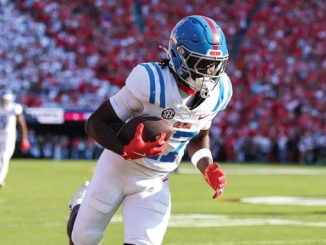
Saban brought up the legal fight Ole Miss quarterback Trinidad Chambliss won over the NCAA. And he would revisit Ole Miss again, LSU fans.
“So, I mean, an example would be Ole Miss’ quarterback,” he said. “They (the NCAA) said he can’t play next year (in 2026). But he’s playing because of litigation. This is just the way it is.”
Saban returned to the Ferrari going into the Grand Canyon abyss.
“It’s become an arm race,” he said. “Who spends the most has got the best chance to win. But I think it’s a race to the bottom, because if you don’t spend to win, you lose your fan base and you don’t have any revenue. So how do you manage the other sports?”
Saban tackled the transfer craze, which appears to be on its own Cuban coffee.
“Unlimited transfers create free agency,” he said. “Free agency with a collective? Now you’re talking about a bidding war for players. And then you’ve got agents out there that are not certified that are enhancing players or encouraging players to get in the portal. ‘I can get you more money.’ So, now we have this unbelievable number of players that get in a portal every year, and we have nothing to control agents. We have nothing to control tampering.”
Saban brought up Ole Miss coach Pete Golding plucking away Clemson linebacker Luke Ferrelli last January shortly after he signed and arrived at Clemson.
Clemson coach Dabo Swinney accused Golding and Rebel coaches of tampering.
“You know, Clemson had a player that was on campus for a whole week,” Saban said. “And they come and got him off the campus and took him some place else. So these kinds of things going on in college football are absolutely not what anybody of any of us signed up for relative to the educational institutions that we’ve all tried to represent.”
Saban touched on what constant transferring can do to a transcript.
“So, what’s the cause and effect of transferring? I think every time you transfer, you have less and less of an opportunity to graduate,” he said. “This hits home with me because I actually coached 50 years ago when people didn’t graduate, and we saw 30-for-30s on what happened to their life.”
And he said so much more.
COMPLETE NICK SABAN TRANSCRIPT
Click just above for the complete transcript of everything Saban said on Wednesday to the Senate Commerce Committee.
As Lake Charles American Press sports editor Scooter Hobbs said, “What you and I have known all along. Saban is always the smartest guy in the room – any room.”
That includes while addressing Congress.
Be the first to comment