
By KACE KIESCHNICK, Tiger Rag Staff Reporter
No. 6 Texas (7-2, 4-2 SEC) at No. 21 LSU (6-3, 3-3 SEC)
Saturday, Nov. 14 • 6:30 p.m. • ABC
Baton Rouge • Tiger Stadium
Spread: LSU -4 | O/U 46.5
OVERVIEW
No. 21 LSU is on its last leg. Even if it wins out, having three losses would still make it a long shot to earn an at-large bid to the College Football Playoff – something a team with three defeats in the regular season has never done. Alabama made it last season at 10-3, but its third loss was in the non-regular season SEC Championship Game, 28-7 to Georgia. Clemson made the CFP in 2024 at 10-3, but that was as an automatic qualifier because it won the ACC title game, 34-31 over SMU.
Working in the Tigers’ favor is a playoff-friendly November schedule, if LSU wins out. That starts on Saturday against No. 6 Texas calling Baton Rouge. Coach Steve Sarkisian’s Longhorns suffered back-to-back upset losses to Oklahoma and Florida early in the season, so they are working to avoid joining the Tigers on the three-loss bubble. Led by senior quarterback Arch Manning, Sarkisian’s offense has not been its potent self this season, but the Burnt Orange defense is not getting burned often as is as talented and physical as ever. LSU, statistically, has been one of the most impressive teams in the nation on both sides of the ball, but the Tigers have failed in crucial moments, made costly errors and still have not notched a marquee win to bolster their playoff resume. The eyes of Texas and the college football world will be upon Tiger Stadium on Saturday night for a top 25 Southeastern Conference clash. If the Tigers get by Texas and then wins at No. 8 Tennessee (7-2, 4-2 SEC) on Nov. 21 (2:30 p.m., ABC or ESPN) and beat Arkansas (3-6, 1-5 SEC) in the regular season finale on Nov. 28, look out. LSU at 9-3 and 6-3 would likely be the most impressive three-loss team in the country.
KEY STORYLINES
Lane Kiffin vs. Steve Sarkisian
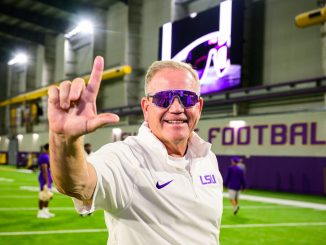
In a season that has been filled with battles against former coaching partners, coordinators and schools, Kiffin faces a coach he may know better than any other on Saturday. Kiffin and Sarkisian first coached together 25 years ago under USC head coach Pete Carroll. They spent five seasons at USC together. Their coaching lives have been connected ever since. When Kiffin was fired as the Trojans head coach in 2013, it was Sarkisian who replaced him the following year. They later reunited Nick Saban’s Alabama staff in 2016. Kiffin was in his third season as offensive coordinator after being fired as USC’s head coach in 2013, and Sarkisian joined as an offensive assistant in ’16 after being fired the previous season as head coach at USC. Sarkisian then replaced Kiffin as offensive coordinator for the week leading up to the national championship game against Clemson, after Saban let Kiffin go for lack of focus. Kiffin had already accepted the Florida Atlantic head coaching job and was trying to work both jobs. Eventually, both ended up back in the SEC as head coaches of their own programs – Kiffin at Ole Miss from 2020-25 and Sarkisian at Texas from 2021 through now. They’ve kept in close contact throughout their careers. They each got their start under Carroll, tried the NFL briefly and perfected their coaching philosophies under Saban. Both ex-college quarterbacks themselves, they are both heralded as offensive gurus in their own right and are known for their run-pass-option-heavy schemes and explosive quarterback play. They have each adapted Norm Chow’s USC pro-style offense, Kiffin favoring simplified reads that help a quarterback and an offense run with tempo, while Sarkisian opts for a more balanced, physical attack. Both are known for being aggressive situational play callers, unafraid to take a chance on fourth down or try for six rather than settle for three in the red zone. Each coach and his staff will need to be at their best for the offensive chess match awaiting in Tiger Stadium.
LSU’s Red Zone Failure
LSU is tied for No. 58 in the nation with an 85.7% red zone scoring percentage, but the Tigers rank sixth in red zone scores (42). That is because they are also tied for third in the nation in trips inside the red zone (49). Every other team that ranks ahead of them in red zone scores or attempts find points at a 90% clip. LSU has also settled for nine red zone field goals this season, meaning it gets in the end zone just 67.3% of the time after crossing the opposing 20-yard line. The failure to finish drives in the end zone was, of course, the difference in the 31-13 loss to Alabama, but it has been true all season. Texas’s defense, meanwhile, has allowed red zone scores at a 75.9% rate this season, 17 on 23 trips. They have also forced eight field goals in the red area, meaning they give up a touchdown just 39.1% of the time. Part of LSU’s struggle in the shortened field has been their inconsistent traditional, inside run game. Once the defense shrinks, it gets harder for LSU’s finesse run game that has been successful overall. And it gets harder close in for LSU to get much out of quick passes and screens that stretch defenses before the red zone entry. Additionally, with less grass to cover, the defense can tee off and send more in pass rush against an offensive line and quarterback that have not handled pressure well for much of the season. The Tigers will either need more from their rushing attack inside or turn to playmakers like wide receiver Jackson Harris and tight end Trey’Dez Green to win one-on-one matches and make contested grabs.
Louisiana Royalty Returns
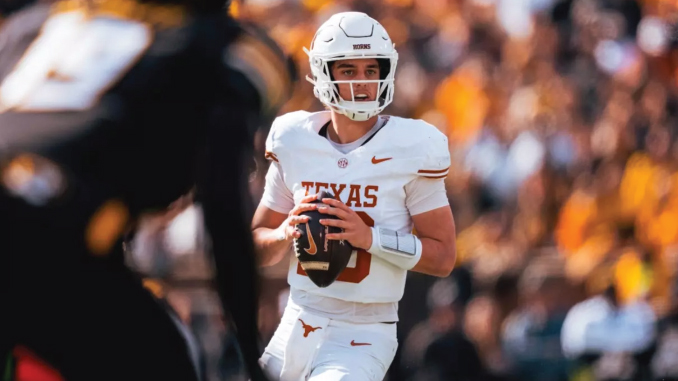
Arch Manning, the latest star quarterback in a line that has become synonymous with football in the SEC and the Bayou State, makes his first trip to Baton Rouge since his many nights in the stands of Tiger Stadium watching iconic moments in LSU history. Manning denied any real connection or “legacy” at LSU, since none of his family were Tigers themselves, but that will not stop the hundreds of thousands of Tiger fans on campus from expecting a grudge match against the son of Louisiana they have followed for years. On the field, Manning has not lived up to the monstrous, at times unachievable, expectations others have set before him. This season, he is 168-of-254 passing for 2,024 yards, 18 touchdowns and seven interceptions. Manning is coming off of back-to-back three touchdown games with no interceptions for the first time in his career and completed 80% and 73.7% of his passes in the wins. Turnovers and consistent decision-making and accuracy have been issues at times for him this season, but he still possesses as much arm talent as any quarterback in football and is averaging eight yards per pass attempt and 12 yards per completion. Manning’s 10 completions of 40-plus yards this season lead all SEC quarterbacks, and two of his top three receivers, Emmet Mosley V and Cam Coleman, are averaging 16.8 and 17.8 yards per catch, respectively. LSU has given up 207.7 passing yards a game to SEC quarterbacks and 20.2 points per game in conference matchups. But it was gashed in key moments by the only top quarterbacks it has faced – Ole Miss’ Trinidad Chambliss, Kentucky’s Kenny Minchey and Alabama’s Keelon Russell. Can Manning show up in big moments and do the same?
The Longhorns’ Uncertain Run Game
Texas enters Tiger Stadium with the No. 13 rushing offense in the SEC and No. 108 attack in the nation, averaging 128.8 yards on the ground per game. Dynamic ball carrier Hollywood Smothers suffered a season-ending ACL tear in Texas’s win over Mississippi State, leaving Arizona State transfer Raleek Brown to shoulder the load. He has averaged 4.9 yards per carry this season, taking 109 attempts for 537 yards and six touchdowns, but the already mediocre run game, for the most part, has been a shell of itself without Smothers. Excluding an outlying 207-yard night against Ole Miss (No. 91 in rushing defense allowing 165.1 ypg), Texas ran for 61 yards without Smothers against Tennessee, put up 60 yards against Mississippi State when Smothers missed the second half and posted 76 yards against Missouri last week with him sidelined. In those games, the Longhorns averaged 1.7, 1.9 and 2.5 yards a carry. LSU has the nation’s No. 7 run defense, allowing an average of 84.7 yards per game. Texas has shown the capacity to have big games on the ground, but its offensive line has not created a consistent push in the trenches.
Texas’s Stifling Defense
Under new defensive coordinator Will Muschamp, the Longhorns’ defense ranks No. 10 in college football in yards allowed per game (280.1). They are No. 17 against the run (100.3 ypg), No. 19 against the pass (179.8 ypg) and No. 19 on the scoreboard (17.4 points per game). Most impressively, they have allowed an FBS-best 4 yards per play this season. Texas generates three sacks per game (No. 13), led by the No. 2 sack artists in the nation, Colin Simmons (10.5). In must-win situations, those numbers hardly drop off. Texas ranks No. 20 in third-down defense, allowing 44 conversions on 139 attempts (31.7%), but it has given up eight of the 16 fourth downs it has faced. Sarkisian’s usually explosive offense has lost its shine for most of this season. Texas has instead relied on Mushchamp’s defense to make timely stops and win the field position battle. LSU’s defense matches Texas’s in most metrics stride-for-stride. In what could become a defensive battle if the offenses are not clicking, a premium could be placed on punting and avoiding the aggressive fourth down attempts Sarkisian and Kiffin are known for. The best way to bail out a struggling offense is by letting them start a drive near midfield.
LONGHORNS TO WATCH
Quarterback Arch Manning: 168-of-254 passing for 2,024 yards, 18 touchdowns and seven interceptions, 76 carries for 91 yards and two touchdowns.
Running Back Raleek Brown: 139 carries for 537 yards and six touchdowns, 313 yards after contact, 18 receptions for 102 yards and two touchdowns.
Edge Colin Simmons: SEC sack leader with 10.5 in seven games, totaled 25 sacks and 15 tackles for loss
Linbacker Rasheem Biles: Tied for team-lead with 67 tackles this season, including 10 tackles for loss and four sacks, also has three interceptions and six pass break-ups.
KEY MATCHUPS
Edge Colin Simmons vs. LSU Offensive Tackles
Simmons is simply the best pass rusher in the nation. He is working his way back from a high ankle sprain and played just 18 snaps at Missouri last week, but he was left off of the initial SEC availability report for Saturday’s game. He has a Pro Football Focus pass rushing grade of 87.3 and a 14.4% pass rush win rate. He can line up on either side of the defensive front but favors the right edge, matching him up against right tackle Weston Davis most often. Davis exited the Alabama game with an apparent ankle injury but is probable to start against the Longhorns. Davis has a 61.4 PFF pass blocking grade this season and has given up two sacks and 14 hurries, according to the database. Left tackle Jordan Seaton has a 75.1 grade this season but has also given up one sack and 11 hurries.
LSU Pass Rush vs. Texas Offensive Tackles
While Simmons may be the SEC sack leader, LSU has a formidable EDGE duo of its own in Princewill Umanmielen and Jordan Ross. Umanmielen has 8.5 sacks and 12 tackles for loss while Ross has five sacks and nine tackles behind the line. Both are effective against both the pass and run, but it is the Longhorns’ pass blocking they can really take advantage of. Texas is No. 124 in the country, giving up three sacks a game. The Longhorns’ top offensive lineman, left tackle Trevor Goosby is out for the season with a knee injury, so they have moved starting right tackle Melvin Siani to the left side while backup Andre Cojoe fills in for him. Siani has given up a sack in each of his two starts at left tackle while Cojoe has recorded a horrid 45.2 pass blocking grade this season.
STATS AND TRENDS TO KNOW
Texas will play in Tiger Stadium for the first time since the No. 11 Longhorns lost 20-7 to unranked LSU on Sept. 19, 1953, to open the season. The two programs were schedule to play in Tiger Stadium in 2020, but the game was scratched because of COVID. LSU and Texas have only met 18 times. The Longhorns lead the series 9-8-1 with LSU taking their last matchup in 2019 (45-38). The Tigers are 4-1 at home in the series. The two schools have met twice in the Cotton Bowl in Dallas with each team winning once.
Saturday will be the third time the teams have met while both are ranked in the top 25. LSU is 2-0 in those games as the No. 6 Tigers beat the No. 9 Longhorns, 45-38, in 2019 and No. 7 LSU beat No. 4 Texas, 13-0, on Jan. 1, 1963 in the Cotton Bowl. No. 9 Texas beat unranked LSU, 35-20, in the Cotton Bowl on Jan. 1, 2003.
It will be LSU coach Lane Kiffin’s first time facing off against the Burnt Orange, but his fourth time going head to head with Steve Sarkisian. Kiffin leads the series 2-1 with all three matchups coming while he was at USC and Sarkisian was at Washington.
Kiffin is 15-27 against ranked teams in his career and 6-18 against top 10 teams.
Saturday will be the first time a Manning has played in Tiger Stadium since quarterback Eli Manning and Ole Miss lost, 14-13, at LSU in 2002. LSU never played quarterback Peyton Manning during his time at Tennessee (1994-97). Arch’s grandfather Archie Manning was 2-1 against LSU in his career from 1968-70 at Ole Miss with a 1-1 mark in Tiger Stadium and a 1-0 record in Jackson, Mississippi. His youngest son Eli was 1-2 against LSU with a 35-24 win at Tiger Stadium in 2001, the 14-13 loss in 2002 at Tiger Stadium and a 17-14 loss in 2003 in Oxford, Mississippi. So the Manning Family is 3-3 overall against LSU and 2-2 in Tiger Stadium. Archie’s oldest son Cooper Manning played his last game in Tiger Stadium in the summer of 1992 as an Ole Miss commitment in a high school All-Star game. Later that summer, Manning was diagnosed with spinal stenosis, which is a narrowing of the spine. And he never played football again.
Texas has six-straight wins over top 25 opponents, the longest streak in the FBS. Manning’s eight career wins as a starting quarterback against ranked teams since 2025 are the most by an FBS quarterback.
THE OUTLOOK
This is the type of major SEC showdown that feels like all of the stats and conventional wisdom gets thrown out the window, and it simply comes down to which team has the bigger playmakers able to make the winning plays. Arch Manning, Colin Simmons, Rasheem Biles, Cam Coleman, Raleek Brown, Jelani McDonald – the Longhorns are packed with talent, but the Tigers’ have a star-studded roster of their own. Both teams have real concerns on the offensive front both in the run game and passing game. Again, LSU holds many of the statistical advantages – total offense, total defense, rushing offense and defense, passing offense and defense, sacks for and against – but this show has been done before. LSU outmatched Ole Miss, Kentucky and Alabama on paper. Names and numbers on a page will not matter in the trenches on a Saturday night in “Death Valley.” The offensive line that can hold up to aggressive Blake Baker and Will Muschamp defenses, and the quarterback that can handle the inevitable pressure better could be the difference in the high-stakes contest.
PREDICTIONS
Tiger Rag Executive Editor Todd Horne: LSU 24, Texas 19
Tiger Rag Editor Glenn Guilbeau: LSU 21, Texas 17
Tiger Rag Staff Reporter Kace Kieschnick: LSU 27, Texas 23

Be the first to comment