
Todd Horne Column
FAYETTEVILLE, Ark. — This LSU football season ended up being different.
Very different.
Just not in the way Lane Kiffin expected when he arrived in Baton Rouge from Ole Miss last December and introduced LSU to his new program’s favorite phrase: Just Different.
It was supposed to describe the energy, the ambition, the roster and the belief that LSU had hired the coach who could change everything immediately. It fit the size of the investment and the speed with which Kiffin and general manager Billy Glasscock rebuilt the team. It fit the 51–10 opening-night demolition of Clemson. For a while, it fit a team ranked No. 7 in the country and sitting at 6–2 with the College Football Playoff still in front of it.
Then November arrived, and Just Different came to mean something else.
LSU could move the football. It could stop good offenses. It could build statistical advantages that looked like winning football in almost every conventional measure. What it could not do consistently was finish the work.
Kiffin had reduced the problem to “one core issue to fix” before the Arkansas game: “how we finish games.”
The Tigers found new ways to demonstrate that problem against Alabama, Texas and Tennessee. They entered the fourth quarter of all three games with a chance to win and were outscored 37–0 in those final periods. They finished the regular season 7–5 after Saturday’s 25–10 victory over Arkansas, a record that does not look anything like the team described by its yardage, its defense or the money spent to assemble it.
Arkansas provided one final, almost perfect summary.
That should have been a beating.
Instead, LSU needed most of the afternoon to make a 15-point victory look secure against a 4–8 team.
The first half explained how that happens.
LSU led 10–0 late in the second quarter and appeared to make it 17–0 when DJ Pickett knocked the ball away from Arkansas receiver Chris Marshall near the goal line and Ty Benefield carried it roughly 92 yards the other way for a touchdown. The Tigers were celebrating what looked like the decisive play in a game they already controlled.
Replay overturned it.
Arkansas kept the ball and kicked a field goal. LSU went three-and-out, committed a delay-of-game penalty before punting and then allowed Sutton Smith to return the punt 79 yards for a touchdown. Smith had returned eight punts for 34 yards all season before Saturday. One return against LSU traveled 45 yards farther than all of them combined.
LSU drove into field-goal range again before halftime, but Scott Starzyk missed from 50 yards.
In less than two minutes of game time, LSU went from appearing to lead 17–0 to walking into the locker room tied 10–10. Considering two earlier failed fourth-down attempts, the Tigers could have been ahead by more than 17.
Instead, they had 266 yards to Arkansas’ 131, 15 first downs to seven, two takeaways to none and an even score.
“Kind of the story of our year.” Lane Kiffin at halftime
It was.
The problem with LSU this season was not that the Tigers were routinely overwhelmed. The more frustrating truth is that they often established control without making that control durable. They could win downs, possessions and statistical categories, then surrender the game through an empty red-zone trip, a protection failure, a penalty, a kicking mistake or one disastrous special-teams play.
Production was not the same as points. Control was not the same as victory. Talent was not the same as a finished product.
Even Saturday, LSU turned 553 yards into 25 points. Two failed fourth downs, a missed field goal and two missed extra points left points scattered across the field. The punt-return touchdown gave Arkansas seven points without its offense having to earn them. The Razorbacks’ offense scored three.
LSU finally did finish this one.
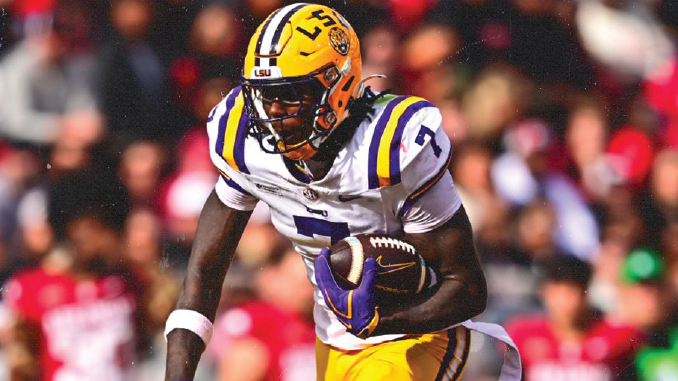
Dilin Jones, the best offensive player on the field, ran for 184 yards and two touchdowns and finished the regular season with 1,072 yards. Husan Longstreet gave LSU a second running threat at quarterback, gaining 62 yards on 11 carries. Trey’Dez Green caught six passes for 91 yards and the touchdown that put LSU ahead 25–10 early in the fourth quarter.
More important, LSU performed the closing operation that had escaped it throughout November. The defense stopped Arkansas twice on downs in the fourth quarter. After the second stop, Longstreet directed a nine-play possession that consumed the final 3:39. LSU made the first downs, kept the ball and ended the game without giving Arkansas another chance.
Kiffin said afterward it was the first time LSU had successfully completed that kind of late-game sequence when it needed to do it. The defense made the stop. The offense exhausted the clock.
He was “glad that we came out and finished well.”
That is finishing.
It is also fair to ask why it took the final game of the regular season, against one of the SEC’s worst teams, for LSU to do it.
Kiffin did not pretend the Arkansas victory redeemed the season. He resisted calling it a springboard into 2027. LSU had lost three consecutive games, was playing a rivalry game on the road and needed to win. It did.
“Proud of the way we finished,” he said. Then he supplied the next instruction: “Make changes where they’re needed.”
Nothing more should be assigned to it.
The postgame press conference was more useful when Kiffin discussed why LSU became 7–5.
“We got to coach better,” he said.
He described LSU as a “frontline team” without enough depth to rotate players or withstand significant injuries without a substantial drop-off. The problem was especially visible on special teams. LSU stopped returning kickoffs. It frequently punted out of bounds because Kiffin did not trust the coverage unit to cover and tackle. The one time LSU gave Arkansas a returnable punt Saturday, Smith took it 79 yards.
“We’ve got to get deeper,” Kiffin said.
Kiffin also confirmed that Longstreet’s package was planned and that LSU probably should have used it earlier at Tennessee when the offense was struggling to protect Sam Leavitt. Longstreet’s role Saturday was not an impulsive benching of Leavitt. It was an adjustment LSU had considered a week earlier and did not make soon enough.
That, too, sounds like this season.
LSU often identified the right answer after the cost of waiting had become clear.
Kiffin has promised a complete review. “We’ll look at everything,” he said before the finale—positions, schemes, coaches, everything.
Now comes a bowl season that will be Just Different in ways few coaches enjoy.
The Tigers will play another game, but Kiffin admitted the regular season already feels over. The transfer market has not waited for LSU’s bowl invitation. Players are already “getting calls” and “knowing their prices” elsewhere. Even backups are being evaluated by other programs as potential starters.
So LSU will prepare for a bowl while Kiffin evaluates changes to his roster, schemes and staff—but cannot fully discuss those changes with a team he still needs to practice and play. Some players will be deciding whether to stay. Others may be negotiating their next destination. The roster that takes the field may not be the roster that beat Arkansas, and the players practicing together may not all be planning to remain together.
Bowl preparation once began with finding out where LSU was going and whom it would play.
This time, it begins with finding out who LSU still has.
That’s different.

Be the first to comment